Physics formulas are compact equations that state exactly how measurable physical quantities depend on one another, such as force equals mass times acceleration. Each symbol stands for a quantity with its own SI unit, so a formula is both a calculation rule and a statement about how the physical world behaves.
Open any physics textbook to the inside back cover and you meet a wall of equations. Dozens of them, packed shoulder to shoulder, with no hint about which ones matter or how they connect. It reads like a list to be memorised. It isn’t.
Here is what actually happens in an exam hall. You know the physics cold — and then you stall, because you cannot recall whether it was v2 = u2 + 2as or v2 = u2 + 2at, and you have ninety seconds to choose. That moment is what this page is built for.
What Are Physics Formulas?
A physics formula is a compact statement that one physical quantity is fixed by other physical quantities in an exact, testable way. Not a rule of thumb. Not an approximation someone found convenient. A claim about reality that experiment can break.
Take Q = mcΔT. It says the heat you must pour into something is set by three things and nothing else: how much of it there is, what it is made of, and how far you want its temperature to move. Change any one of those and the answer moves with it, in a way you can predict before you touch the apparatus.
That is the part most formula sheets throw away. They give you the equation and leave out what each letter is — which is precisely the information you need to use it.
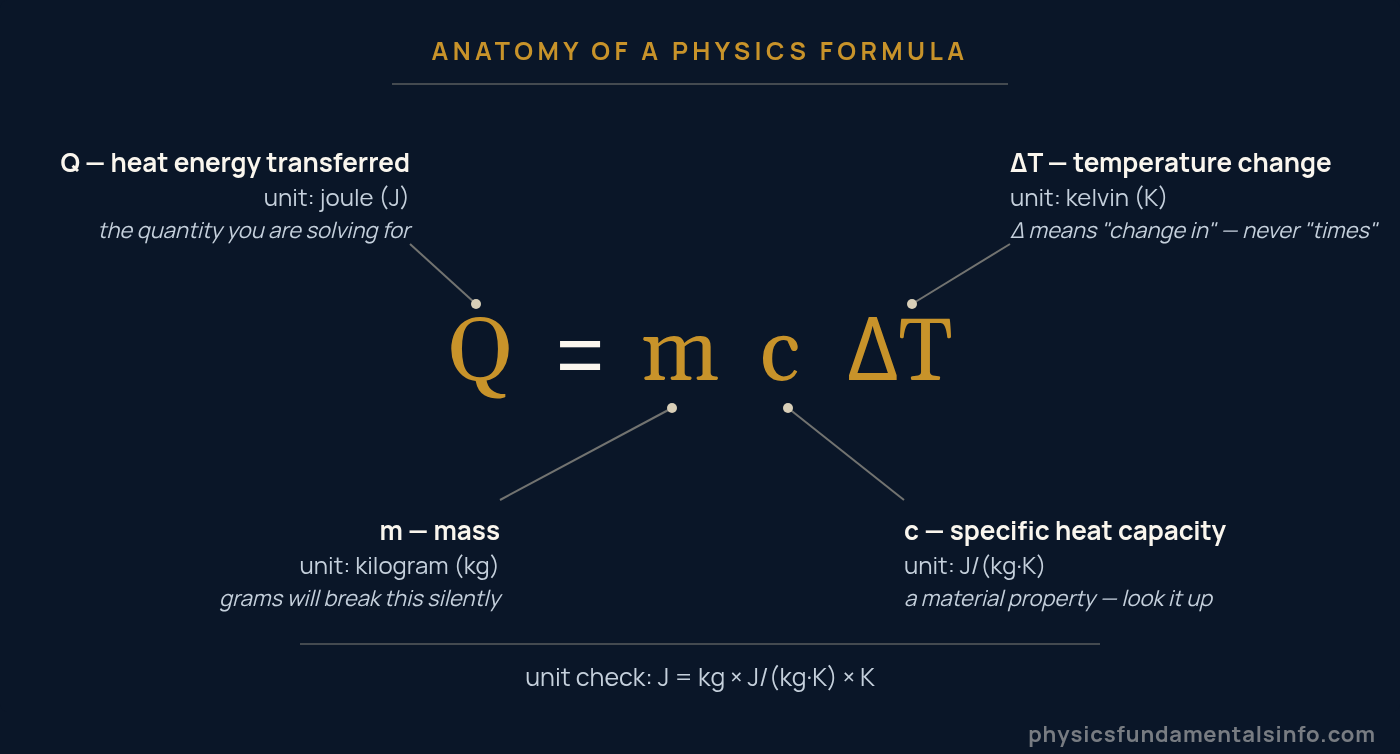
Every physics formula has this same anatomy: a subject, quantities, and units that must cancel correctly on both sides.
Every Symbol Is a Quantity, and Every Quantity Has a Unit
The unit line at the bottom of that diagram is not decoration — it is a free correctness check. Kilograms times joules-per-kilogram-per-kelvin times kelvin leaves joules. The kilograms cancel, the kelvins cancel, and joules survive on both sides.
If your units do not cancel down to the units of the answer, the formula is wrong or you have written it down wrong. No exceptions. This works because since 20 May 2019 the entire International System of Units has been defined by seven fixed constants of nature, so every unit in every formula on this page traces back to the same seven numbers.
The 10 Groups That Organise Every Physics Formula
Introductory physics is not one subject with a hundred formulas. It is ten small subjects with about ten formulas each — and that reframing is the single most useful thing on this page.
Each group answers one question, and each has one signature formula that the rest of the group hangs off. Learn the signature and you have a hook to hang the others on.
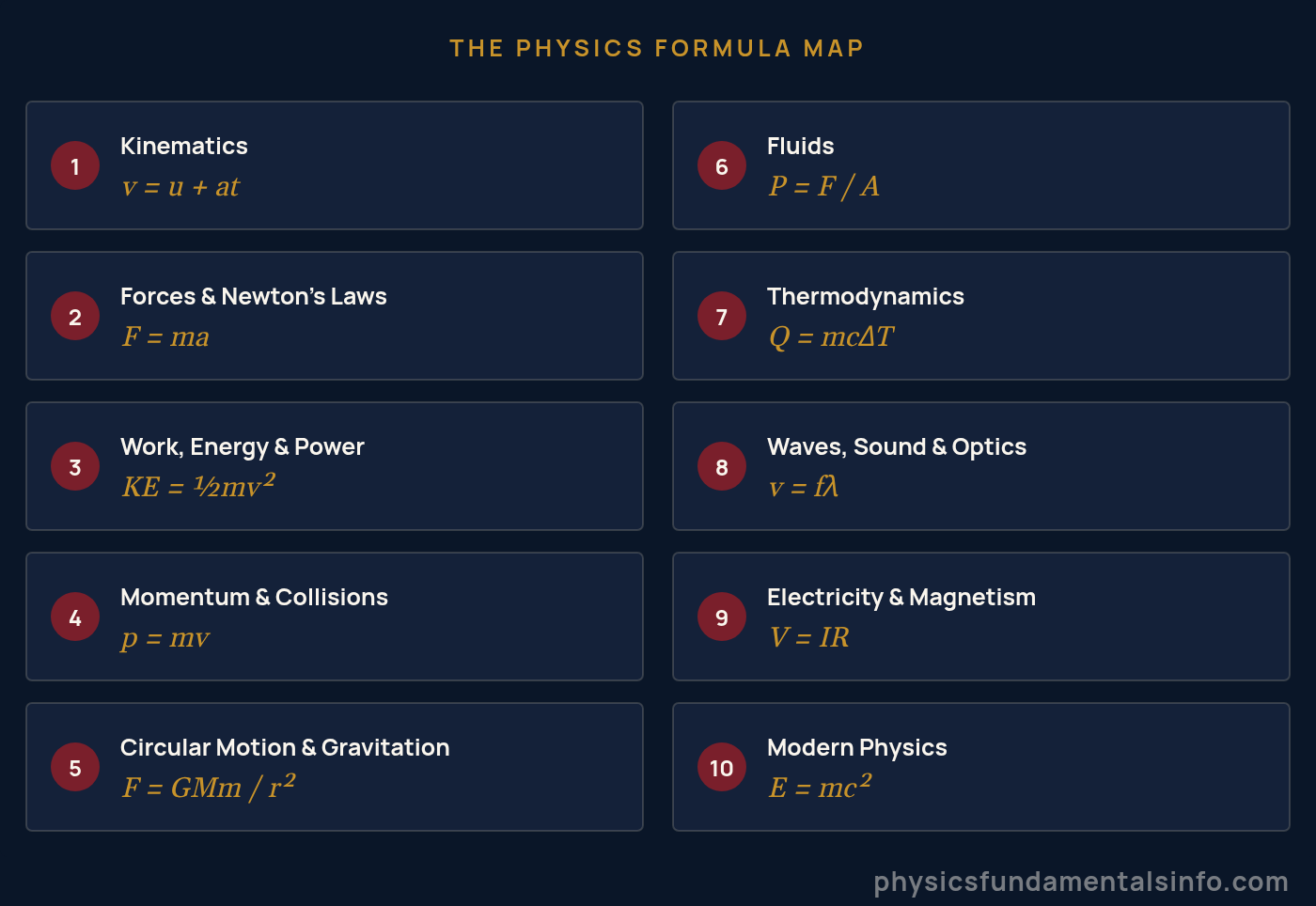
The ten groups of physics formulas and the signature equation of each.
| # | Group | The question it answers | Signature formula | Core SI units |
|---|---|---|---|---|
| 1 | Kinematics | How is it moving? | v = u + at | m, s, m/s, m/s2 |
| 2 | Forces | Why did the motion change? | F = ma | N, kg, m/s2 |
| 3 | Work, energy & power | What did it cost, and how fast? | KE = ½mv2 | J, W |
| 4 | Momentum | What survives a collision? | p = mv | kg·m/s, N·s |
| 5 | Circular motion & gravitation | What holds it on a curve? | F = GMm/r2 | N, m, rad/s |
| 6 | Fluids | Will it float, and how hard does it push? | P = F/A | Pa, kg/m3 |
| 7 | Thermodynamics | Where did the heat go? | Q = mcΔT | J, K, Pa |
| 8 | Waves, sound & optics | How does it travel and repeat? | v = fλ | Hz, m, m/s |
| 9 | Electricity & magnetism | What is charge doing? | V = IR | V, A, Ω, T |
| 10 | Modern physics | What happens when it is very fast or very small? | E = mc2 | J, eV, Hz |
Everything below is grouped in that order. If you would rather put numbers in than read equations, every formula here also has a matching tool in our library of 97 physics calculators, which solves each one for any variable you like.
Mechanics Formulas: Motion, Forces, Energy and Momentum
Mechanics is roughly half of any introductory course, and groups 1 to 5 all live here. Start with motion described, then move to motion explained.
Kinematics: Constant Acceleration (SUVAT)
These five formulas describe any object whose acceleration does not change. They are not five separate facts — they are one fact viewed from five angles, which is why you can always get from any three known quantities to the other two.
| Formula | Gives you | Use it when | Calculator |
|---|---|---|---|
| v = u + at | Final velocity | You know the time, not the distance | SUVAT |
| s = ut + ½at2 | Displacement | You know the time and the start speed | SUVAT |
| s = ½(u + v)t | Displacement | You know both speeds, not the acceleration | SUVAT |
| v2 = u2 + 2as | Final velocity | Time is not mentioned — the most useful one | SUVAT |
| s = vt − ½at2 | Displacement | You know the end speed, not the start | SUVAT |
| vav = Δs / Δt | Average velocity | Acceleration is not constant | Velocity |
| a = Δv / Δt | Average acceleration | Acceleration is not constant | Acceleration |
| R = v02 sin(2θ) / g | Projectile range | Level ground, no air resistance | Projectile Motion |
| H = v02 sin2θ / (2g) | Projectile peak height | Level ground, no air resistance | Projectile Motion |
| T = 2v0 sinθ / g | Projectile flight time | Level ground, no air resistance | Projectile Motion |
- s = displacement — metres (m)
- u = initial velocity — metres per second (m/s)
- v = final velocity — metres per second (m/s)
- a = acceleration — metres per second squared (m/s2)
- t = time — seconds (s)
- v0 = launch speed — metres per second (m/s)
- θ = launch angle above the horizontal — degrees or radians
- g = acceleration due to gravity — 9.81 m/s2 near Earth’s surface
The full derivation of all five, and why the fourth is the one examiners love, is in our guide to the SUVAT equations. To skip the algebra entirely, give any three values to the SUVAT calculator and it returns the other two.
Forces and Newton’s Laws
Kinematics tells you what happened. Forces tell you why. The bridge between them is a single equation that Newton published in 1687 and that has not needed correcting since — except at speeds near light.
| Formula | Gives you | Watch out for | Calculator |
|---|---|---|---|
| ΣF = ma | Acceleration from the net force | ΣF is the total, not one single force | Newton’s 2nd Law |
| W = mg | Weight (a force) | Weight is in newtons; mass is in kilograms | Weight Calculator |
| f = μN | Friction force | N is the normal force, not always mg | Friction |
| F = kx | Spring force (Hooke’s law) | x is the extension, not the total length | Hooke’s Law |
| F = Δp / Δt | Force as rate of momentum change | Newton’s actual second law; works if mass changes | Impulse |
| FAB = −FBA | Newton’s third law | The pair acts on different bodies | — |
- F, ΣF = force and net force — newtons (N), where 1 N = 1 kg·m/s2
- m = mass — kilograms (kg)
- a = acceleration — metres per second squared (m/s2)
- W = weight — newtons (N)
- f = friction force — newtons (N)
- μ = coefficient of friction — dimensionless (no unit)
- N = normal force — newtons (N)
- k = spring constant — newtons per metre (N/m)
- x = extension from natural length — metres (m)
- p = momentum — kilogram metres per second (kg·m/s)
Three laws underpin that whole table, and they are worth reading as a set rather than three slogans — our explainer on Newton’s laws of motion covers what each one actually claims.
Work, Energy and Power
Energy is the accountant of physics. It never lies and it never vanishes — it only changes form, and every formula in this group is a statement about where it went.
| Formula | Gives you | Note | Calculator |
|---|---|---|---|
| W = Fd cos θ | Work done by a force | θ = 90° means zero work, however tired you feel | Work & Power |
| KE = ½mv2 | Kinetic energy | Double the speed, quadruple the energy | Kinetic Energy |
| PE = mgh | Gravitational potential energy | Only differences in h matter | Gravitational PE |
| Eelastic = ½kx2 | Energy stored in a spring | Area under a force-extension graph | Spring Constant |
| Wnet = ΔKE | Work-energy theorem | Often faster than F = ma | Kinetic Energy |
| P = W / t | Power | 1 W = 1 J/s | Power |
| P = Fv | Power at constant speed | The engine version of P = W/t | Power |
| η = (useful / total) × 100% | Efficiency | Never above 100%, ever | Work & Power |
- W = work done — joules (J), where 1 J = 1 N·m
- F = force — newtons (N)
- d = distance moved in the direction of the force — metres (m)
- θ = angle between force and displacement — degrees or radians
- KE, PE = kinetic and potential energy — joules (J)
- h = height change — metres (m)
- P = power — watts (W)
- η = efficiency — a percentage or a fraction
Momentum, Circular Motion and Gravitation
Momentum is what a collision preserves. Circular motion and gravitation are what happens when a force refuses to point along the direction of travel.
| Formula | Gives you | Note | Calculator |
|---|---|---|---|
| p = mv | Momentum | A vector — direction counts | Momentum |
| J = FΔt = Δp | Impulse | Why airbags work: stretch Δt, shrink F | Impulse |
| m1u1 + m2u2 = m1v1 + m2v2 | Conservation of momentum | Holds in every collision, elastic or not | Collision |
| ac = v2 / r | Centripetal acceleration | Points inward, always | Circular Motion |
| Fc = mv2 / r | Centripetal force | Not a new force — a job some force is doing | Centripetal Force |
| ω = 2πf = 2π / T | Angular velocity | Radians per second | Angular Velocity |
| v = ωr | Linear speed on a circle | Outer edge moves faster | Circular Motion |
| F = GMm / r2 | Gravitational force | r is centre-to-centre, not surface-to-surface | Gravitational Force |
| g = GM / r2 | Gravitational field strength | Why g differs on the Moon | Gravitational Force |
| vesc = sqrt(2GM / r) | Escape velocity | Independent of the escaping mass | Escape Velocity |
- p = momentum — kilogram metres per second (kg·m/s)
- J = impulse — newton seconds (N·s), identical to kg·m/s
- u, v = velocity before and after — metres per second (m/s)
- ac, Fc = centripetal acceleration (m/s2) and force (N)
- r = radius or separation — metres (m)
- ω = angular velocity — radians per second (rad/s)
- T = period — seconds (s); f = frequency — hertz (Hz)
- G = gravitational constant — 6.674 × 10⁻¹¹ N·m2/kg2
- M, m = the two masses — kilograms (kg)
Fluids and Thermodynamics Formulas
Both groups deal with the same awkward fact: you cannot track every particle, so you track averages instead. Pressure is an average push; temperature is an average kinetic energy.
Fluids
| Formula | Gives you | Note | Calculator |
|---|---|---|---|
| ρ = m / V | Density | Water is 1000 kg/m3 — a useful anchor | Density |
| P = F / A | Pressure | 1 Pa = 1 N/m2 | Pressure |
| P = ρgh | Pressure at depth h | Depends on depth, never on container shape | Pressure |
| F1/A1 = F2/A2 | Pascal’s law (hydraulics) | Force gain is paid for in distance | Pascal’s Law |
| Fb = ρVg | Buoyant force (Archimedes) | ρ is the fluid’s density; V is displaced volume | Buoyancy |
| A1v1 = A2v2 | Continuity (flow rate) | Narrow pipe, faster flow | Bernoulli Equation |
| P + ½ρv2 + ρgh = constant | Bernoulli’s equation | Energy conservation for a streamline | Bernoulli Equation |
| Fd = ½ρv2CdA | Drag force | Grows with the square of speed | Drag Force |
| vt = sqrt(2mg / (ρCdA)) | Terminal velocity | When drag finally balances weight | Terminal Velocity |
- ρ = density — kilograms per cubic metre (kg/m3)
- P = pressure — pascals (Pa)
- A = area — square metres (m2)
- V = volume — cubic metres (m3)
- h = depth or height — metres (m)
- Fb = buoyant force — newtons (N)
- Cd = drag coefficient — dimensionless
- vt = terminal velocity — metres per second (m/s)
Thermodynamics and Gas Laws
| Formula | Gives you | Note | Calculator |
|---|---|---|---|
| Q = mcΔT | Heat to change temperature | Only while it stays in one phase | Specific Heat |
| Q = mL | Heat to change phase | Temperature does not move during this | Latent Heat |
| ΔL = αL0ΔT | Thermal expansion | Why bridges have gaps | Thermal Expansion |
| PV = nRT | Ideal gas law | T must be in kelvin | Ideal Gas Law |
| P1V1 = P2V2 | Boyle’s law | Constant temperature | Boyle’s Law |
| V1/T1 = V2/T2 | Charles’s law | Constant pressure | Charles’s Law |
| P1/T1 = P2/T2 | Gay-Lussac’s law | Constant volume | Gay-Lussac’s Law |
| ΔU = Q − W | First law of thermodynamics | Energy conservation, heat included | — |
| η = 1 − Tc/Th | Carnot efficiency | The ceiling no engine can beat | Carnot Efficiency |
| Q/t = kAΔT / d | Conduction rate (Fourier) | Thicker insulation, slower loss | Thermal Conduction |
| P = σAεT4 | Radiated power (Stefan-Boltzmann) | The fourth power bites hard | Stefan-Boltzmann |
- Q = heat energy — joules (J)
- c = specific heat capacity — J/(kg·K)
- L = specific latent heat — joules per kilogram (J/kg)
- ΔT = temperature change — kelvin (K)
- α = linear expansion coefficient — per kelvin (K-1)
- n = amount of substance — moles (mol)
- R = molar gas constant — 8.314 J/(mol·K)
- ΔU = internal energy change — joules (J)
- k = thermal conductivity — W/(m·K)
- σ = Stefan-Boltzmann constant — 5.670 × 10⁻⁸ W/(m2·K4)
- ε = emissivity — dimensionless, between 0 and 1
A common slip is treating ΔT in celsius as if it were the T in PV = nRT. A change of 10 °C equals a change of 10 K, so ΔT is safe either way — but an absolute T of 10 °C is 283.15 K, and the gas laws will punish you for the difference. The reasoning behind all four laws is in our guide to the laws of thermodynamics.
Waves, Sound and Optics Formulas
One formula runs this entire group, and it is almost embarrassingly simple: a wave’s speed is how often it wiggles times how long each wiggle is.
| Formula | Gives you | Note | Calculator |
|---|---|---|---|
| v = fλ | Wave speed | True for every wave, from sound to gamma rays | Wave Speed |
| f = 1 / T | Frequency from period | 1 Hz = one cycle per second | Wave Speed |
| n1 sin θ1 = n2 sin θ2 | Snell’s law of refraction | Angles measured from the normal | Snell’s Law |
| n = c / v | Refractive index | Always 1 or greater in a medium | Refractive Index |
| sin θc = n2 / n1 | Critical angle | Only when n1 is greater than n2 | Snell’s Law |
| 1/f = 1/do + 1/di | Thin lens and mirror equation | Sign conventions matter enormously | Lens & Mirror |
| m = −di / do | Magnification | Negative means inverted | Lens & Mirror |
| d sin θ = nλ | Diffraction grating maxima | n is the order, an integer | Diffraction Grating |
| I = I0 cos2θ | Malus’s law (polarisation) | Cross the filters and it goes dark | Malus’s Law |
| T = 2π sqrt(L / g) | Pendulum period | Mass cancels; small angles only | Pendulum Period |
| T = 2π sqrt(m / k) | Mass-spring period | Here mass does not cancel | SHM |
| L = 10 log10(I / I0) | Sound level in decibels | A logarithmic scale, so +10 dB is 10× the intensity | Decibel |
- v = wave speed — metres per second (m/s)
- f = frequency — hertz (Hz)
- λ = wavelength — metres (m)
- T = period — seconds (s)
- n = refractive index — dimensionless
- θ = angle from the normal — degrees or radians
- do, di = object and image distance — metres (m)
- d = grating slit spacing — metres (m)
- I, I0 = intensity — watts per square metre (W/m2)
- L = pendulum length — metres (m); sound level — decibels (dB)
Notice that L carries two meanings inside this one table — a pendulum’s length, and a sound level in decibels. n is worse still: refractive index in one row, diffraction order in another, moles back in thermodynamics, and turns per metre in the section below.
Symbols are recycled across physics, and the only reliable guide is context — which is exactly why every table on this page names its symbols rather than assuming you remember. Our explainer on the frequency formula unpacks the f and T relationship properly.
Electricity and Magnetism Formulas
This is the largest group, and the one students most often try to brute-force. Resist that. Almost all of it grows from two ideas: charge flowing, and charge creating fields.
| Formula | Gives you | Note | Calculator |
|---|---|---|---|
| Q = It | Charge from current | 1 A = 1 C/s | Electric Current |
| V = IR | Ohm’s law | Only for ohmic conductors at fixed temperature | Ohm’s Law |
| P = IV = I2R = V2/R | Electrical power, three ways | Pick whichever two quantities you know | Ohm’s Law |
| R = ρL / A | Resistance of a wire | ρ here is resistivity, not density | Resistivity |
| Rtotal = R1 + R2 + … | Series resistance | Always larger than the biggest one | Resistor |
| 1/Rtotal = 1/R1 + 1/R2 + … | Parallel resistance | Always smaller than the smallest one | Resistor |
| V = W / Q | Potential difference | Energy per unit charge | Potential Difference |
| F = kq1q2 / r2 | Coulomb’s law | Same inverse-square shape as gravity | Coulomb’s Law |
| E = F / q = kQ / r2 | Electric field strength | Volts per metre, or newtons per coulomb | Electric Field |
| C = Q / V | Capacitance | Charge stored per volt | Capacitance |
| E = ½CV2 | Energy in a capacitor | Same ½ shape as ½mv2 and ½kx2 | Capacitance |
| F = qvB sin θ | Force on a moving charge | Zero if it moves along the field | Magnetic Force |
| F = BIL sin θ | Force on a current-carrying wire | How every electric motor turns | Magnetic Force |
| B = μ0nI | Field inside a solenoid | n is turns per metre, not total turns | Magnetic Field |
| ε = −N ΔΦ / Δt | Faraday’s law of induction | The minus sign is Lenz’s law | Faraday’s Law |
| Vs/Vp = Ns/Np | Transformer ratio | Ideal transformer only | Faraday’s Law |
| τ = RC | RC time constant | Ohms times farads gives seconds | RC Time Constant |
| Vrms = V0 / sqrt(2) | RMS from peak voltage | Mains figures are always RMS | RMS Voltage |
- Q, q = charge — coulombs (C)
- I = current — amperes (A)
- V = potential difference — volts (V)
- R = resistance — ohms (Ω)
- ρ = resistivity — ohm metres (Ω·m)
- P = power — watts (W)
- E = electric field strength — volts per metre (V/m)
- C = capacitance — farads (F)
- B = magnetic flux density — teslas (T)
- Φ = magnetic flux — webers (Wb)
- ε = induced emf — volts (V)
- N = number of turns — dimensionless
- τ = time constant — seconds (s)
- k = Coulomb constant — 8.99 × 10⁹ N·m2/C2
- μ0 = vacuum magnetic permeability — 1.2566 × 10⁻⁶ N/A2
The trap in this group is ρ. In the fluids table it meant density; here it means resistivity. Different quantity, different unit, same Greek letter. For the full picture of the group’s cornerstone see our Ohm’s law explainer, or put your own numbers into the Ohm’s Law calculator to check a circuit in one step.
Modern Physics Formulas
These are the formulas that took over when classical physics ran out of road — at speeds approaching light, and at scales where matter stops behaving like a tiny billiard ball.
| Formula | Gives you | Note | Calculator |
|---|---|---|---|
| E = mc2 | Rest energy of a mass | Mass is a form of energy, not a source of it | E = mc2 |
| E = hf = hc / λ | Photon energy | Colour sets the energy, brightness sets the count | Photon Energy |
| KEmax = hf − φ | Photoelectric equation | Below the threshold, nothing happens at all | Photoelectric Effect |
| λ = h / (mv) | De Broglie wavelength | Everything has one; yours is absurdly small | De Broglie Wavelength |
| γ = 1 / sqrt(1 − v2/c2) | Lorentz factor | Essentially 1 until you approach c | Lorentz Factor |
| t = γt0 | Time dilation | t0 is the proper time | Time Dilation |
| L = L0 / γ | Length contraction | Only along the direction of motion | Lorentz Factor |
| p = γmv | Relativistic momentum | Reduces to p = mv at everyday speeds | Momentum |
| N = N0(½)(t / t½) | Radioactive decay | Halving is independent of how much you started with | Half-Life |
| λ = ln2 / t½ | Decay constant | λ here is not wavelength | Half-Life |
| A = λN | Activity | Measured in becquerels (Bq) | Half-Life |
- E = energy — joules (J), often quoted in electronvolts (eV)
- m = mass — kilograms (kg)
- c = speed of light in vacuum — 299,792,458 m/s exactly
- h = Planck constant — 6.626 × 10⁻³⁴ J·s
- f = photon frequency — hertz (Hz)
- φ = work function — joules (J) or electronvolts (eV)
- γ = Lorentz factor — dimensionless
- t0, L0 = proper time (s) and proper length (m)
- N, N0 = number of undecayed nuclei — dimensionless
- t½ = half-life — seconds (s)
- λ = decay constant — per second (s-1) in this table only
- A = activity — becquerels (Bq)
That last group is where symbol collisions get genuinely dangerous: λ is a wavelength in the optics table and a decay constant here. Our guide to special relativity works through where γ comes from, and the E = mc2 calculator will show you just how much energy hides inside a gram of anything.
Physical Constants Every Formula Assumes
A formula is only half a tool without its constants. These are the numbers that appear inside the equations above, and the ones worth having on the same sheet.
| Constant | Symbol | Value | Unit |
|---|---|---|---|
| Speed of light in vacuum | c | 299,792,458 (exact) | m/s |
| Standard gravity | g | 9.80665 (use 9.81) | m/s2 |
| Gravitational constant | G | 6.67430 × 10⁻¹¹ | N·m2/kg2 |
| Planck constant | h | 6.62607015 × 10⁻³⁴ (exact) | J·s |
| Elementary charge | e | 1.602176634 × 10⁻¹⁹ (exact) | C |
| Boltzmann constant | kB | 1.380649 × 10⁻²³ (exact) | J/K |
| Avogadro constant | NA | 6.02214076 × 10²³ (exact) | mol-1 |
| Molar gas constant | R | 8.314462618 | J/(mol·K) |
| Coulomb constant | k | 8.9875518 × 10⁹ | N·m2/C2 |
| Vacuum electric permittivity | ε0 | 8.8541878188 × 10⁻¹² | F/m |
| Vacuum magnetic permeability | μ0 | 1.25663706127 × 10⁻⁶ | N/A2 |
| Stefan-Boltzmann constant | σ | 5.670374419 × 10⁻⁸ | W/(m2·K4) |
| Electron mass | me | 9.1093837139 × 10⁻³¹ | kg |
| Proton mass | mp | 1.67262192595 × 10⁻²⁷ | kg |
| Atomic mass constant | u | 1.66053906892 × 10⁻²⁷ | kg |
| Electronvolt | eV | 1.602176634 × 10⁻¹⁹ (exact) | J |
| Speed of sound in air (20 °C) | v | 343 | m/s |
Values follow the CODATA 2022 set; the full list, with uncertainties, lives in the NIST fundamental constants database. For exam work, three or four significant figures is almost always enough.
Here is a sanity check worth trying once. Take ε0 and μ0 from that table and compute 1 divided by the square root of their product. You get 299,792,458 m/s — the speed of light, falling out of two electrical constants. That is not a coincidence; it is Maxwell’s discovery that light is an electromagnetic wave.
How Do You Rearrange a Physics Formula?
You rearrange a physics formula by doing the same operation to both sides until the quantity you want is alone — divide to undo a multiplication, subtract to undo an addition, take a square root to undo a square.
That is the whole method. It is also the single biggest source of lost marks in physics, because students learn a shortcut instead — and the shortcut has a blind spot.
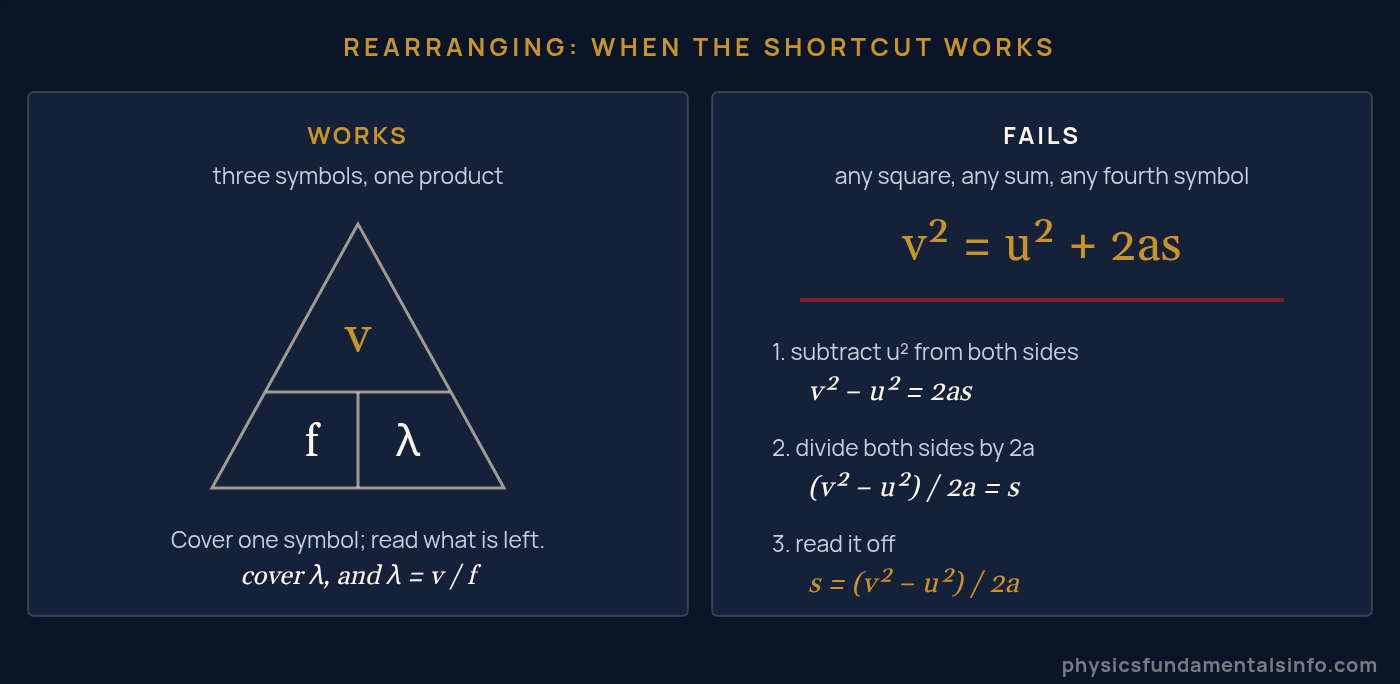
Formula triangles only handle three-symbol products. Everything else needs the algebra.
Formula triangles are not wrong — they are just narrow. They handle exactly one shape: one quantity equals two others multiplied together.
F = ma fits. V = IR fits. v = fλ fits. Roughly a third of this page fits.
The other two thirds do not, and a student who has only ever used triangles will stall the first time a square or a plus sign appears. Learn the algebra; keep the triangle as a shortcut you can justify.
The lab below lets you drill exactly that. Pick a relationship, choose which variable to solve for, and watch the rearranged equation and the answer update together.
Which Physics Formulas Should You Memorise First?
Memorise the six that everything else is built from: F = ma, KE = ½mv2, p = mv, v = fλ, V = IR and Q = mcΔT. Learn those cold and you can reconstruct or recognise most of the rest.
Six of the ten signatures on the map above do the heaviest lifting, and those are they. Once F = ma is automatic, W = Fd is one step away, and P = W/t is one step after that.
The Order That Works
- The six signatures above. Non-negotiable. These are the hooks.
- The five SUVAT equations. High yield, and they appear in disguise everywhere.
- The energy family: W = Fd, PE = mgh, P = W/t, Wnet = ΔKE.
- The inverse-square pair: F = GMm/r2 and F = kq1q2/r2. Identical shape, so learn them together.
- Your syllabus’s data sheet. Find out what is given to you — and stop memorising that.
That last point saves more time than any mnemonic. Most exam boards hand you a formula sheet. Spend an hour finding out precisely which formulas are on yours, and you have just deleted half your memorisation workload.
One more habit worth building: check magnitudes. If you calculate a car’s kinetic energy and get 3 joules, something is wrong — a moving car carries hundreds of thousands. Physicists develop a feel for what answers should look like, and that instinct catches errors no formula sheet ever will.
Common Misconceptions About Physics Formulas
“You have to memorise all of them”
You do not. Professional physicists look formulas up constantly — what they carry in their heads is which formula exists and roughly what shape it has. Recognition beats recall. Knowing that a v2 term means energy is somewhere in the problem is worth more than reciting the equation perfectly.
“Physical constants are measured, so they might change”
Several of them cannot change, because they are now definitions rather than measurements. Since 20 May 2019, c, h, e, kB and NA have exact fixed values, and the kilogram, kelvin, ampere and mole were redefined in terms of constants of nature.
The traffic even ran the other way. μ0 used to be exactly 4π × 10-7 N/A2 by definition; it is now a measured quantity, and it sits about 1 part in 10 billion away from that old value.
“A formula and a law are the same thing”
A law is a claim about nature; a formula is one way of writing it down. Newton’s second law is the claim that force sets the rate of change of momentum. F = ma is a formula expressing it — and only when mass is constant, which is why F = Δp/Δt is the more honest version.
“If the numbers go in, the answer comes out”
Every formula has a domain, and outside it the arithmetic still works while the physics does not. T = 2π sqrt(L/g) fails for a pendulum swung hard. V = IR fails for a filament lamp as it heats. Ohm’s law is not a law of nature at all — it is a description of how some materials behave, some of the time.
Worked Problems
Show Solution
Solution:
Step 1: Newton’s second law relates these three quantities: F = ma
Step 2: Rearrange for mass by dividing both sides by a: m = F / a
Step 3: Substitute with units: m = 3000 N / 2.5 m/s2 = 1200 kg
Answer: 1200 kg (2 s.f.)
Show Solution
Solution:
Step 1: Use KE = ½mv2
Step 2: Convert the mass to SI units first — this is where marks are lost: 500 g = 0.500 kg
Step 3: Substitute: KE = ½ × 0.500 kg × (12 m/s)2 = ½ × 0.500 × 144 = 36 J
Answer: 36 J
Leaving the mass in grams would have given 36,000 J — a ball with the energy of a rifle round.
Show Solution
Solution:
Step 1: Time is not given and not asked for, so use the SUVAT equation without t: v2 = u2 + 2as
Step 2: Rearrange for a: a = (v2 − u2) / (2s)
Step 3: Substitute: a = (02 − 282) / (2 × 40) = −784 / 80 = −9.8 m/s2
Answer: −9.8 m/s2 (the minus sign means deceleration)
Show Solution
Solution:
Step 1: Heat needed uses Q = mcΔT, and ΔT = 100 − 20 = 80 °C = 80 K
Step 2: Substitute: Q = 2.0 kg × 4180 J/(kg·K) × 80 K = 668,800 J
Step 3: Time comes from P = W / t, rearranged to t = Q / P
Step 4: Substitute: t = 668,800 J / 2000 W = 334 s
Answer: 6.7 × 10⁵ J, taking about 330 s (5.6 minutes)
Show Solution
Solution:
Step 1: You know P and V but not I, so use the power form containing only those: P = V2 / R
Step 2: Rearrange for R: R = V2 / P
Step 3: Substitute: R = (230 V)2 / 60 W = 52,900 / 60 = 881.7 Ω
Step 4: For current use P = IV, so I = P / V = 60 / 230 = 0.26 A
Answer: R = 8.8 × 10² Ω and I = 0.26 A
Check: I2R = 0.262 × 882 = 60 W. It closes.
Show Solution
Solution:
Step 1: Radio waves are electromagnetic, so they travel at c and obey v = fλ, giving c = fλ
Step 2: Rearrange for wavelength: λ = c / f
Step 3: Convert the frequency: 98.5 MHz = 98.5 × 10⁶ Hz
Step 4: Substitute: λ = 299,792,458 m/s / 98.5 × 10⁶ Hz = 3.044 m
Answer: 3.04 m (3 s.f.)
Show Solution
Solution:
Step 1: Photon energy comes from E = hc / λ
Step 2: Substitute, converting 400 nm to 400 × 10-9 m:
E = (6.626 × 10⁻³⁴ J·s × 2.998 × 10⁸ m/s) / (400 × 10-9 m) = 4.966 × 10⁻¹⁹ J
Step 3: Convert to electronvolts to match the work function:
E = 4.966 × 10⁻¹⁹ / 1.602 × 10-19 = 3.10 eV
Step 4: Apply the photoelectric equation KE(max) = hf − φ:
KE(max) = 3.10 eV − 2.28 eV = 0.82 eV
Answer: 0.82 eV, which is 1.3 × 10⁻¹⁹ J
Show Solution
Solution:
Step 1: Use conservation of energy — all kinetic energy becomes potential energy at the top: ½mv2 = mgh
Step 2: Mass appears on both sides, so it cancels: ½v2 = gh
Step 3: Rearrange for h: h = v2 / (2g)
Step 4: Substitute: h = (40 m/s)2 / (2 × 9.81 m/s2) = 1600 / 19.62 = 81.5 m
Answer: about 82 m (2 s.f.)
The 0.145 kg was never needed — a deliberate distractor. Heavy and light objects rise to the same height at the same launch speed.