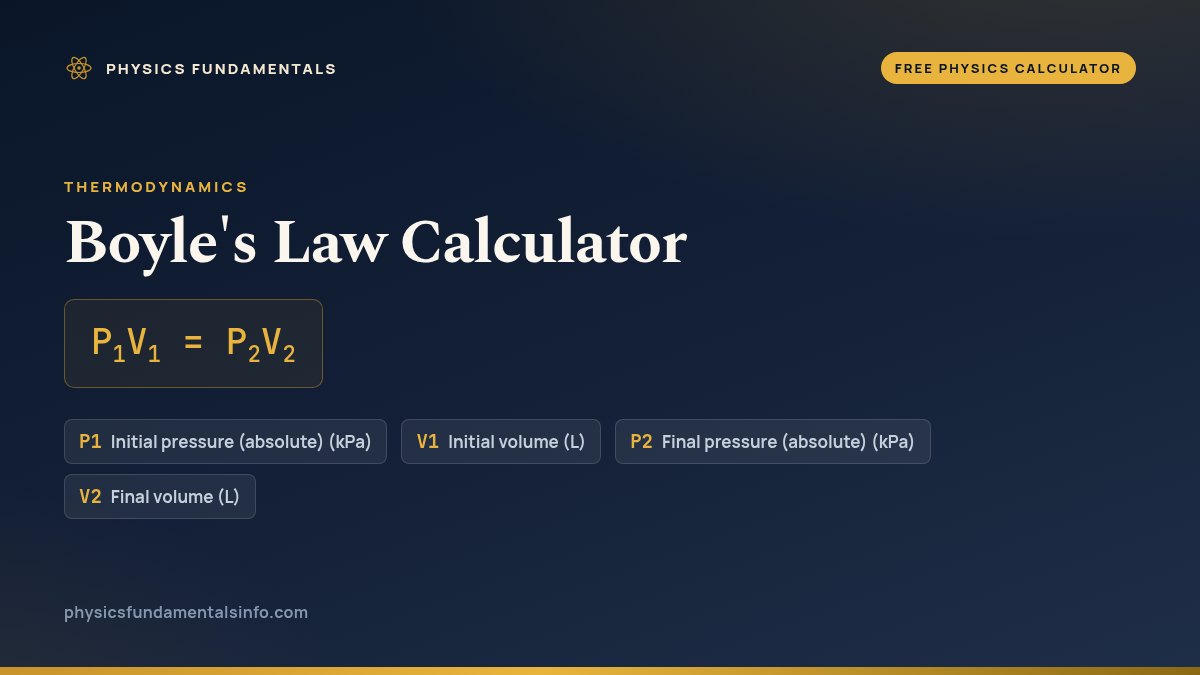
Boyle's law: at constant temperature the pressure of a fixed mass of gas is inversely proportional to its volume, so the product P × V stays constant — P1V1 = P2V2. This free calculator solves for either pressure or either volume, in any consistent units, and shows every step of the working plus the invariant product.
What Is the Boyle's Law Calculator?
The Boyle's law calculator is a free online tool built on the formula P1V1 = P2V2. Enter the values you already know, in whichever units suit you, and it solves for pressure or volume in either state and shows every step of the substitution. Boyle's Law is pressure-volume product of a gas at constant temperature.
| Symbol | Quantity | Default unit | Also accepts | Example value |
|---|---|---|---|---|
| P1 | Initial pressure (absolute) | kPa | Pa, atm, bar, psi | 100 |
| V1 | Initial volume | L | mL, cm³, m³ | 2 |
| P2 | Final pressure (absolute) | kPa | Pa, atm, bar, psi | 400 |
| V2 | Final volume | L | mL, cm³, m³ | 0.5 |
How to calculate with Boyle's law
Boyle's law describes what happens when you compress or expand a gas while holding its temperature fixed: squeeze the volume and the pressure rises in exact inverse proportion. Written as a product, P1V1 = P2V2, which rearranges to P2 = P1V1/V2. Halve the volume and the pressure doubles; triple the volume and the pressure falls to a third.
There are three steps. First, choose what you want in the Solve for menu: the final pressure P2, the initial pressure P1, or either volume. Second, enter the values you know — pressures in Pa, kPa, atm, bar or psi, and volumes in litres, millilitres, cubic centimetres or cubic metres. Because the law is a ratio, the units cancel, so you only need to be consistent within each pair. The one rule that matters is that pressures must be absolute, not gauge. Third, read the answer with its worked steps and the constant product P × V.
The relationship is a hyperbola on a pressure-versus-volume graph: the curve falls steeply near small volumes and flattens as the gas expands, but every point on it shares the same P × V. To watch that hyperbola build as you drag a piston, open the Boyle's law simulator, and to bring temperature and amount of gas into the picture, use the ideal gas law calculator.
Worked example
A syringe holds 2.00 L of air at 100 kPa. The plunger is pushed in until the volume is 0.500 L, with the temperature unchanged — what is the new pressure? Using P2 = P1V1/V2 = 100 × 2.00 / 0.500 = 400 kPa. The volume dropped to a quarter, so the pressure rose four-fold, and the product checks out: P × V = 100 × 2.00 = 200 kPa·L, the same as 400 × 0.500.
Why it matters
Boyle's law explains how syringes, bicycle pumps and lungs work, why deep-sea divers must exhale as they ascend, how pressure cookers and pneumatic tools behave, and how gas is stored in cylinders. It is one of the three simple gas laws — with Charles's and Gay-Lussac's — that combine into the ideal gas law, and it was the first quantitative gas law ever measured.
Frequently asked questions
Do I enter gauge pressure or absolute pressure?
Absolute pressure. Boyle's law relates the true (absolute) pressures of the gas, so add atmospheric pressure to any gauge reading first — roughly 101 kPa (about 14.7 psi) at sea level. A tyre gauge reading 200 kPa is about 301 kPa absolute.
Do my pressure and volume units have to be SI?
No. Because P1V1 = P2V2 is a ratio, the units cancel as long as you are consistent within each pair — the same pressure unit for P1 and P2, and the same volume unit for V1 and V2. This calculator lets you mix units freely and converts everything to SI internally, so it always works out.
What happens if the temperature changes between the two states?
Then Boyle's law alone no longer applies. Boyle's law assumes constant temperature and a fixed amount of gas. If the temperature also changes, use the combined gas law, P1V1/T1 = P2V2/T2, or the full ideal gas law PV = nRT.
How do I solve for the final volume V2 instead of the pressure?
Use the “Solve for” selector and choose V2. The engine rearranges Boyle's law to V2 = P1V1/P2 and asks for the other three values. You can solve for P1, P2, V1 or V2 the same way.
Why does the calculator refuse a volume of zero?
Because compressing a gas to zero volume would require infinite pressure, which is unphysical. Zero or negative pressures and volumes are rejected, and the divide-by-zero case returns a prompt rather than an infinite number.
References & formula source
- Young & Freedman — University Physics with Modern Physics, chapter on Thermal Properties of Matter (the ideal-gas equation).
- Halliday, Resnick & Walker — Fundamentals of Physics, chapter on The Kinetic Theory of Gases.
- Zemansky & Dittman — Heat and Thermodynamics, chapter on equations of state and the ideal gas.
- Further reading: Boyle's law — Wikipedia