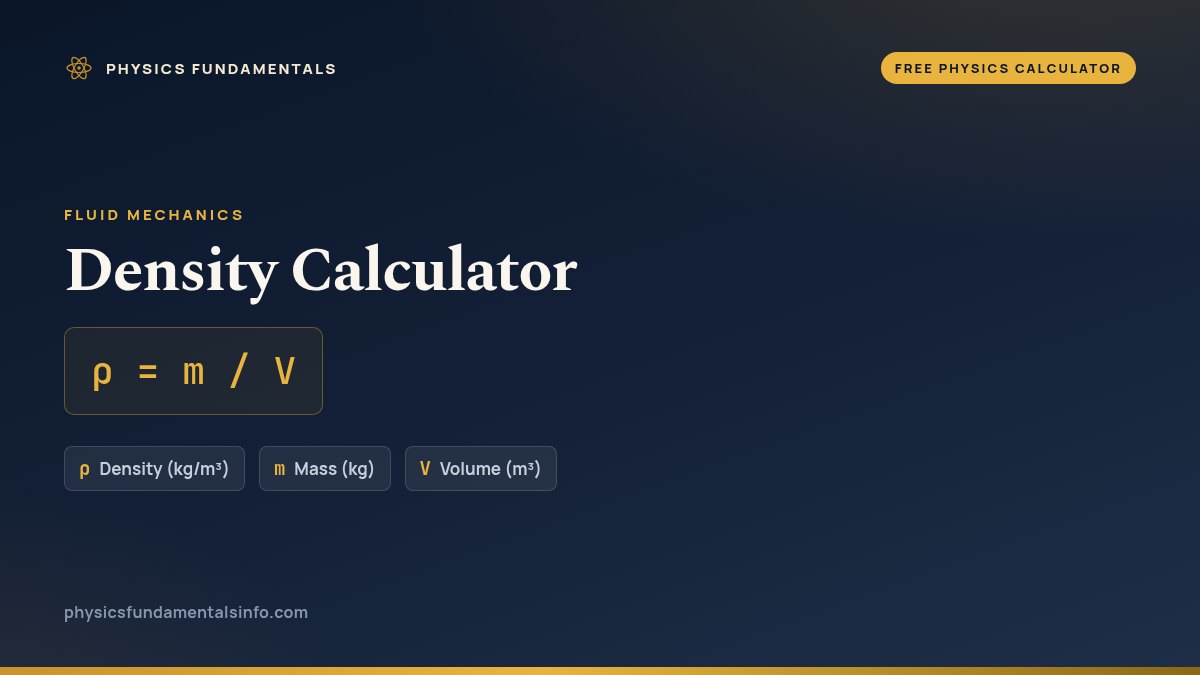
Density: density (ρ) is how much mass is packed into a given volume, defined by ρ = m/V. This free calculator solves for density, mass or volume — in any unit — and shows every step of the working.
What Is the Density Calculator?
The density calculator is a free online tool built on the formula ρ = m / V. Enter the values you already know, in whichever units suit you, and it solves for density, mass or volume and shows every step of the substitution. Mass packed into a given volume — solves for density, mass or volume.
| Symbol | Quantity | Default unit | Also accepts | Example value |
|---|---|---|---|---|
| ρ | Density | kg/m³ | g/cm³, g/mL, kg/L, g/L, lb/ft³ | 1000 |
| m | Mass | kg | g, tonne, lb | 1 |
| V | Volume | m³ | L, cm³, mL, ft³, gal (US) | 1 |
How to calculate density
Density tells you how tightly matter is packed together. To calculate it, divide an object’s mass by the volume it takes up: ρ = m / V. The result is usually quoted in kilograms per cubic metre (kg/m³) in physics, or grams per cubic centimetre (g/cm³) in chemistry, where 1 g/cm³ equals 1000 kg/m³.
There are three steps. First, decide which quantity you want — density, mass or volume — and select it in the calculator’s Solve for menu. Second, enter the two values you already know and pick their units; the calculator converts everything to SI base units (kilograms and cubic metres) behind the scenes, so you never have to convert by hand. Third, read the answer together with the worked steps, which show the formula, your numbers substituted in, and the final value with its units.
The equation rearranges easily. If you know density and volume, the mass is m = ρ × V. If you know mass and density, the volume is V = m ÷ ρ. The key rule is to keep units consistent — mixing grams with cubic metres, for example, gives an answer that is wrong by a factor of a thousand. Letting the calculator handle the unit conversion removes that risk entirely.
Density also predicts floating and sinking. An object floats in a fluid when its average density is lower than the fluid’s, and sinks when it is higher — the principle behind ships, hot-air balloons and hydrometers. To turn density into an actual upward force, use the buoyancy calculator; for a definition of the term itself, see the physics glossary.
Worked example
An aluminium block has a mass of 540 g and a volume of 200 cm³. Its density is ρ = m / V = 540 / 200 = 2.7 g/cm³, which is 2700 kg/m³ — exactly the textbook density of aluminium. Reading it the other way, a 200 cm³ block of water (ρ = 1 g/cm³) would have a mass of just 200 g, so the aluminium block is 2.7 times heavier for the same size.
Why density matters
Density connects an object’s size to its mass, so it underpins material selection in engineering, identifying unknown substances in the lab, mixing and layering of liquids, weather and ocean circulation, and the design of anything that has to float or fly.
Frequently asked questions
What is the formula for density?
Density (ρ) is mass divided by volume: ρ = m/V. Divide an object’s mass by the volume it occupies. The same equation rearranges to m = ρV and V = m/ρ, so you can solve for any one of the three quantities.
What are the units of density?
The SI unit is kilograms per cubic metre (kg/m³). In chemistry and the lab, grams per cubic centimetre (g/cm³) is common, where 1 g/cm³ = 1000 kg/m³. This calculator converts between kg/m³, g/cm³, g/mL, kg/L, g/L and lb/ft³ for you.
How do you find mass or volume from density?
Rearrange ρ = m/V. To get mass, multiply density by volume: m = ρ × V. To get volume, divide mass by density: V = m ÷ ρ. Choose the quantity you want in the “Solve for” menu and the calculator does the rearrangement automatically.
What is the density of water?
Pure water is about 1000 kg/m³ (1 g/cm³, or 1 kg/L) at 4 °C, which is why it is used as a reference. Seawater is denser at roughly 1025 kg/m³ because of dissolved salts, and ice is less dense at about 917 kg/m³ — which is why ice floats.
How do I know whether an object will float or sink?
Compare average densities. An object floats if its average density is less than the fluid’s density, and sinks if it is greater. A steel ship floats because its overall density (steel plus the air inside the hull) is lower than water’s.
References & formula source
- Halliday, Resnick & Walker — Fundamentals of Physics, Chapter 14 (Fluids).
- Young & Freedman — University Physics with Modern Physics, §12.1 (Density).
- NIST Chemistry WebBook — reference densities of common substances.
- BIPM — The International System of Units (SI): the kilogram and the metre.
- Further reading: Density — Wikipedia