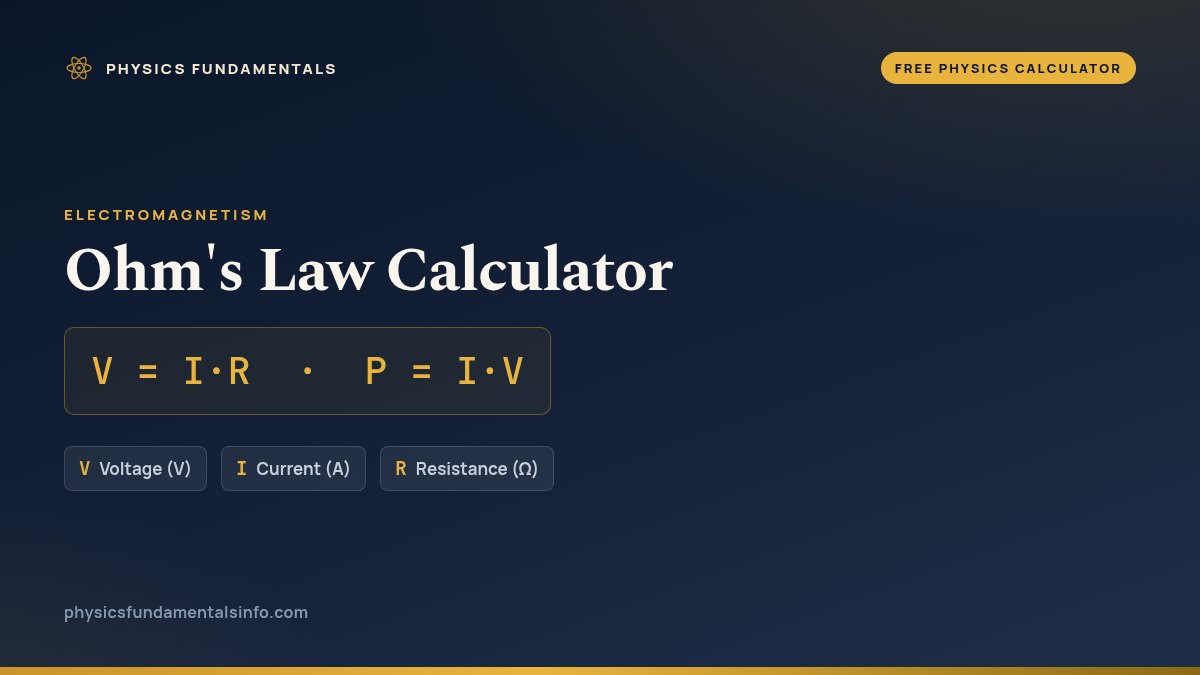
Ohm's law: the voltage across a resistor equals the current through it times its resistance — V = I·R — and the power it dissipates is P = I·V. This free calculator takes any two of voltage, current and resistance and returns all four quantities, including power, with every step of the working shown.
What Is the Ohm's Law Calculator?
The Ohm's law calculator is a free online tool built on the formula V = I·R · P = I·V. Enter the values you already know, in whichever units suit you, and it solves for voltage, current, resistance, power and shows every step of the substitution. Ohm's Law is voltage, current, resistance and power in a circuit.
| Symbol | Quantity | Default unit | Also accepts | Example value |
|---|---|---|---|---|
| V | Voltage | V | mV, kV | — |
| I | Current | A | mA | — |
| R | Resistance | Ω | kΩ, MΩ | — |
How to use the Ohm's law calculator
Ohm's law is the workhorse of circuit analysis: voltage drives current through resistance — our full guide to Ohm's law walks through the concept in more depth. Voltage (V) is the electrical "push", current (I) is the rate of charge flow that push produces, and resistance (R) is how strongly the component opposes that flow. The three are tied together by V = I·R, so knowing any two pins down the third. The current itself is the flow of charge, set in motion by the electrostatic force between charges, and once it is flowing the voltage drop across a component depends on its resistance.
Using the tool takes three steps. First, enter any two of voltage, current and resistance — there is no menu to set, because two inputs are always enough. Second, choose the units you actually have: millivolts or kilovolts, milliamps, kilo-ohms or megohms are all accepted and converted to base SI units before the calculation. Third, read the answer: the calculator fills in the missing quantity using V = IR, I = V/R or R = V/I as appropriate, and alongside it reports the power dissipated, P = I·V. The worked steps show the formula, your numbers, and the result so you can follow the algebra.
When several components share a circuit you first combine resistors in series or parallel into a single total resistance before applying V = IR. The same two power relationships, P = I²R and P = V²/R, follow directly by substituting Ohm's law into P = IV, and let you find the heat a resistor must dissipate from whichever pair of quantities you already know.
Worked example
Take a 12 V supply connected across a 4 Ω resistor. Entering V = 12 V and R = 4 Ω, the calculator finds the current from I = V/R = 12/4 = 3 A, then the power from P = V·I = 12 × 3 = 36 W. You could equally start from current and resistance: with I = 3 A and R = 4 Ω the voltage is V = I·R = 3 × 4 = 12 V, and the power is the same 36 W. Halve the resistance to 2 Ω at the same 12 V and the current doubles to 6 A while the power quadruples to 72 W — a direct reminder that, at fixed voltage, power scales as V²/R.
Why it matters
Ohm's law underpins circuit and electronics design, choosing fuses and wire gauges, power-supply sizing, LED series-resistor selection and everyday fault-finding. Because P = IV gives the power a device draws, the same figures feed straight into working out the running cost of an appliance once you factor in how long it runs. It is also the first tool you reach for when diagnosing a circuit: an unexpected current or voltage drop, checked against V = IR, quickly points to a short, an open connection or a component out of spec. For terms you are unsure of, the physics glossary has short definitions.
Frequently asked questions
What is Ohm's law?
Ohm's law states that the current through a conductor between two points is directly proportional to the voltage across them and inversely proportional to the resistance: V = IR. Rearranged, I = V/R and R = V/I. It holds for ohmic materials (most metals and resistors at constant temperature) and is the single most-used relationship in circuit analysis.
How do I calculate power from voltage, current and resistance?
Electrical power is the rate at which energy is dissipated, P = IV. Because V = IR, this can be written two other ways: P = I²R (handy when you know the current and resistance) and P = V²/R (handy when you know the voltage and resistance). All three give the same answer in watts. For a 12 V supply driving 3 A, P = 12 × 3 = 36 W.
Which two values do I need to enter?
Any two of voltage, current and resistance. With voltage and current, the calculator returns resistance (R = V/I); with voltage and resistance it returns current (I = V/R); with current and resistance it returns voltage (V = IR). In every case it also reports the power, so two inputs always give you all four quantities.
What units does the Ohm's law calculator use?
Voltage is in volts (with millivolts and kilovolts available), current in amperes (or milliamps), and resistance in ohms (Ω), kilo-ohms (kΩ) or megohms (MΩ). The calculator converts every prefix to base SI units before computing, and reports power in watts. Mixing units — say kΩ with mA — is fine; the conversions are handled for you.
Does Ohm's law apply to every component?
No. Ohm's law assumes a constant resistance, which is a good approximation for metal wires and resistors at a fixed temperature. Components such as diodes, LEDs, transistors and filament lamps are non-ohmic — their resistance changes with voltage, current or temperature — so V = IR only describes them at a single operating point, not across their whole range.
References & formula source
- Halliday, Resnick & Walker — Fundamentals of Physics, Chapter 26 (Current and Resistance) and Chapter 27 (Circuits).
- Young & Freedman — University Physics with Modern Physics, §25.2–25.3 (Resistance and Ohm's Law) and §25.5 (Energy and Power in Electric Circuits).
- Hayt, Kemmerly & Durbin — Engineering Circuit Analysis, Chapter 2 (Basic Components and Electric Circuits).
- Further reading: Ohm's law — Wikipedia