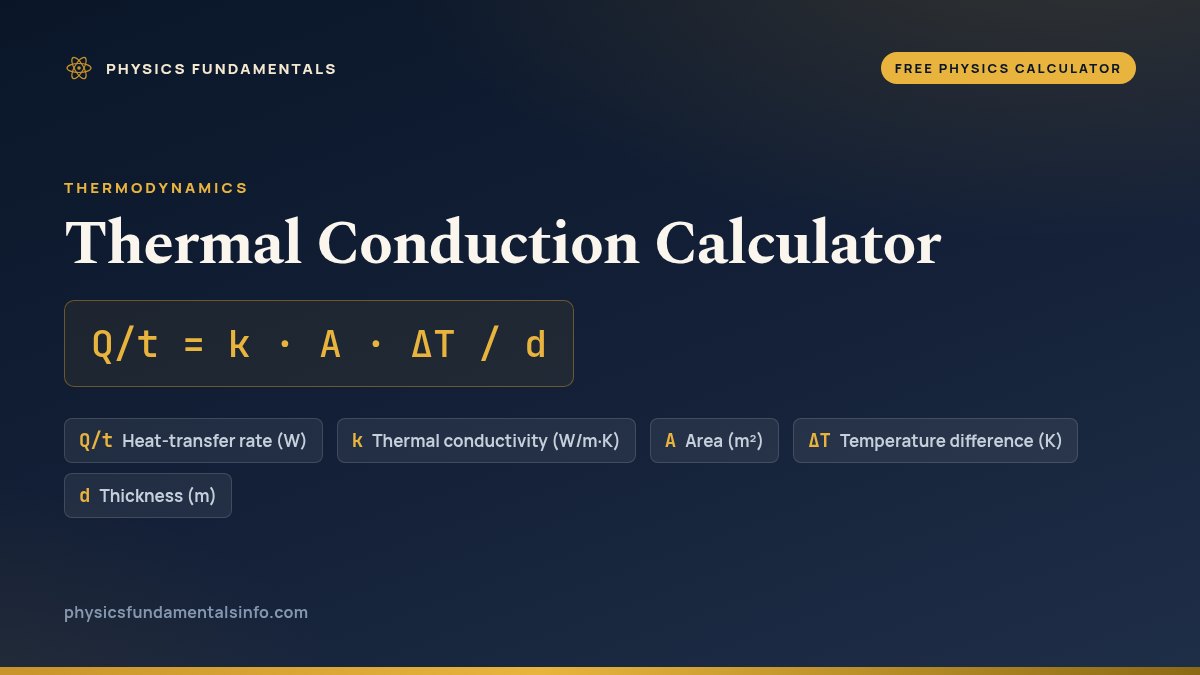
Fourier's law: heat conducts through a slab at a rate set by its conductivity, area and the temperature difference across it, divided by its thickness — Q/t = kAΔT/d. This free calculator solves for the heat-transfer rate, the conductivity, the area, the temperature difference or the thickness, in any unit, and shows every step of the working.
What Is the Thermal Conduction Calculator?
The thermal conduction calculator is a free online tool built on the formula Q/t = k · A · ΔT / d. Enter the values you already know, in whichever units suit you, and it solves for heat-transfer rate, conductivity, area, ΔT or thickness and shows every step of the substitution. Thermal Conduction is steady-state heat-conduction rate through a slab, Q/t = kAΔT/d.
| Symbol | Quantity | Default unit | Also accepts | Example value |
|---|---|---|---|---|
| Q/t | Heat-transfer rate | W | kW | 160 |
| k | Thermal conductivity | W/m·K | — | 0.8 |
| A | Area | m² | cm² | 1 |
| ΔT | Temperature difference | K | °C | 20 |
| d | Thickness | m | cm, mm | 0.1 |
How to calculate the rate of heat conduction
Conduction is heat moving through a material without the material itself flowing — energy passing from hotter to cooler atoms along a solid. Fourier's law gives the steady-state rate at which it happens across a flat slab. Multiply three things and divide by one: the material's thermal conductivity k, the cross-sectional area A and the temperature difference ΔT across the slab, all divided by the slab thickness d — Q/t = k·A·ΔT/d. The answer is a rate of heat flow in watts. The full derivation, the assumptions behind the steady-state form and where each symbol comes from are covered in the guide to Fourier's law of thermal conduction.
There are three steps. First, decide what you want — the heat-transfer rate, or one of k, A, ΔT or d — and pick it in the calculator's Solve for menu. Second, enter the values you know: conductivity in W/m·K, area in square metres or centimetres, the temperature difference in kelvin (a gap in K is the same as a gap in °C), and the thickness in metres, centimetres or millimetres. Third, read the answer with the worked steps, which show the formula, your numbers substituted in, and the result in watts and kilowatts.
Two relationships are worth feeling directly. Conduction is proportional to area and temperature difference — double either and the rate doubles — but inversely proportional to thickness, so doubling the thickness halves the flow. That single fact is why insulation works: a thick layer of low-conductivity foam slows conduction to a trickle. Conductivity itself ranges enormously, from about 0.03 W/m·K for insulating foam to roughly 400 W/m·K for copper, which is why a thin copper plate and a thick foam panel behave so differently.
Conduction rarely acts alone. A hot surface also loses heat by convection to the surrounding air and by radiation; for the radiative term, which climbs with the fourth power of absolute temperature, see the Stefan–Boltzmann calculator. To find the heat needed to change a body's temperature in the first place, see the specific heat calculator, or look up a term in the physics glossary.
Worked example
A solid brick wall has conductivity k = 0.8 W/m·K and is 0.1 m thick, with an area of 1 m² and a 20 K temperature difference between its faces. The conduction rate is Q/t = k·A·ΔT/d = 0.8 × 1 × 20 / 0.1 = 160 W. Halve the thickness to 0.05 m and the rate doubles to 320 W; double the temperature difference to 40 K and it doubles again — a direct illustration of the proportional and inverse relationships in Fourier's law.
Why it matters
Conduction governs building insulation and U-values, the design of heat sinks and CPU coolers, cookware and kettle bases, double glazing, cryogenic storage, and the thermal protection of spacecraft and engines. Anywhere heat has to be either moved efficiently or held back, Fourier's law is the starting point.
Frequently asked questions
What is Fourier's law of heat conduction?
Fourier's law states that the steady-state rate of heat conduction through a flat slab is Q/t = kAΔT/d: proportional to the material's thermal conductivity k, the cross-sectional area A and the temperature difference ΔT across it, and inversely proportional to the thickness d. The result is a rate of heat flow in watts.
What units does the thermal conduction calculator use?
Conductivity k is in W/m·K, area A in m² (or cm²), temperature difference ΔT in kelvin (a difference in K equals a difference in °C), and thickness d in metres (or cm/mm). The heat-transfer rate is returned in watts, with a kilowatt value alongside. Because ΔT is a temperature difference, you do not convert to absolute kelvin — only radiation needs that.
Why does a thicker slab conduct less heat?
Thickness d is in the denominator, so the rate is inversely proportional to it: double the thickness and the conduction rate halves. A thicker wall makes heat travel further through the material for the same temperature difference, which is exactly why insulation works by adding thickness of a low-conductivity material.
What are typical thermal conductivity values?
Thermal conductivity spans four orders of magnitude: insulating foams and air sit near 0.03 W/m·K, water about 0.6, glass and brick around 0.8–1.0, stainless steel near 15, aluminium about 240, and copper roughly 400 W/m·K. This calculator accepts k from 0.01 up to 500 W/m·K, covering insulators through to the best metallic conductors.
Does this calculator assume steady state?
Yes. Fourier's law in the form Q/t = kAΔT/d gives the steady-state rate, once the temperature profile through the slab has stopped changing. Transient (time-dependent) conduction, where the slab is still heating up or cooling down, needs the heat equation and the material's specific heat and density instead.
References & formula source
- Incropera, DeWitt, Bergman & Lavine — Fundamentals of Heat and Mass Transfer, Chapter 2 (Introduction to Conduction).
- Young & Freedman — University Physics with Modern Physics, §17.7 (Mechanisms of Heat Transfer: Conduction).
- Halliday, Resnick & Walker — Fundamentals of Physics, Chapter 18 (Temperature, Heat & the First Law of Thermodynamics).
- Further reading: Thermal conduction — Wikipedia