Projectile motion: launch something at speed v0 and angle θ and it follows a parabola, landing a horizontal range R = v0²·sin(2θ)/g away. This free calculator gives the range, the maximum height and the flight time for any launch speed, angle, height and gravity, plots the trajectory, and shows every step of the working.
What Is the Projectile Motion Calculator?
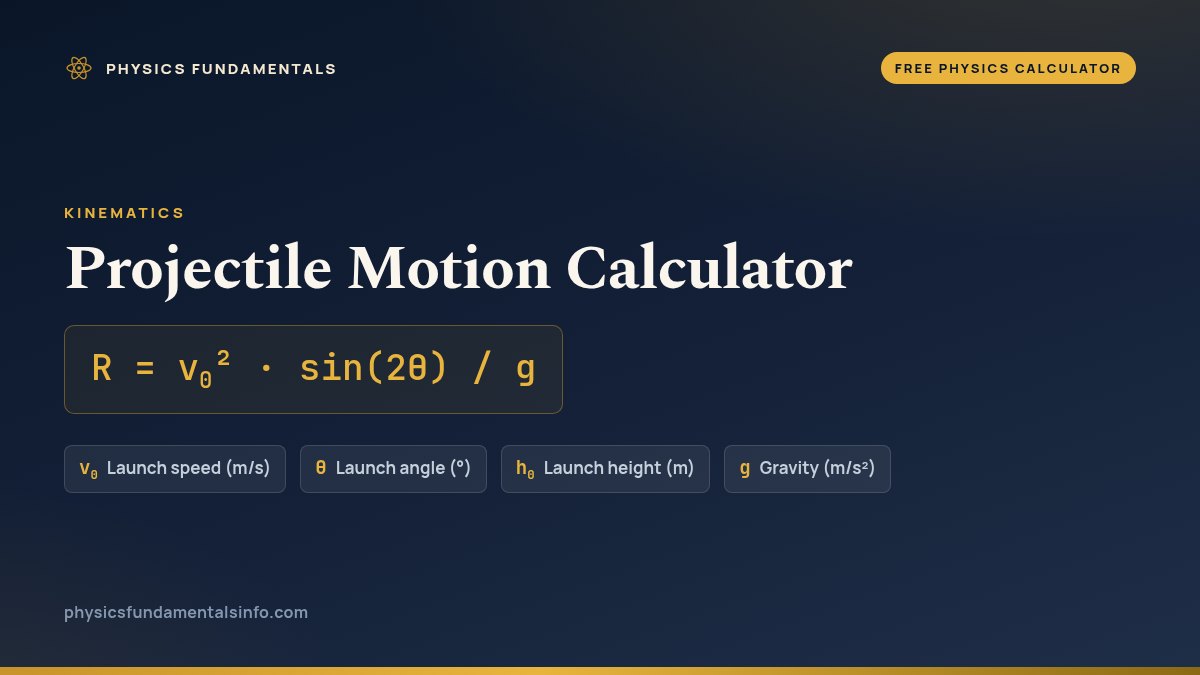
The projectile motion calculator is a free online tool built on the formula R = v0² · sin(2θ) / g. Enter the values you already know, in whichever units suit you, and it solves for range, max height, flight time and shows every step of the substitution. Projectile Motion is range, peak height and flight time for any launch speed, angle and gravity.
| Symbol | Quantity | Default unit | Also accepts | Example value |
|---|---|---|---|---|
| v0 | Launch speed | m/s | km/h, mph | 20 |
| θ | Launch angle | ° | — | 45 |
| h0 | Launch height | m | cm, ft | 0 |
| g | Gravity | m/s² | — | — |
How to calculate projectile motion
A projectile is anything thrown, kicked or fired that then moves under gravity alone — a basketball, a long-jumper, a water jet, a cannonball. The key idea is that horizontal and vertical motion are completely independent. The horizontal velocity stays constant because no horizontal force acts, while the vertical velocity changes at a steady rate g. Constant horizontal displacement combined with accelerating vertical displacement traces a parabola, as our guide to projectile motion explains step by step.
There are three steps with this calculator. First, enter the launch speed v0 and the launch angle θ above the horizontal; speed can be in m/s, km/h or mph. Second, set the launch height h0 — leave it at zero for flat ground, or raise it if the projectile starts on a cliff or table — and choose the gravity g, with Earth, Moon, Mars and Jupiter presets ready to pick. Third, read the answer: the range appears with the maximum height, the flight time and the horizontal and vertical velocity components, plus a plotted trajectory and the full worked steps.
On level ground the maths is compact. Split the launch speed into a horizontal part vx = v0·cosθ and a vertical part v_y = v0·sinθ. The time of flight follows from the vertical motion, the maximum height is H = h0 + v_y²/2g, and the range is simply R = vx · t. Combined for flat ground this collapses to the famous R = v0²·sin(2θ)/g. Because the sin(2θ) term is largest when 2θ = 90°, the range is greatest at θ = 45°; with air resistance the real optimum drops to roughly 38–42°.
One striking feature of the ideal model is that mass cancels out — a feather and a cannonball launched identically would trace the same path, exactly as in free fall. The horizontal and vertical pieces are each ordinary constant-acceleration problems, so the same SUVAT equations describe them, and you can look up any term in the physics glossary.
Worked example
Launch a ball at v0 = 20 m/s and θ = 45° from flat ground on Earth (g = 9.81 m/s²). The velocity components are vx = 20·cos45° = 14.1 m/s and v_y = 20·sin45° = 14.1 m/s. The flight time is t = 2·v_y/g = 2·14.1/9.81 = 2.88 s, the range is R = v0²·sin90°/g = 400/9.81 = 40.8 m, and the maximum height is H = v_y²/2g = (14.1)²/19.62 = 10.2 m. Try the same speed at 30° and 60° and you will get the same range from each — a neat consequence of the sin(2θ) symmetry about 45°.
Why it matters
Projectile motion is the model behind ballistics, sport (basketball arcs, golf drives, javelin and the long jump), water-jet fountains, fireworks and any "launch and land" trajectory problem. It is usually the first time a physics student sees two-dimensional motion broken into independent components, and that decomposition — handle each direction separately, then link them through time — is a habit that carries straight into orbital mechanics, electromagnetism and beyond.
Frequently asked questions
What is the formula for the range of a projectile?
For a projectile launched from and landing on level ground, the horizontal range is R = v0²·sin(2θ)/g, where v0 is the launch speed, θ the launch angle above the horizontal and g the gravitational acceleration. The sin(2θ) term peaks at θ = 45°, so 45° gives the greatest range on flat ground in the absence of air resistance. When the launch and landing heights differ, the range is found from R = vx·t with the flight time t solved from the full vertical equation.
At what angle does a projectile travel the farthest?
On flat ground with no air resistance, 45° gives the maximum range, because sin(2θ) is largest when 2θ = 90°. Angles equally spaced either side of 45°, such as 30° and 60°, give the same range as each other. With air resistance the optimum drops to roughly 38–42°, and launching from a raised height shifts the best angle below 45° as well.
Does mass affect projectile motion?
No. In the ideal drag-free model the acceleration due to gravity is the same for every object, so mass cancels out of the equations entirely — a feather and a cannonball launched identically follow exactly the same parabola. Mass only matters once air resistance is included, because drag depends on size and shape rather than on the gravitational pull alone.
How are horizontal and vertical motion related in a projectile?
They are completely independent. The horizontal velocity vx = v0·cosθ stays constant because no horizontal force acts, while the vertical velocity changes steadily under gravity from v_y = v0·sinθ. Constant horizontal displacement combined with accelerating vertical displacement traces a parabola. The two motions share only one quantity — the time of flight, which the vertical motion sets and the horizontal motion then uses to find the range.
Does this calculator include air resistance?
No. It uses the standard ideal-projectile model with no air resistance, so the path is an exact parabola and energy is conserved. This matches almost every textbook and exam problem. Real trajectories with significant drag are shorter, peak at a lower angle and fall more steeply than they rise; modelling them needs the drag force and numerical integration rather than these closed-form equations.
References & formula source
- Young & Freedman — University Physics with Modern Physics, §3.3 (Projectile Motion).
- Halliday, Resnick & Walker — Fundamentals of Physics, Chapter 4 (Motion in Two and Three Dimensions).
- Serway & Jewett — Physics for Scientists and Engineers, Chapter 4 (Motion in Two Dimensions).
- Further reading: Projectile motion — Wikipedia