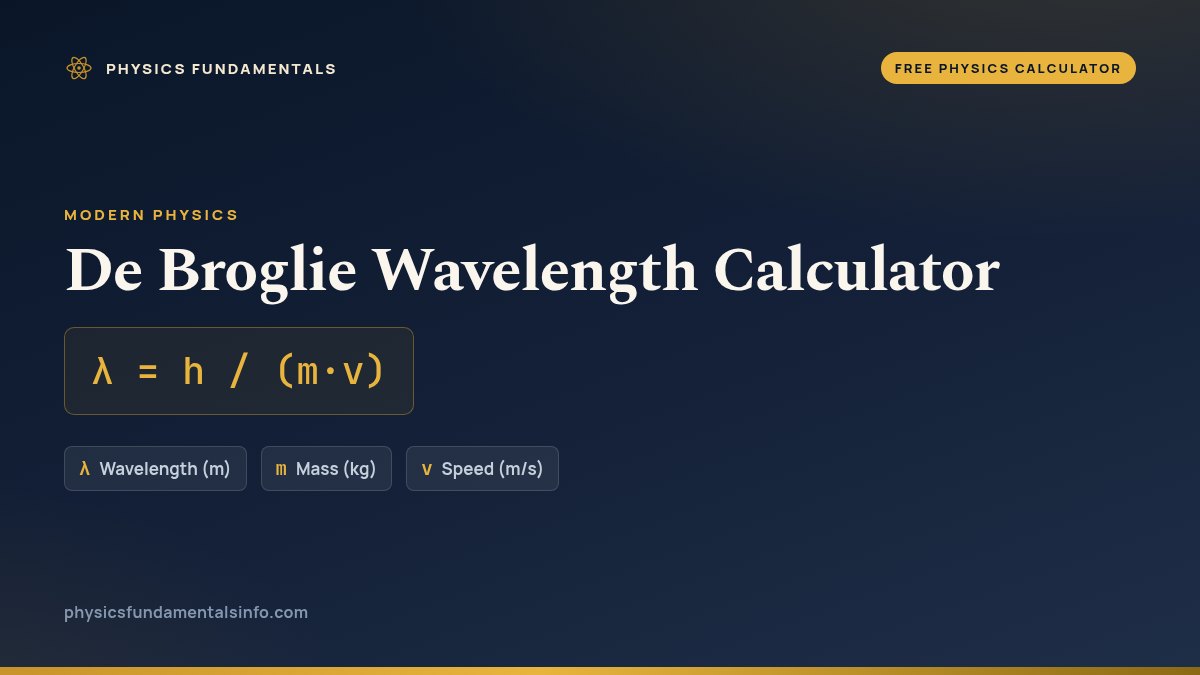
De Broglie wavelength: every moving particle behaves as a wave whose wavelength is λ = h/(m·v), where h is Planck’s constant. This free calculator solves for wavelength, mass or speed — in any unit — and shows every step of the working.
What Is the De Broglie Wavelength Calculator?
The De Broglie wavelength calculator is a free online tool built on the formula λ = h / (m·v). Enter the values you already know, in whichever units suit you, and it solves for wavelength, mass or speed and shows every step of the substitution. De Broglie Wavelength is matter wavelength of a moving particle, λ = h/mv.
| Symbol | Quantity | Default unit | Also accepts | Example value |
|---|---|---|---|---|
| λ | Wavelength | m | nm, pm, Å | — |
| m | Mass | kg | g, u (amu) | 9.109e-31 |
| v | Speed | m/s | km/s | 1000000 |
How to calculate the de Broglie wavelength
In 1924 Louis de Broglie proposed that matter, like light, has a wave nature: any particle carrying momentum p has an associated wavelength λ = h/p, where h = 6.62607015 × 10-³4 J·s is Planck’s constant. For a particle of mass m moving at speed v, the non-relativistic momentum is p = mv, so the working formula becomes λ = h/(m·v). The result is a length, normally quoted in nanometres (nm), picometres (pm) or ångströms (Å) because matter wavelengths are extremely small.
There are three steps. First, decide which quantity you want — wavelength, mass or speed — and select it in the calculator’s Solve for menu. Second, enter the two values you already know and pick their units; the calculator converts mass to kilograms, speed to metres per second and wavelength to metres behind the scenes, so you never juggle powers of ten by hand. Third, read the answer together with the worked steps, which show the formula, your numbers substituted in, and the final value with its units.
The equation rearranges easily. If you know the wavelength and speed, the mass is m = h/(λ·v). If you know the mass and wavelength, the speed is v = h/(m·λ). Because h is so tiny, only very small masses — electrons, neutrons, protons and atoms — produce wavelengths large enough to measure; this is why matter waves dominate the subatomic world but are invisible for everyday objects.
De Broglie’s idea was confirmed by the Davisson–Germer experiment, in which electrons diffracted off a nickel crystal exactly as waves of this wavelength should. It sits alongside the photon picture of light: where the photon energy calculator turns a wavelength into energy, the de Broglie relation turns a particle’s momentum into a wavelength. For a definition of the underlying terms, see the physics glossary.
Worked example
Find the de Broglie wavelength of an electron moving at 1 × 10⁶ m/s. The electron’s mass is m = 9.109 × 10-³¹ kg, so λ = h/(m·v) = 6.626 × 10-³4 / (9.109 × 10-³¹ × 1 × 10⁶) = 7.27 × 10-¹0 m ≈ 0.73 nm. That is roughly the spacing between atoms in a solid, which is exactly why such electrons diffract through crystal lattices and make electron microscopy possible. A thermal neutron (mass 1 u) at 2200 m/s, by contrast, has λ ≈ 1.8 × 10-¹0 m — about 1.8 Å — the basis of neutron diffraction.
Why the de Broglie wavelength matters
Matter waves are the foundation of quantum mechanics: they explain electron diffraction, the discrete energy levels of atoms, and the resolution limits of electron and neutron microscopes. Comparing a particle’s de Broglie wavelength with the size of an object tells you whether wave or particle behaviour will dominate.
Frequently asked questions
What is the de Broglie wavelength?
The de Broglie wavelength is the wavelength of the matter wave associated with a moving particle. Louis de Broglie proposed in 1924 that every particle with momentum p has a wavelength λ = h/p, where h is Planck’s constant. For a particle of mass m moving at speed v this becomes λ = h/(mv).
What is the formula for the de Broglie wavelength?
λ = h/(m·v), where h = 6.62607015×10^-34 J·s is Planck’s constant, m is the particle’s mass in kilograms and v is its speed in metres per second. More generally λ = h/p, with p the momentum. The equation rearranges to m = h/(λv) and v = h/(mλ).
What is the de Broglie wavelength of an electron?
It depends on the electron’s speed. An electron (mass 9.109×10^-31 kg) moving at 1×10^6 m/s has a wavelength of about 7.3×10^-10 m, or 0.73 nm — comparable to atomic spacings, which is why electron beams diffract through crystals in electron microscopes.
Why don’t everyday objects show a de Broglie wavelength?
Because their mass is enormous compared with Planck’s constant. A 1 kg ball thrown at 10 m/s has λ = h/(mv) ≈ 6.6×10^-35 m — far smaller than an atomic nucleus, so no wave behaviour is ever observed. Matter-wave effects only become measurable for tiny masses like electrons, neutrons and atoms.
Is this the relativistic de Broglie wavelength?
No — this calculator uses the non-relativistic momentum p = mv, which is accurate when the speed is well below the speed of light (roughly under 10% of c). For very fast particles you must use the relativistic momentum, which makes the true wavelength slightly shorter than λ = h/(mv) predicts.
References & formula source
- Halliday, Resnick & Walker — Fundamentals of Physics, Chapter 38 (Photons and Matter Waves).
- Young & Freedman — University Physics with Modern Physics, §39.1 (De Broglie Waves).
- NIST — CODATA recommended value of the Planck constant h = 6.62607015 × 10^-34 J·s.
- BIPM — The International System of Units (SI): definition of the kilogram via the Planck constant.
- Further reading: Matter wave — Wikipedia