The work energy theorem states that the net work done on a body equals the change in its kinetic energy. Add up the work every force did, each with its own sign, and the total equals ½mv22 – ½mv12. It turns a force and a distance into a speed, with no time in it.
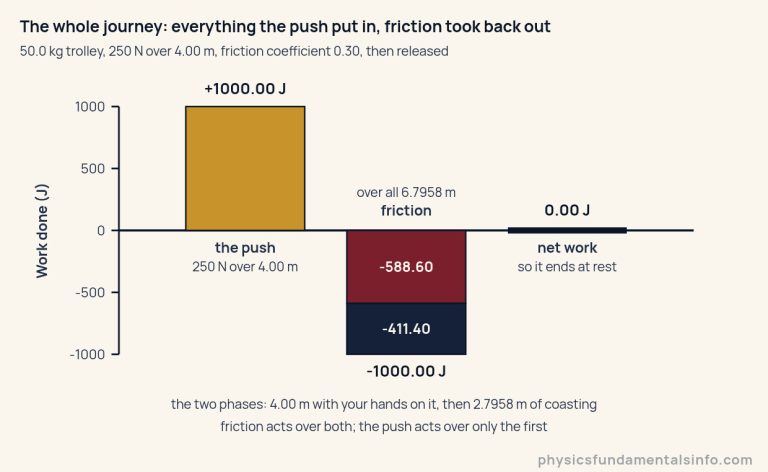
Shove a supermarket trolley across a car park and let go. It rolls on, slows, stops — and you can work out exactly where it stops without knowing how long any of it took, and without ever writing down an acceleration.
That is what this one equation buys you. Count the energy that went in, subtract the energy that friction took back out, and the speed drops out of the arithmetic. It is also why a car braking from 60 m/s needs four times the road it needs from 30 m/s, and not twice.
What Is the Work Energy Theorem?
The work-energy theorem says that the total work done on a body by all the forces acting on it equals the change in its kinetic energy. Energy in, speed up. Energy out, slow down.
One word in that sentence does most of the damage when it is skipped: net. Every force acting gets its own term, with its own sign, and it is their sum that the change in kinetic energy matches — not the work done by the force you happen to be thinking about.
The mechanism is worth a moment. Work done is energy transferred by a force pushing something through a distance, and kinetic energy is the store that energy lands in. Our guide to work done also carries the one-line derivation from a = F/m and v2 = u2 + 2ad, which is where it belongs; this page takes the finished result and puts it to work.
Where the theorem earns its keep is the middle of a problem. You are handed a force and a distance, you are asked for a speed, and nobody has told you how long anything took — that is exactly the gap it fills.
One convention runs through every number below. Take g = 9.81 m/s2, the standard value rounded to three figures and the figure the simulator on this page uses. Real local gravity runs from roughly 9.78 to 9.83 m/s2, so three significant figures is the ceiling on any answer here.
The Work Energy Theorem Formula
Written out in full, the theorem equates one sum of work terms to one difference of kinetic energies.
When the net force is constant and points along the direction of travel, the left-hand side has a shape you can evaluate in one multiplication.
| Symbol | What it is | SI unit | Worth knowing |
|---|---|---|---|
| Wnet | total work done by every force acting | J | negative when the body is being slowed; the unit is the joule, and the seven SI base units define the twenty-two derived units with special names |
| Fnet | vector sum of the forces, resolved along the motion | N | add the forces before you multiply; anything acting sideways contributes nothing |
| d | distance over which that net force acts | m | the length of the skid or the depth of the dent, not the whole journey |
| m | mass of the body | kg | cancels when the forces themselves scale with the mass, and not otherwise |
| v1, v2 | speed at the start and at the end | m/s | speeds, not velocities; the equation is blind to direction |
Rearranged, that single relation answers five different questions, and grinding through the algebra by hand every time is thankless. The work-energy theorem calculator solves it for whichever of the five you nominate — either speed, the net force, the distance or the mass — and prints the kinetic energy at both ends beside the answer.
The simulator below is the same equation with a block, a floor and something to rub against. Five sliders set the mass, your push, the friction coefficient, how far you push and how fast the block was already going; the readouts split the work into the push’s share and friction’s share and show the change in kinetic energy they add up to. It also runs as a standalone work energy theorem simulator.
One habit of that lab is worth knowing before it trips you up. It prints joules and newtons to one decimal place and speeds to two, so the numbers you see are rounded versions of quantities that are exact underneath — the opening state has a net work of 122.28 J and shows 122.3 J, and a final speed of 5.529014 m/s shown as 5.53 m/s.
The rounding has a consequence that looks like a bug and is not. Because each readout is rounded on its own, the two work boxes do not always add up on screen: a 30 N push over 20.0 m on a 1.0 kg block shows 600.0 J and -49.1 J against a net of 551.0 J, and 600.0 minus 49.1 is 550.9.
The same applies to the kinetic-energy pair. Subtracting the two printed energies is not a reliable check on the net work — one state shows 2.3 J going to 2.1 J beside a net of -0.1 J. The quantities balance perfectly; it is the printed strings that need not.
Not every ratio is spoiled, though, so do not over-learn the lesson. Doubling the push distance doubles the net work exactly, and on screen 1.0 m to 2.0 m really does run 20.4 J to 40.8 J. Try 3.0 m to 6.0 m and it reads 61.1 J then 122.3 J, where doubling the printed figure would have given 122.2 J.
Four Steps That Turn Forces into a Speed
Almost every mistake on this topic is made before the arithmetic starts, in the step where the forces are collected. Work through these four in order and the sums look after themselves.
- List every force acting along the motion. The push or the drive, friction, drag, the component of the weight on a slope. Forces perpendicular to the motion — the normal force on a level floor, the tension in a pendulum string — do no work at all, so they do not appear.
- Work out each force’s own work, with its sign. A force pushing the body along does positive work, force times distance. A force opposing the motion does negative work, the same product with a minus sign in front.
- Add them. The sum is the net work. If it comes out negative, the body is slowing; if it comes out zero, the speed at the end matches the speed at the start, however violent the journey between them was.
- Set that total equal to the change in kinetic energy. Wnet = ½mv22 – ½mv12, then rearrange for whatever you were asked for.
Watch what that looks like along a single push. An 8.00 kg crate shoved with 40.0 N across a floor with a friction coefficient of 0.25 collects energy from the push at a steady 40.0 J per metre and loses it to friction at 19.62 J per metre, and the gap between those two lines is the kinetic energy it actually has.
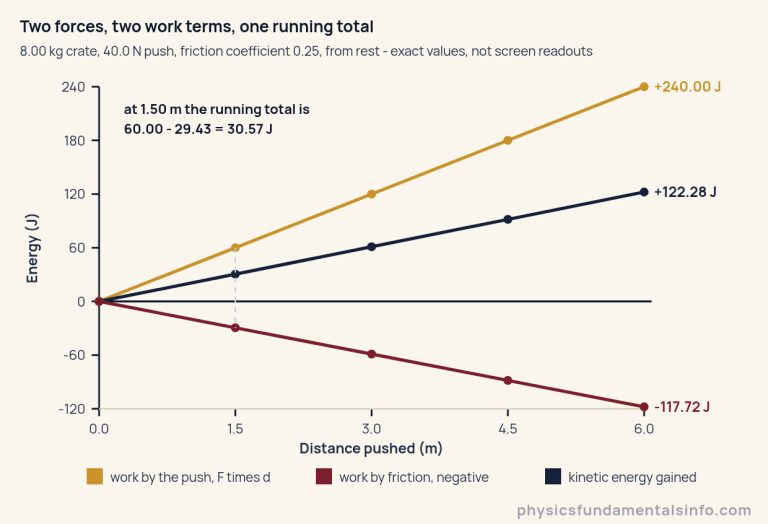
Read the far right of that figure and you have problem 1 below already solved: 240.00 J in, 117.72 J out, 122.28 J left as motion. The call-out makes the same point a quarter of the way along, where 60.00 minus 29.43 leaves 30.57 J.
When to Use It Instead of SUVAT
Reach for the theorem when you have a force and a distance but no time, and reach for kinematics when the clock is part of the question. Neither is more accurate than the other.
That is worth stating plainly, because students often suspect the energy route of being a shortcut that costs something. It is not. On a straight path under a constant net force the theorem and the SUVAT equations are the same algebra wearing different clothes, one multiplication by ½m apart, and across a grid of test cases the two answers differ only in the fifteenth decimal place.
The difference is scope. SUVAT needs one steady acceleration to exist; the theorem does not care whether the force held still, provided you can find the total work it did.
- Use the theorem when the question gives you a force and a distance and asks for a speed, or gives you speeds and asks how far or how hard.
- Use the theorem when the force varies along the way, because the work is still the area under its force-distance graph even though no single acceleration exists.
- Use kinematics the moment a time, a direction or a position part-way through is wanted. Energy has none of those.
- Use an energy balance with heights when the problem is a drop or a climb rather than a push; the conservation of energy calculator carries the mgh terms this equation has no room for.
Why Stopping Distance Goes as the Square of the Speed
Kinetic energy carries the speed squared and the braking force does not, so doubling the speed leaves four times as much energy for the same force to remove over four times the distance.
Set the final speed to zero and rearrange: d = ½mv12 divided by the braking force. Every doubling of v1 quadruples the numerator while the denominator sits still. Here is a 1200 kg car under a constant 5000 N, worked out at six speeds.
| Speed before braking | Kinetic energy to remove | Braking distance at 5000 N |
|---|---|---|
| 10 m/s | 60 000 J | 12 m |
| 20 m/s | 240 000 J | 48 m |
| 30 m/s | 540 000 J | 108 m |
| 40 m/s | 960 000 J | 192 m |
| 50 m/s | 1 500 000 J | 300 m |
| 60 m/s | 2 160 000 J | 432 m |
Every doubling in that column is an exact quadrupling: 12 to 48, 48 to 192, 108 to 432. Not four to a good approximation, not four as a rule of thumb — exactly four times, because the only thing that moved between the two rows was a squared term.
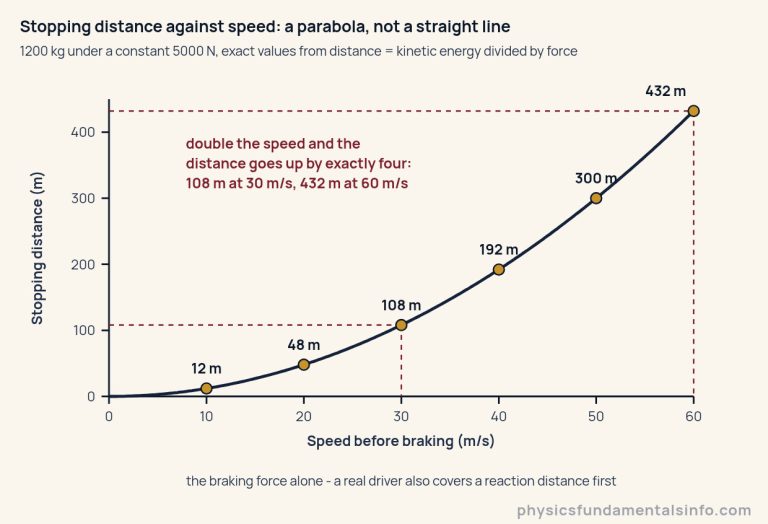
Two things ordinary speech runs together here, and they should not be. The 108 m is the distance the brakes need once they are gripping; a driver’s real stopping distance also includes everything covered while the news is still travelling from eye to foot, and this theorem says nothing at all about that reaction distance.
Nor is 108 m a figure any particular car on any particular road would deliver. It is what a 1200 kg body under a steady 5000 N does, and real braking is neither perfectly steady nor delivered by a single number.
Does the mass matter? Both answers are right
It depends entirely on what is setting the braking force, and the two ordinary cases answer in opposite directions. Take them one at a time.
At a fixed force, the mass matters exactly. Hold the braking force at 5000 N and let the mass change: from 30.0 m/s a 1000 kg car needs 90 m and a 2000 kg one needs 180 m. Twice the mass, twice the energy, twice the distance.
When grip is the limit, it cancels completely. Braking on a road is usually limited by friction, and that friction force is itself proportional to the mass, so the mass divides out of both sides. Taking a coefficient of 0.70, every vehicle braking from 30.0 m/s needs the same 65.5 m, whatever it weighs.
So “heavier vehicles always take longer to stop” is true of a winch with a fixed pull and false of the ordinary road case, and the opposite slogan fails in the opposite situation. The question to settle first is always what sets the force.
What the Work Energy Theorem Cannot Tell You
The theorem returns a speed, an energy, a force or a distance, and nothing else. Four of its blind spots cause most of the trouble.
It never gives you a time. There is no t in the equation and none can be recovered from it. The simulator does animate the push, but that replay is built from separate kinematics and it stretches or compresses the clock to fit a watchable few seconds — it is not a measurement of how long anything took.
It never gives you a direction. Both speeds enter squared, so the equation cannot tell a body travelling north from one travelling south, and it has nothing to say about where the body was part-way through.
Only the energy of moving along counts. A rolling ball, a spinning flywheel and a crumpling wing all hold energy that ½mv2 cannot see. The model behind this page is a rigid body that slides without turning, which is why the simulator’s block cannot tip or spin.
The work it needs is the total, not a convenient part of it. If the force changes as it acts, the product of a force and a distance is the wrong quantity and you need the area under the curve instead — problem 5 shows how badly that goes if it is ignored.
The lab itself is a model at its own scale, and worth reading as one. Its push is horizontal, so the normal force is exactly mg and the friction force exactly μmg; angle the push and every number changes. It also uses one friction coefficient for both sticking and sliding, so it does not reproduce the extra shove a stationary object often needs to get going.
Where You Meet the Work Energy Theorem
The pattern to look for is a known force acting over a measurable distance, with a speed at one end of it.
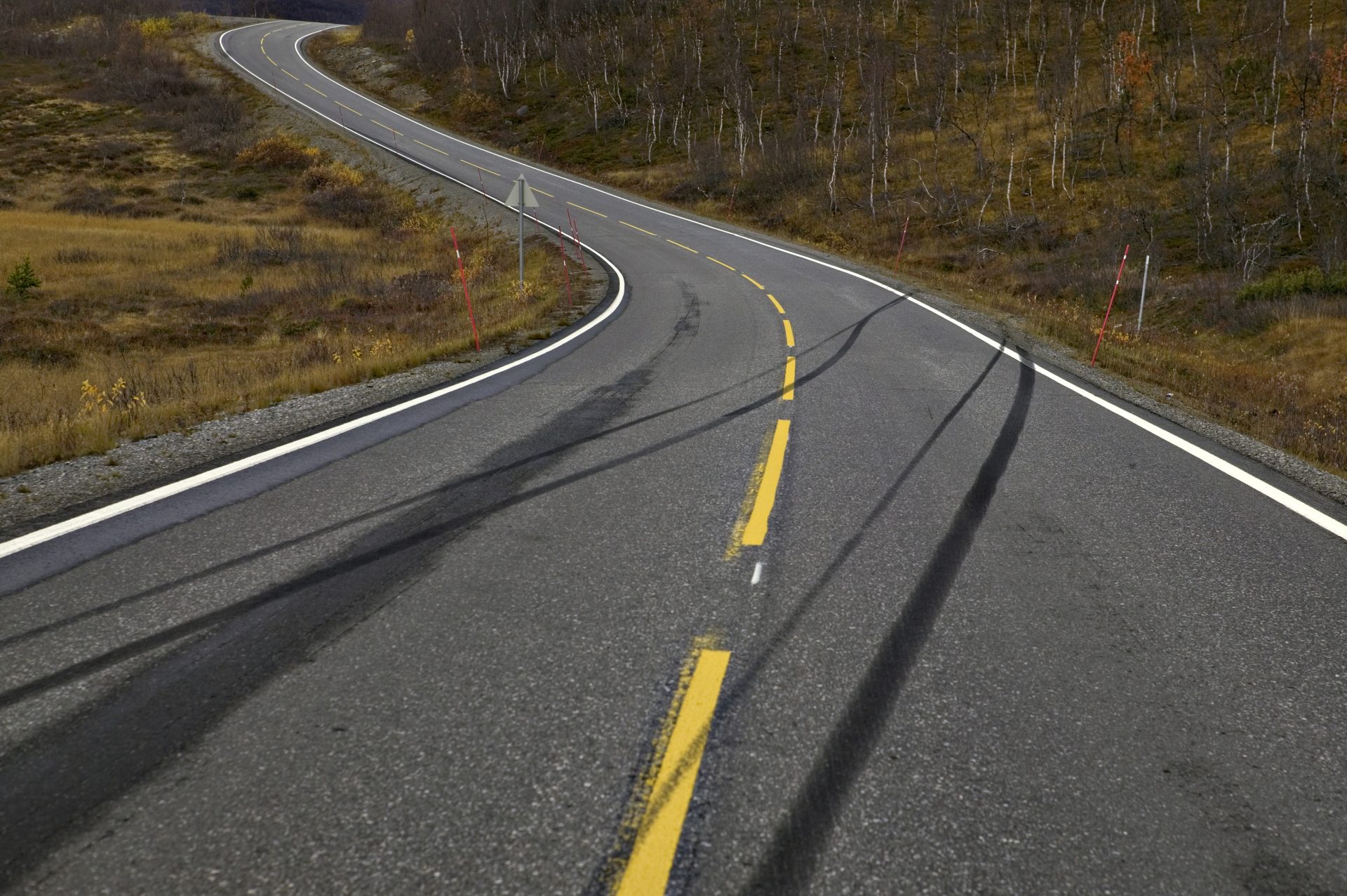
- Reading a skid backwards. The mark on the road is a measured distance and the friction force can be estimated, so the equation runs in reverse to give the speed that produced it. Any coefficient used in such an estimate is a figure chosen for the calculation, never a measured property of one tyre on one road.
- Anything that hits. A hammer head, a punch, a piling rig: the energy arriving is modest, the distance it is stopped in is tiny, and the force is whatever the division demands. Problem 6 puts a number on how violent that gets.
- Crumple zones. The energy is fixed by the mass and the speed before impact, so the only variable a designer controls is how far the structure folds. Longer fold, smaller force — the same division read as a design brief.
- Gravel arrester beds. A runaway lorry buries its wheels in loose stone, which supplies a large backwards force over a short distance and empties the kinetic-energy store without a collision.
- A bow, a catapult, a spring launcher. Here the force fades as the string returns, so the work is the area under the force-distance curve rather than a single product — which is precisely the case problem 5 works through.
- The trolley-and-track practical. Pull a trolley with a known force over a measured distance, time it through a gate, and compare the measured speed with the one this equation predicts. The shortfall is the energy the axles and the track quietly took.
Notice what those six have in common. Not one of them needs a stopwatch, and not one of them needs the force to have been acting for a known length of time.
Common Misconceptions About the Work Energy Theorem
Four beliefs do most of the damage, and the first is far and away the most expensive.
“W = ΔKE means the work I did”
It means the work everything did. Push a crate 6.00 m with 40.0 N and you have done 240.00 J of work on it, but if friction removed 117.72 J over the same distance, the crate’s kinetic energy rose by 122.28 J and not by 240.00 J. Put a single force’s work on the left-hand side and the answer comes out too fast, every time.
“Negative work is just bookkeeping”
Negative work is as physical as positive work — it is energy leaving the body. Friction, drag and brakes all transfer energy out into heat and sound, and the minus sign is what stops you adding that energy to the motion instead of subtracting it.
“The theorem can tell you how long the stop took”
It cannot, and this trips up exam candidates who have just got the right distance. Energy connects forces to distances and speeds; time enters only through a kinematic equation or an average speed, worked out separately afterwards.
“It applies to anything that moves”
It applies cleanly to a rigid body sliding along. Let the body roll, spin or deform and part of the work goes into stores that ½mv2 does not count, so the predicted speed comes out too high for a rolling ball and the absorbed force too low for a panel that folds. Know which model you are in before you trust the number.
Worked Problems
Show Solution
Show Solution
Show Solution
Show Solution
Show Solution
Show Solution
Show Solution
Show Solution