Gravitational potential energy: lifting a mass against gravity stores energy equal to its weight times the height raised — PE = mgh. This free calculator solves for the potential energy, the mass or the height, on Earth, the Moon, Mars or Jupiter, in any unit, and shows every step of the working.
What Is the Gravitational Potential Energy Calculator?
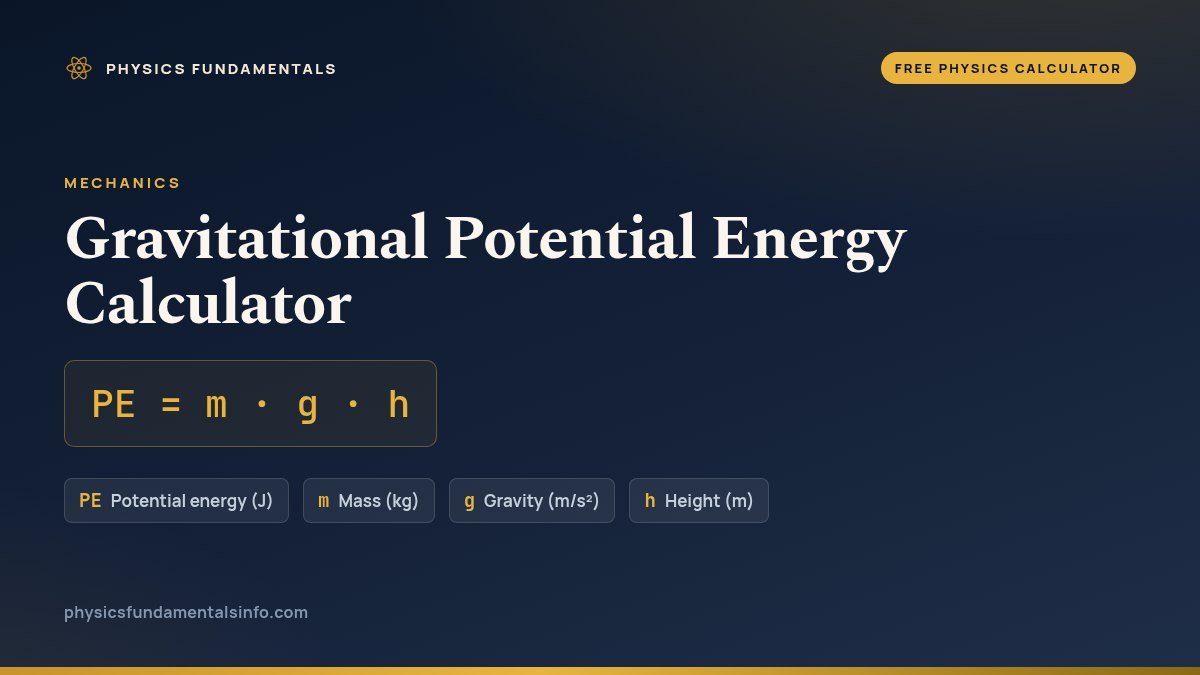
The gravitational potential energy calculator is a free online tool built on the formula PE = m · g · h. Enter the values you already know, in whichever units suit you, and it solves for potential energy, mass, height, gravity and shows every step of the substitution. Gravitational Potential Energy is stored energy of a raised mass, on any world.
| Symbol | Quantity | Default unit | Also accepts | Example value |
|---|---|---|---|---|
| PE | Potential energy | J | kJ | 490.5 |
| m | Mass | kg | g, tonne | 5 |
| g | Gravity | m/s² | — | — |
| h | Height | m | cm, km, ft | 10 |
How to calculate gravitational potential energy
Gravitational potential energy is the energy a mass gains simply by being raised against gravity — energy that is stored in its position and released the moment it falls. Near a planet's surface the formula is wonderfully simple: multiply the mass m, the local gravitational field strength g and the height h above a chosen reference level — PE = m·g·h. With kilograms, m/s² and metres, the answer is in joules. The constant g is just the local approximation of the gravitational force between two masses (F = Gm1m2/r²), which barely changes over the small heights this formula covers.
There are three steps. First, decide what you want — the potential energy, or instead the mass or the height — and pick it in the calculator's Solve for menu. Second, enter the values you know: mass in kilograms, grams or tonnes, height in metres, centimetres, kilometres or feet, and the gravity preset for the world you are on. Third, read the answer with the worked steps, which show the formula, your numbers substituted in, and the result in joules (switchable to kilojoules).
One idea is worth feeling directly: PE is proportional to all three of mass, gravity and height, so doubling any one of them doubles the stored energy. Because energy depends on g, the same mass raised the same height stores far more PE on Jupiter (g ≈ 24.8 m/s²) than on the Moon (g ≈ 1.62 m/s²) — about fifteen times as much. And the height h is always measured from a reference level you choose, usually the ground; only differences in PE are physical, so shifting the zero point changes nothing that matters.
Potential energy rarely sits still. As an object falls, gravity does work and the stored PE converts into kinetic energy; ignoring air resistance, mgh becomes ½mv² and the object lands at v = sqrt(2gh). Lifting the mass in the first place takes work equal to the PE gained, and for heights large compared with a planet's radius — satellites, deep space, escaping a body's gravity — the constant-g formula gives way to the full potential U = −GMm/r. For a quick definition of any term, see the physics glossary.
Worked example
A mass m = 5 kg is lifted h = 10 m on Earth, where g = 9.81 m/s². The stored energy is PE = m·g·h = 5 × 9.81 × 10 = 490.5 J. If it now falls freely, that 490.5 J converts almost entirely to kinetic energy, so it strikes the ground at about v = sqrt(2gh) = sqrt(2 × 9.81 × 10) ≈ 14 m/s. Raise the same mass to 20 m and the PE doubles to 981 J; lift it 10 m on the Moon instead and it drops to just 5 × 1.62 × 10 = 81 J — a direct illustration of the proportional relationship in PE = mgh.
Why it matters
Gravitational potential energy underpins hydroelectric dams and pumped-storage power plants, the drops and climbs of roller coasters, cranes and lifts, pile drivers, and the design of anything that stores energy by raising a mass. Anywhere height is converted into energy — or energy spent to gain height — PE = mgh is the starting point.
Frequently asked questions
What is the formula for gravitational potential energy?
Near a planet's surface, gravitational potential energy is PE = mgh: the product of the mass m, the local gravitational field strength g and the height h above a chosen reference level. With mass in kilograms, g in m/s² and height in metres, the result is in joules. The formula assumes g is constant, which holds for the modest heights this calculator covers.
What units does the gravitational potential energy calculator use?
Mass m can be entered in kilograms, grams or tonnes, and height h in metres, centimetres, kilometres or feet — all converted to SI internally. Gravity g is chosen from a preset (Earth 9.81, the Moon 1.62, Mars 3.72 or Jupiter 24.79 m/s²). The potential energy is returned in joules, and you can switch it to kilojoules.
Why does potential energy depend on a reference level?
Only changes in gravitational potential energy have physical meaning, so the zero point is yours to choose — usually the ground, a table top or the lowest point of the motion. The h in PE = mgh is always measured from that reference. Choosing a different zero shifts every PE value by a constant but leaves the differences, which is what drives the physics, unchanged.
How does potential energy turn into kinetic energy?
As an object falls, gravity does work on it and its stored PE converts into kinetic energy. Ignoring air resistance, all of the PE becomes KE at the lowest point, so mgh = ½mv². That is why a mass lifted to height h arrives at the ground with speed v = sqrt(2gh), independent of its mass.
Does this formula work far from a planet's surface?
No. PE = mgh treats g as constant, which is accurate only over heights small compared with the planet's radius. For satellites, deep space or large altitude changes, gravity weakens with distance and you need the full gravitational potential U = −GMm/r, the same physics behind escape velocity.
References & formula source
- Young & Freedman — University Physics with Modern Physics, §7.1 (Gravitational Potential Energy).
- Halliday, Resnick & Walker — Fundamentals of Physics, Chapter 8 (Potential Energy and Conservation of Energy).
- Serway & Jewett — Physics for Scientists and Engineers, Chapter 7 (Energy of a System).
- Further reading: Gravitational energy — Wikipedia