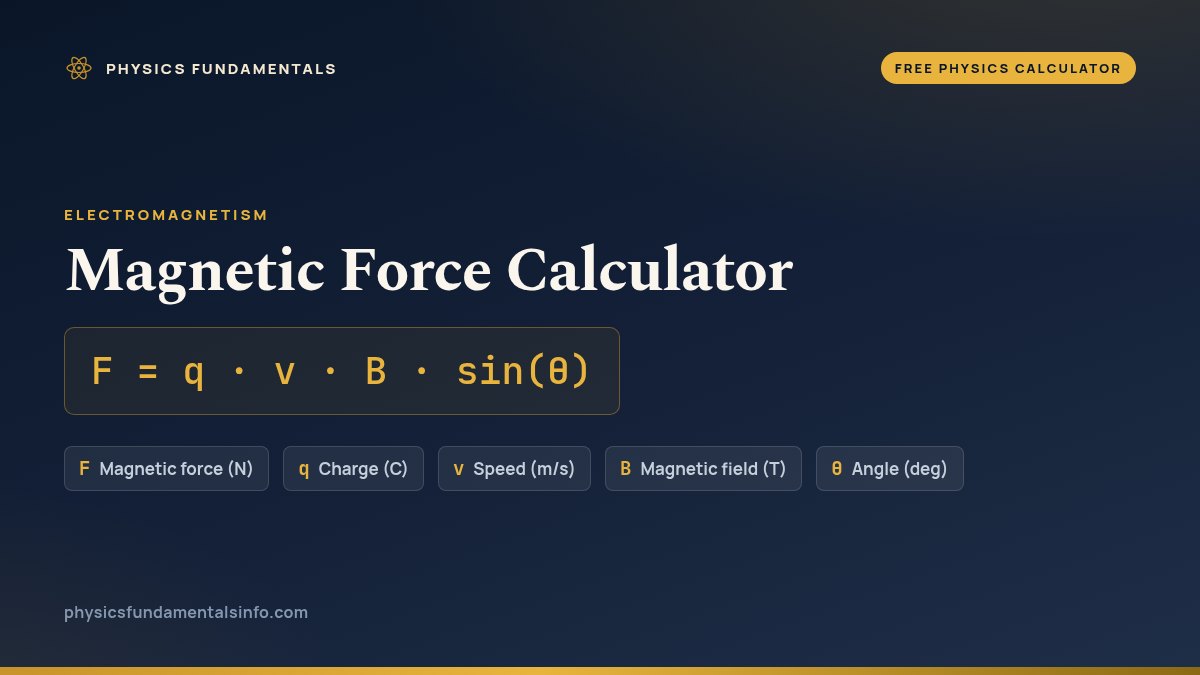
Magnetic force: the magnetic force (F) on a charge q moving at speed v through a magnetic field B is F = qvB·sinθ, where θ is the angle between the velocity and the field. This free calculator solves for force, charge, speed or field strength — in any unit — and shows every step of the working.
What Is the Magnetic Force Calculator?
The magnetic force calculator is a free online tool built on the formula F = q · v · B · sin(θ). Enter the values you already know, in whichever units suit you, and it solves for force, charge, speed or field and shows every step of the substitution. Lorentz force on a moving charge in a magnetic field.
| Symbol | Quantity | Default unit | Also accepts | Example value |
|---|---|---|---|---|
| F | Magnetic force | N | mN, µN | — |
| q | Charge | C | µC, nC | 1 |
| v | Speed | m/s | km/s | 100000 |
| B | Magnetic field | T | mT, G | 0.5 |
| θ | Angle | deg | — | 90 |
How to calculate magnetic force
A charged particle moving through a magnetic field feels a sideways push called the magnetic force. Its size is the product of four things: the charge q, the particle’s speed v, the magnetic flux density B, and the sine of the angle θ between the velocity and the field. Put together, that is F = q·v·B·sinθ. This is the magnetic part of the full Lorentz force on a charge.
There are three steps. First, decide which quantity you want — force, charge, speed or field — and select it in the calculator’s Solve for menu. Second, enter the values you already know, including the angle, and pick their units; the calculator converts everything to SI base units (coulombs, metres per second and tesla) behind the scenes, so a field given in gauss or a charge in nanocoulombs is handled automatically. Third, read the answer alongside the worked steps, which show the formula, your numbers substituted in, the value of sinθ, and the final result with its units.
The equation rearranges in the obvious way. If you know the force, the charge is q = F / (v·B·sinθ); the speed is v = F / (q·B·sinθ); and the field is B = F / (q·v·sinθ). One rule matters most: the angle controls everything through sinθ. At θ = 90° the force is greatest, and at θ = 0° — a charge gliding straight along the field lines — the force vanishes, so the calculator treats sinθ = 0 as having no defined solution when you rearrange for q, v or B.
The force only sets the magnitude; its direction is perpendicular to both v and B, given by the right-hand rule for v × B. Because the push is always at right angles to the motion, it bends the path without ever changing the speed. For the electric force between stationary charges instead, see the Coulomb’s law calculator, or look up the underlying terms in the physics glossary.
Worked example
A proton carrying a charge of q = 1.6 × 10-¹9 C moves at v = 2 × 10⁶ m/s through a B = 0.5 T field, crossing the field lines at θ = 30°. Then sinθ = 0.5, so F = q·v·B·sinθ = (1.6 × 10-¹9)(2 × 10⁶)(0.5)(0.5) = 8.0 × 10-¹4 N. If instead the proton crossed at right angles (θ = 90°, sinθ = 1), the force would double to 1.6 × 10-¹³ N — the maximum possible for that speed and field.
Why magnetic force matters
The magnetic force on moving charges steers electron beams in old CRT displays, separates ions by mass in mass spectrometers, confines fusion plasmas in tokamaks, accelerates particles in cyclotrons, and produces the thrust in electric motors — anywhere charges move through a field, this single equation sets the scale of the push.
Frequently asked questions
What is the formula for the magnetic force on a moving charge?
The magnetic force is F = qvB·sinθ, where q is the charge, v is its speed, B is the magnetic flux density, and θ is the angle between the velocity and the field. This is the magnetic part of the Lorentz force. It rearranges to q = F/(vB·sinθ), v = F/(qB·sinθ) and B = F/(qv·sinθ).
Why does the angle θ matter so much?
Only the component of velocity perpendicular to the field produces a force, so the force scales with sinθ. When the charge moves at right angles to the field (θ = 90°, sinθ = 1) the force is maximum; when it moves parallel to the field (θ = 0° or 180°, sinθ = 0) the force is zero. That is why a charge travelling straight along a magnetic field line feels no magnetic push.
What are the units of magnetic force, field and charge?
Force is in newtons (N), charge in coulombs (C), speed in metres per second (m/s) and magnetic flux density in tesla (T). One tesla is a large field; lab and everyday fields are often quoted in millitesla (mT) or gauss (G), where 1 T = 10,000 G. This calculator converts µC, nC, km/s, mT and G to SI for you.
In which direction does the magnetic force point?
The magnitude is qvB·sinθ, but the direction is given by the right-hand rule: point your fingers along the velocity v, curl them toward B, and your thumb gives the direction of v × B for a positive charge (reverse it for a negative charge). The force is always perpendicular to both v and B, which is why it changes a charge’s direction without changing its speed.
Does the magnetic force do work on the charge?
No. Because the force is always perpendicular to the velocity, it does zero work and cannot change the particle’s kinetic energy or speed — it only bends the path. A charged particle entering a uniform field at right angles therefore moves in a circle of radius r = mv/(qB), the principle behind cyclotrons and mass spectrometers.
References & formula source
- Halliday, Resnick & Walker — Fundamentals of Physics, Chapter 28 (Magnetic Fields).
- Young & Freedman — University Physics with Modern Physics, §27.2 (Magnetic Force on a Moving Charge).
- NIST — Reference on Constants, Units and Uncertainty: the tesla and the coulomb.
- BIPM — The International System of Units (SI): the tesla as the unit of magnetic flux density.
- Further reading: Lorentz force — Wikipedia