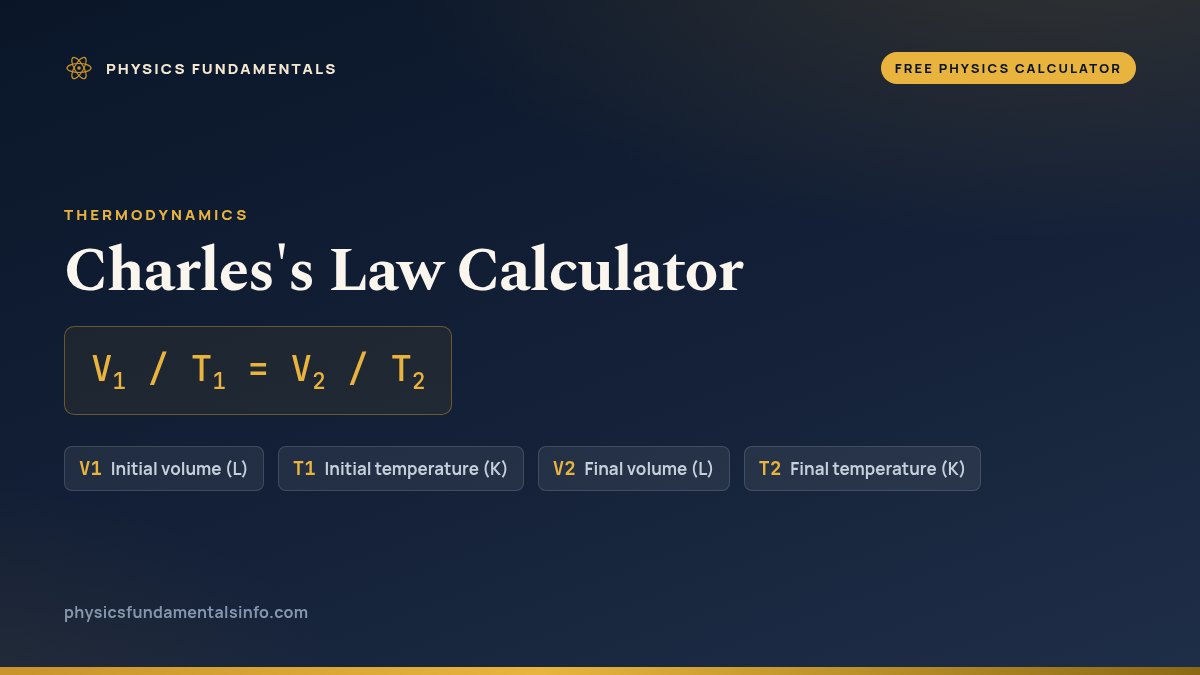
Charles's law: at constant pressure the volume of a fixed mass of gas is proportional to its absolute temperature, so the ratio V / T stays constant — V1/T1 = V2/T2. This free calculator solves for either volume or either temperature, in litres and kelvin (or °C/°F), and shows every step of the working plus the constant k = V/T.
What Is the Charles's Law Calculator?
The Charles's law calculator is a free online tool built on the formula V1 / T1 = V2 / T2. Enter the values you already know, in whichever units suit you, and it solves for volume or temperature at constant pressure and shows every step of the substitution. Charles's Law is volume-temperature ratio of a gas at constant pressure.
| Symbol | Quantity | Default unit | Also accepts | Example value |
|---|---|---|---|---|
| V1 | Initial volume | L | mL, m³ | 2.5 |
| T1 | Initial temperature | K | °C, °F | 300 |
| V2 | Final volume | L | mL, m³ | 3 |
| T2 | Final temperature | K | °C, °F | 360 |
How to calculate with Charles's law
Charles's law describes what happens to a gas when you heat or cool it while holding the pressure constant: its volume changes in direct proportion to its absolute temperature. Written as a ratio, V1/T1 = V2/T2, which rearranges to V2 = V1·T2/T1. The single most important rule is that T must be in kelvin — the ratio only holds when temperature is measured from absolute zero.
There are three steps. First, choose what you want in the Solve for menu: the final volume V2, the initial volume V1, or either temperature. Second, enter the values you know — volumes in litres, millilitres or cubic metres, and temperatures in kelvin, °C or °F. The calculator converts every temperature to kelvin (adding 273.15 to a Celsius value) before it does any arithmetic. Third, read the answer with its worked steps, plus the constant k = V/T, which comes out identical for both states.
The relationship is a straight line through the origin on a volume-versus-temperature graph: double the kelvin temperature and the volume doubles; halve it and the volume halves. Because the line passes through the origin, small Celsius changes are deceptively small in kelvin — a jump from 20 °C to 40 °C is only 293 K to 313 K, a rise of about 6.8%, not 100%. To see the same idea in motion, open the Charles's law simulator, and for the full state equation that combines pressure too, use the ideal gas law calculator.
Worked example
A balloon holds 2.50 L of gas at 27 °C. It is warmed to 87 °C at the same pressure — what is its new volume? Convert first: 27 °C = 300.15 K and 87 °C = 360.15 K. Then V2 = V1·T2/T1 = 2.50 × 360.15 / 300.15 = 3.00 L. The constant checks out: k = V/T = 2.50/300.15 = 0.00833 L/K, the same as 3.00/360.15. Note that the Celsius temperature roughly tripled while the volume rose only 20% — proof that only the kelvin ratio matters.
Why it matters
Charles's law underlies hot-air balloons, which rise because warmed air expands and becomes less dense; the behaviour of car tyres and gas cylinders across seasons; the design of thermometers and thermostats; and the calibration of gas volumes in chemistry. It is one of the three simple gas laws — with Boyle's and Gay-Lussac's — that combine into the ideal gas law, and it is the cleanest demonstration that gas temperature must be measured from absolute zero.
Frequently asked questions
Do I have to use kelvin for Charles's law?
Yes. The ratio V/T is only constant when T is the absolute temperature in kelvin. If you use Celsius the ratio breaks, because 0 °C is not zero volume — it is 273.15 K. This calculator lets you type °C or °F for convenience, but it converts every temperature to kelvin first (K = °C + 273.15) before applying V1/T1 = V2/T2.
What is the most common mistake with Charles's law?
Forgetting to convert to kelvin. Warming a gas from 20 °C to 40 °C is not doubling the temperature — in kelvin it goes from 293 K to 313 K, a rise of only about 6.8%, so the volume rises about 6.8%, not 100%. Doubling the volume would need doubling the kelvin temperature, from 293 K to 586 K (about 313 °C).
What happens if I enter 0 K or a negative temperature?
The calculator rejects it. Absolute zero (0 K) and anything below it is unphysical for a real gas, and T = 0 K would divide by zero in the ratio. Volumes must likewise be greater than zero. Any impossible combination returns a prompt rather than a non-finite number.
How do I solve for T2 instead of V2?
Use the “Solve for” selector at the top of the calculator and choose T2. The engine rearranges Charles's law to T2 = T1 · V2 / V1 and asks for the other three values instead. You can solve for V1, V2, T1 or T2 the same way.
Does Charles's law work for real gases?
Closely, as long as the pressure stays low and the temperature stays well above the gas's boiling point, where a real gas behaves almost ideally. Near condensation, or at high pressure, real-gas deviations appear and the simple V ∝ T relationship becomes approximate.
References & formula source
- Halliday, Resnick & Walker — Fundamentals of Physics, chapter on the kinetic theory of gases.
- Young & Freedman — University Physics with Modern Physics, chapter on the thermal properties of matter.
- Atkins & de Paula — Physical Chemistry, chapter on the properties of gases.
- Further reading: Charles's law — Wikipedia