Gay-Lussac’s law: at constant volume, the pressure of a fixed mass of gas is directly proportional to its absolute temperature, P1/T1 = P2/T2. This free calculator solves for either pressure or either temperature, works in K, °C or °F, and shows every step.
What Is the Gay-Lussac's Law Calculator?
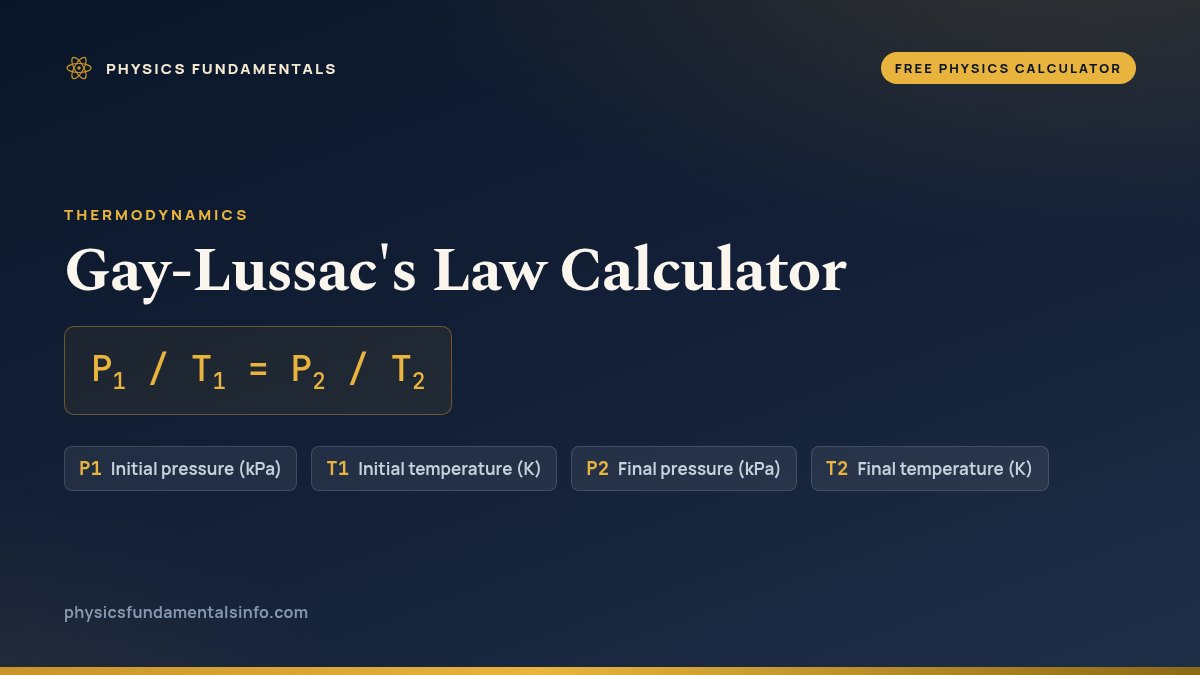
The Gay-Lussac's law calculator is a free online tool built on the formula P1 / T1 = P2 / T2. Enter the values you already know, in whichever units suit you, and it solves for pressure or temperature at constant volume and shows every step of the substitution. Gay-Lussac's Law is pressure-temperature ratio of a gas at constant volume.
| Symbol | Quantity | Default unit | Also accepts | Example value |
|---|---|---|---|---|
| P1 | Initial pressure | kPa | Pa, atm, bar, psi | 100 |
| T1 | Initial temperature | K | °C, °F | 300 |
| P2 | Final pressure | kPa | Pa, atm, bar, psi | — |
| T2 | Final temperature | K | °C, °F | 600 |
How to calculate with Gay-Lussac's law
Gay-Lussac’s law describes what happens to a gas sealed in a rigid container when you change its temperature. Because the volume can’t change, all the effect goes into the pressure: warm the gas and the pressure climbs, cool it and the pressure falls, always in exact proportion to the absolute temperature. In symbols, P1/T1 = P2/T2, where every T is in kelvin.
There are three steps. First, decide which quantity you want and select it in the Solve for menu. Second, enter the three values you know. You may type temperatures in kelvin, °C or °F and pressures in pascals, kilopascals, atmospheres, bar or psi — the calculator converts everything to SI base units and to absolute temperature before it applies the law. Third, read the answer with the rearranged formula and your numbers substituted in.
The single most important rule is that the temperature must be absolute. Kelvin has its zero at absolute zero, so a ratio of kelvin temperatures is physically meaningful; a ratio of Celsius temperatures is not. If you enter °C or °F this calculator adds the offset for you, but if you ever apply the law by hand, convert to kelvin first (K = °C + 273.15).
Gay-Lussac’s law is one of the three simple gas laws. Hold temperature fixed instead and you get Boyle’s law; hold pressure fixed and you get Charles’s law; combine all three and you arrive at the ideal gas law. For the term itself, see the physics glossary.
Worked example
A sealed rigid canister holds gas at 100 kPa and 300 K (about 27 °C). It is heated to 600 K. Because the volume is fixed, P2 = P1·T2/T1 = 100 kPa × 600/300 = 200 kPa. Doubling the absolute temperature doubles the pressure. Notice that had we (wrongly) used Celsius, 27 °C to 327 °C is a factor of 12, which would predict 1200 kPa — showing exactly why absolute temperature is essential.
Why it matters
Gay-Lussac’s law explains why aerosol cans warn against heating, why tyre pressures read higher after a fast drive, and why pressure cookers and sealed sterilisers behave as they do. It is also the reason engineers derate pressure vessels for temperature, and it underlies constant-volume gas thermometers, which read temperature directly from pressure.
Frequently asked questions
What is Gay-Lussac’s law?
Gay-Lussac’s law (the pressure-temperature law) states that at constant volume the pressure of a fixed amount of gas is directly proportional to its absolute temperature: P/T = constant, so P1/T1 = P2/T2. Heat a sealed rigid container and its pressure rises in exact proportion to the kelvin temperature.
Why must the temperature be in kelvin?
The proportionality P ∝ T only holds for absolute temperature, measured from absolute zero. Using kelvin (K = °C + 273.15) makes the ratio meaningful; plugging in Celsius or Fahrenheit gives a wrong answer because those scales have arbitrary zero points. This calculator accepts °C and °F but converts them to kelvin before applying the law.
How is Gay-Lussac’s law different from Boyle’s and Charles’s laws?
Each gas law holds one quantity constant. Boyle’s law fixes temperature and links pressure and volume (P1V1 = P2V2). Charles’s law fixes pressure and links volume and temperature (V1/T1 = V2/T2). Gay-Lussac’s law fixes volume and links pressure and temperature (P1/T1 = P2/T2). Combine all three and you get the ideal gas law.
What is a real-world example of Gay-Lussac’s law?
A sealed aerosol can or a car tyre. Because the volume is essentially fixed, heating the can — leaving it in the sun or near a fire — raises the internal pressure in proportion to the absolute temperature, which is why aerosol cans carry a warning not to heat them. Tyre pressure likewise reads higher after a long drive as the air warms.
Does Gay-Lussac’s law use gauge or absolute pressure?
It uses absolute pressure, measured from a vacuum. If you have a gauge reading (as on a tyre gauge), add atmospheric pressure — about 101.3 kPa or 14.7 psi — before applying the law, then subtract it again from the answer if you need a gauge value.
References & formula source
- Halliday, Resnick & Walker — Fundamentals of Physics, Chapter 19 (The Kinetic Theory of Gases).
- Young & Freedman — University Physics with Modern Physics, §18.1 (Equations of State).
- Atkins & de Paula — Physical Chemistry, Chapter 1 (The properties of gases and the gas laws).
- Further reading: Gay-Lussac's law — Wikipedia