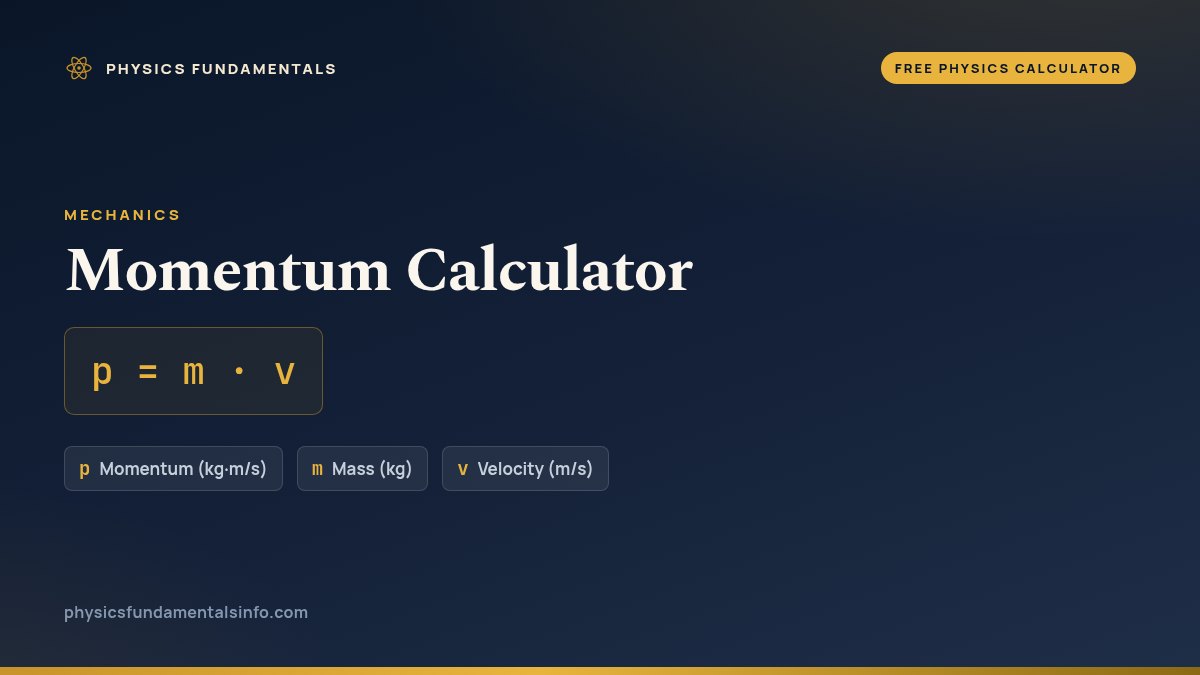
Linear momentum: the quantity of motion in a body, equal to its mass times its velocity — p = m·v. This free calculator solves for momentum, mass or velocity in any unit, shows every step of the working, and gives the force needed to bring the object to rest in a given time.
What Is the Momentum Calculator?
The momentum calculator is a free online tool built on the formula p = m · v. Enter the values you already know, in whichever units suit you, and it solves for momentum, impulse, collisions and shows every step of the substitution. Mass in motion, impulse and the change in momentum.
| Symbol | Quantity | Default unit | Also accepts | Example value |
|---|---|---|---|---|
| p | Momentum | kg·m/s | — | 20000 |
| m | Mass | kg | g, tonne | 1000 |
| v | Velocity | m/s | km/h, mph | 20 |
How to calculate momentum
Momentum is mass in motion — a measure of how much motion an object carries and how hard it is to stop. It is the product of just two things: the object's mass m and its velocity v, so p = m·v. The answer comes out in kilogram-metres per second (kg·m/s). Because velocity is a vector, momentum is too: it points in the same direction the object is moving, which matters as soon as you start adding momenta together.
There are three steps. First, decide what you want — momentum, or one of mass or velocity — and pick it in the calculator's Solve for menu. Second, enter the values you know: mass in kilograms, grams or tonnes, and velocity in metres per second, kilometres per hour or miles per hour. Third, read the answer with the worked steps, which show the formula, your numbers substituted in, and the result, along with the constant force needed to stop the object in 1 or 2 seconds.
One relationship is worth feeling directly. Momentum is proportional to both mass and velocity — double either and the momentum doubles. A 1000 kg car at 20 m/s and a 2000 kg van at 10 m/s carry exactly the same momentum, 20,000 kg·m/s, even though they have very different speeds. That is why a slow, heavy object can be every bit as hard to stop as a fast, light one.
Momentum rarely acts alone. The impulse delivered by a force — force multiplied by the time it acts — equals the change in momentum, J = F·Δt = Δp, which is why crumple zones and airbags (a longer Δt) lower the force in a crash. In a closed system total momentum is conserved, the principle behind both elastic and inelastic collisions. To work the force–time side directly, see the impulse calculator; for the energy of the same motion, see the kinetic energy calculator, or look up a term in the physics glossary.
Worked example
A 1000 kg car travels at 20 m/s. Its momentum is p = m·v = 1000 × 20 = 20,000 kg·m/s. To bring it to rest, the impulse must remove all of that momentum: stopping it in 2 s needs an average force of F = Δp/Δt = 20,000 / 2 = 10,000 N, while stopping it in just 1 s would need twice that, 20,000 N — a direct illustration of why a longer stopping time means a gentler force.
Why it matters
Momentum governs vehicle crash analysis and the safety engineering of airbags and crumple zones, rocket propulsion and gun recoil, the break in a game of billiards and the tackle in a contact sport, and the bookkeeping of particle physics, where conservation of momentum lets physicists reconstruct collisions they never directly see. Anywhere objects collide, push off one another or change their motion, momentum is the starting point.
Frequently asked questions
What is momentum in physics?
Momentum is mass in motion: the product of an object’s mass and its velocity, p = m·v. It is a vector, pointing in the same direction as the velocity, and its SI unit is the kilogram-metre per second (kg·m/s). The faster or heavier a body is, the more momentum it carries, and the harder it is to stop.
What units does the momentum calculator use?
Momentum is returned in kilogram-metres per second (kg·m/s). Mass can be entered in kilograms, grams or tonnes, and velocity in metres per second, kilometres per hour or miles per hour — the calculator converts everything to SI before computing, so you can mix units freely.
Is momentum conserved?
Yes. In any closed system with no external forces, the total momentum before an interaction equals the total momentum after it — the law of conservation of momentum. It holds in every collision and explosion, whether kinetic energy is conserved (elastic) or not (inelastic), which is what makes it so powerful for analysing crashes, recoil and rocket propulsion.
What is the difference between momentum and impulse?
Momentum p = m·v is the quantity of motion an object has at an instant. Impulse J = F·Δt is the effect of a force acting over a time interval, and it equals the change in momentum: J = Δp. So a small force applied for a long time produces the same change in momentum as a large force applied briefly — which is exactly why airbags and crumple zones (longer Δt) reduce the force in a crash.
How do you find the force needed to stop something?
Rearrange impulse: the average force is the change in momentum divided by the stopping time, F = Δp/Δt. To bring an object to rest, Δp equals its starting momentum p, so F = p/Δt. This calculator shows the constant force needed to stop the object in 1 second and in 2 seconds — halve the time and the force doubles.
References & formula source
- Young & Freedman — University Physics with Modern Physics, Chapter 8 (Momentum, Impulse, and Collisions).
- Halliday, Resnick & Walker — Fundamentals of Physics, Chapter 9 (Center of Mass and Linear Momentum).
- Serway & Jewett — Physics for Scientists and Engineers, Chapter 9 (Linear Momentum and Collisions).
- Further reading: Momentum — Wikipedia