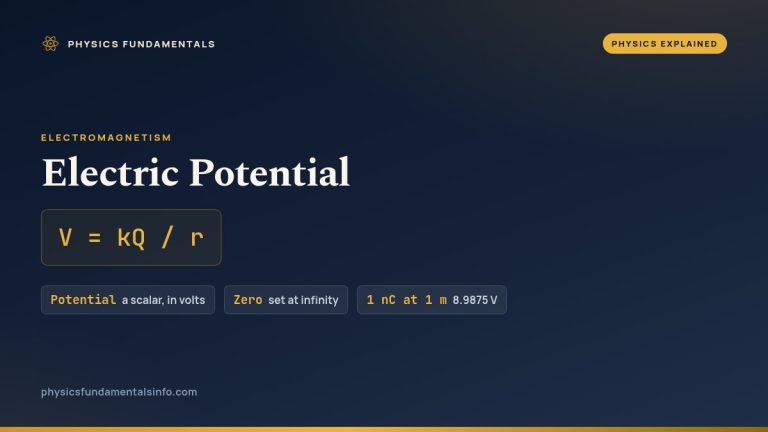
Electric Potential (V = kQ/r)
Electric potential is the energy per coulomb at a point in space, measured in volts against a zero set infinitely far away, and around a point charge it is…
Clear explanations grounded in real-world intuition, 141 interactive labs where you can manipulate the variables yourself, and worked practice problems on every topic. Built for curious minds and serious students.
Physics fundamentals are the core principles describing how matter, energy, space, and time behave. They include Newton's laws of motion, the laws of thermodynamics, electromagnetic theory, wave mechanics, and the foundations of quantum theory. These principles form the basis of all engineering, technology, and natural science — from why a bridge stays standing to how your phone connects to a satellite.
Adjust variables in real time. Watch the physics respond. 141 interactive labs covering mechanics, waves, electricity, optics and modern physics.
Every simulation on the site, grouped by topic. Pick one and it loads right here.
Change the initial velocity and acceleration and read the acceleration off the slope of a live velocity-time graph.
Set a temperature from 600 K down to 0 K, pick a gas, and watch the molecules slow and the gas volume shrink to zero.
Set any altitude to 20 km and a sea-level pressure and see a mercury barometer track the standard atmosphere.
Free interactive Boyle\
Change lens type, focal length and object distance and watch real and virtual images form.
Slide peak voltage and frequency to see the sine wave, the flat DC line and the RMS value that makes them equal.
Free interactive beta decay simulator: choose a real isotope, fire beta-minus, beta-plus or electron capture, and watch the true beta spectrum build up.
Free interactive angular velocity simulator: set the spin rate in rpm, slide the marker out from the axis, and watch rad/s, period and tangential speed respond.
Every core formula, solved in any direction, with full step-by-step working shown. No login, no ads — enter your numbers and learn the method.
Every topic is built from physical intuition before mathematics. Start anywhere — but if you're new to physics, start with mechanics.
Motion, forces, energy, momentum, and the laws that govern everything from baseballs to planets.
Heat, temperature, entropy, and energy transfer. The science of engines and the universe's arrow of time.
How sound travels, why light bends, and the universal mathematics behind every oscillation in nature.
Electric charge, magnetic fields, circuits, and the unified theory that powers every device you own.
Relativity, quantum mechanics, and the strange truths discovered when we looked closely enough at the universe.
Position, velocity, acceleration. The mathematical language for describing how things move through space and time.
Quick references, study aids, and downloads to help you go deeper. All free, all yours.
Every formula you need, organized by topic. Free download.
Key physics terms defined clearly, A–Z, with links to deeper reading.
30, 60, and 90-day curriculum roadmaps for self-learners.
1650+ problems with full step-by-step solutions.
141 live simulations. Manipulate variables, see physics.
160+ in-depth physics articles in the blog. Free, always.
127 free calculators. Every core formula, solved step by step.
Jump into mechanics, waves, thermodynamics, electromagnetism and more.
Long-form articles built for genuine understanding. Each piece ends with worked problems.
Electric potential is the energy per coulomb at a point in space, measured in volts against a zero set infinitely far away, and around a point charge it is…
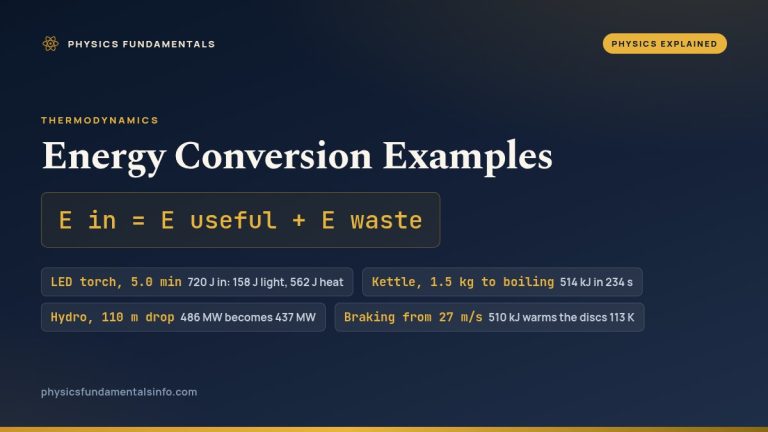
Energy conversion is the same joules changing form without changing total, and this guide traces fourteen of the commonest conversions from one end to the…
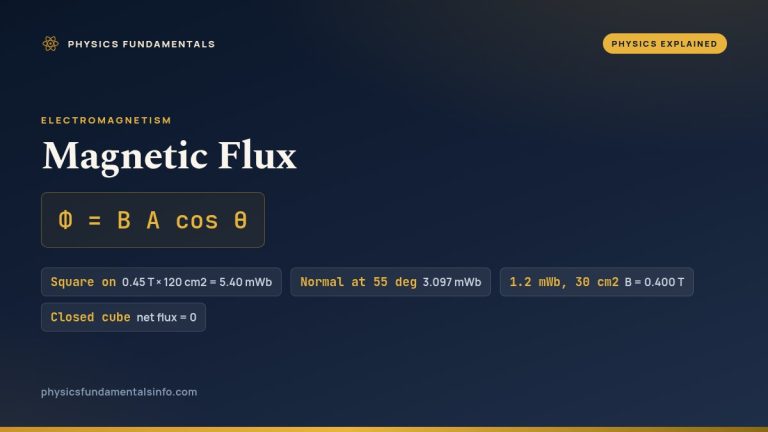
Magnetic flux is the total magnetic field passing through a surface, Phi = B A cos theta, measured in webers. This guide fixes the one thing that goes wron…
Every topic opens with the physical insight — what's actually happening, why it matters, where you encounter it. The math comes after you understand the idea.
You can't learn physics without solving problems. Every article ends with five to eight worked problems showing every step — not just the answers.
Manipulate variables. Watch what happens. Every major concept gets its own simulation you can play with — adjust the inputs and watch the physics respond in real time.
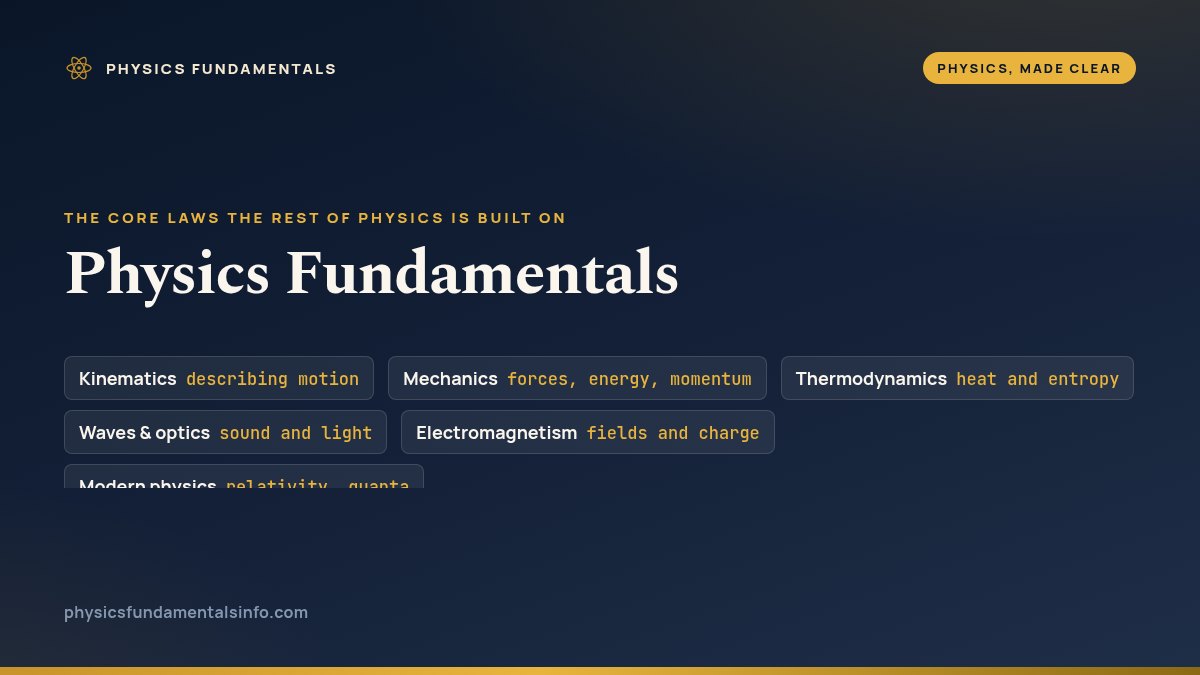
When people talk about physics fundamentals, they don't mean a long list of facts to memorize. They mean a surprisingly small set of laws from which almost everything else can be derived. Newton's three laws describe how forces change motion. The conservation laws — energy, momentum, and electric charge are never created or destroyed, only moved around — constrain what any system is allowed to do. A handful of field equations describe how electricity, magnetism, and light behave. Master these, and you are not memorizing physics; you are learning the rules the rest of the subject is built on.
This is what makes physics different from subjects where knowledge accumulates as a pile of separate facts. Here, understanding compounds. The same idea of energy you meet in a swinging pendulum reappears in a heated gas, in an electric circuit, and eventually in Einstein's E = mc². The same calculus that describes a falling apple describes a satellite's orbit. Once a fundamental clicks, it keeps paying you back across every topic that follows.
Mechanics comes first because everything leans on it. Kinematics describes motion — position, velocity, acceleration — while dynamics explains why motion changes, through forces, energy, and momentum. Thermodynamics then scales those same ideas up to enormous numbers of particles, where temperature, heat, and entropy emerge from the statistics of countless tiny collisions. Waves and optics take the oscillation you first met in a pendulum and let it travel: sound, light, and the interference patterns that reveal a wave's hidden structure.
Electromagnetism unifies electricity, magnetism, and light into a single framework of fields, and it is where most students first feel physics become genuinely powerful — the equations that run every motor, antenna, and microchip. Finally, modern physics — relativity and quantum mechanics — is where the classical picture breaks down at very high speeds and very small scales, and where the fundamentals are rebuilt on stranger but deeper foundations.
| Pillar | What it explains | Where to start |
|---|---|---|
| Kinematics | Describing motion: position, velocity and acceleration | Kinematics articles |
| Classical mechanics | Why motion changes: forces, energy and momentum | Mechanics articles |
| Thermodynamics | Heat, temperature and entropy in systems of many particles | Thermodynamics articles |
| Waves & optics | Oscillation that travels: sound, light and interference | Waves & optics articles |
| Electromagnetism | Fields uniting electricity, magnetism and light | Electromagnetism articles |
| Modern physics | Relativity and quantum mechanics, where the classical picture breaks down | Modern physics articles |
Sequence matters more in physics than in almost any other subject, because each topic quietly assumes you've understood the last. A reliable path looks like this:
At every stage the rule is the same: understand the physical picture first, then reach for the equation. Reading alone won't do it — you learn physics by solving problems, which is why every article we publish ends with worked examples. When you're ready, start with our complete guide to Newton's laws, or grab the free formula sheet and a structured study plan to follow alongside.