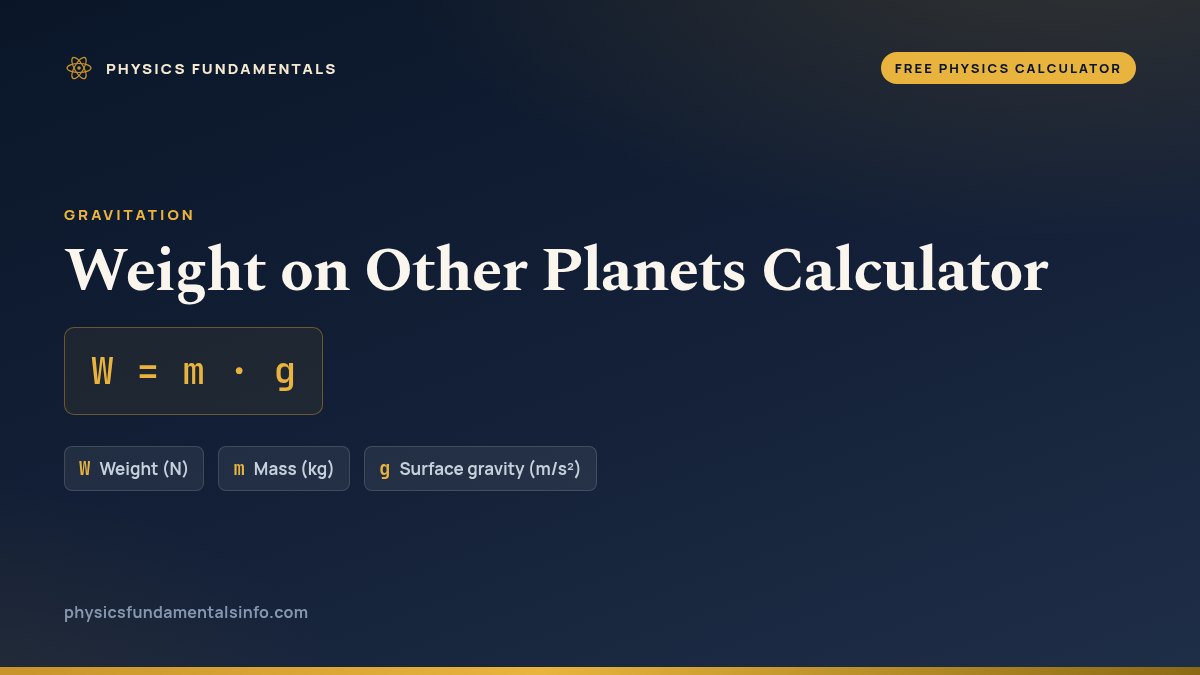
Weight on other planets: your weight (W) is your mass times the local surface gravity, W = m·g. Your mass stays the same everywhere, but gravity is different on every world — so this free calculator instantly shows what you would weigh on the Moon, Mars, Jupiter and every planet in the Solar System.
What Is the Weight on Other Planets Calculator?
The weight on other planets calculator is a free online tool built on the formula W = m · g. Enter the values you already know, in whichever units suit you, and it solves for weight or mass on any planet and shows every step of the substitution. Weight on Other Planets is how much you would weigh on the Moon, Mars and every planet.
| Symbol | Quantity | Default unit | Also accepts | Example value |
|---|---|---|---|---|
| W | Weight | N | kgf, lbf | — |
| m | Mass | kg | g, lb, stone | 70 |
| g | Surface gravity | m/s² | — | — |
How to calculate your weight on other planets
Weight is the gravitational pull on your body, and it depends on two things: how much mass you have and how strong gravity is where you are standing. The formula is simply W = m · g, where m is your mass in kilograms and g is the local surface gravity in metres per second squared. On Earth, g is about 9.81 m/s², so a 70 kg person weighs about 687 newtons.
The trick to comparing worlds is that your mass never changes — only g does. Every planet, moon and star has its own surface gravity, set by its mass and radius. The Moon pulls with just 1.62 m/s², about a sixth of Earth\'s, while Jupiter pulls with 24.79 m/s², about two and a half times stronger. Swap g into the formula and your weight rises or falls in exact proportion.
To use the calculator, first enter your mass in kilograms, pounds or stone. Then choose a world from the surface-gravity menu — it fills in the right g automatically — or type any gravity value you like. The headline result is your weight on that world, and the comparison cards show what you would weigh on the Moon, Mars, Jupiter and beyond. You can switch the answer between newtons, kilograms-force and pounds-force to match a bathroom scale. Behind the scenes the engine works in SI base units and rounds only the display, so the numbers stay accurate. If you would rather work backwards from a known weight, switch the Solve for menu to mass and the calculator rearranges to m = W / g.
Surface gravity is also what sets the speed you would need to leave a world for good — see the escape velocity calculator — and how much energy it takes to climb to a given height, covered by the gravitational potential energy calculator.
Worked example
Suppose your mass is 70 kg and you want your weight on Mars, where g = 3.72 m/s². Substitute into the formula: W = m · g = 70 · 3.72 = 260.4 N. On Earth the same person weighs 70 · 9.81 = 686.7 N, so on Mars they weigh only about 38% as much. On the Moon (g = 1.62 m/s²) the figure drops to just 70 · 1.62 = 113.4 N — light enough to bound across the surface like the Apollo astronauts.
Why it matters
Knowing weight across different worlds is essential for spacecraft and lander design, for sizing rocket thrust, and for understanding how astronauts move and how their bodies adapt to low gravity. It is also one of the clearest ways to grasp the difference between mass and weight — a distinction that trips up many students but becomes obvious the moment you see your own number change from planet to planet.
Frequently asked questions
How do you calculate your weight on another planet?
Multiply your mass by that world's surface gravity: W = m × g. On Earth g is about 9.81 m/s², so a 70 kg person weighs about 687 N. On Mars g is only 3.72 m/s², so the same person weighs about 260 N — roughly 38% of their Earth weight.
How much would I weigh on the Moon?
The Moon's surface gravity is about 1.62 m/s², which is roughly one sixth of Earth's. So you would weigh about 16.5% of your Earth weight there. A person who weighs 600 N (about 61 kgf) on Earth would weigh only about 99 N on the Moon.
Does my mass change on other planets?
No. Mass is the amount of matter in your body and stays the same anywhere in the universe. What changes is weight — the gravitational force pulling on that mass. That is why astronauts have the same mass on the Moon but weigh far less and can bounce around.
On which planet would I weigh the most?
Of the eight planets, Jupiter has the strongest surface gravity at about 24.79 m/s², so you would weigh roughly 2.5 times your Earth weight there. The Sun is far stronger still at about 274 m/s² — about 28 times Earth — though you could never actually stand on it.
What is the difference between weight in newtons and kilograms?
Weight is a force, measured in newtons (N). Bathroom scales show kilograms-force (kgf), where 1 kgf is the Earth weight of a 1 kg mass, about 9.81 N. This calculator can display your weight in newtons, kilograms-force or pounds-force so you can compare with everyday scales.
References & formula source
- Halliday, Resnick & Walker — Fundamentals of Physics, Chapter 13 (Gravitation).
- Young & Freedman — University Physics with Modern Physics, §13.1–13.3 (Newton's Law of Gravitation; Weight).
- NASA Planetary Fact Sheet — surface gravity of the planets, Moon, Pluto and Sun.
- BIPM — The International System of Units (SI): the newton and the kilogram.
- Further reading: Surface gravity — Wikipedia