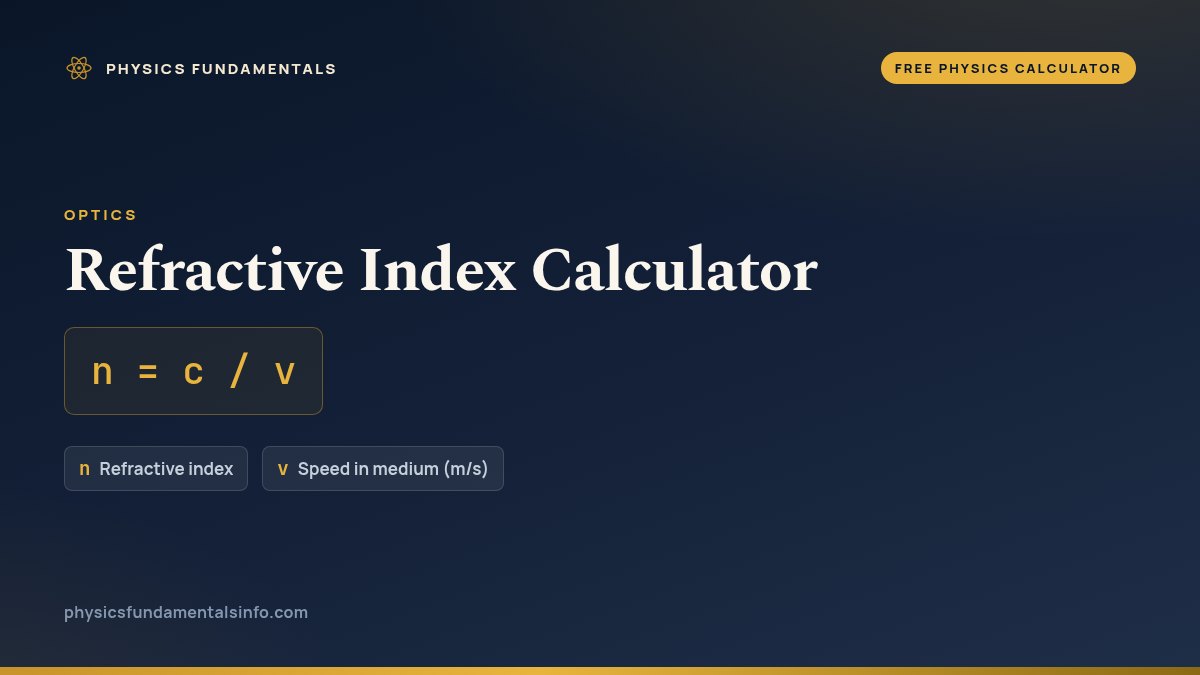
Refractive index: the refractive index (n) of a medium tells you how much it slows down light, defined by n = c/v — the vacuum speed of light divided by the speed of light inside the medium. This free calculator solves for the index or the speed in the medium, and shows every step of the working.
What Is the Refractive Index Calculator?
The refractive index calculator is a free online tool built on the formula n = c / v. Enter the values you already know, in whichever units suit you, and it solves for refractive index or speed and shows every step of the substitution. Refractive Index is index of refraction from the speed of light in a medium.
| Symbol | Quantity | Default unit | Also accepts | Example value |
|---|---|---|---|---|
| n | Refractive index | — | — | 1.333 |
| v | Speed in medium | m/s | km/s | 224900000 |
How to calculate refractive index
The refractive index of a material is a single number that describes how strongly it slows and bends light. You calculate it by dividing the speed of light in a vacuum, c = 2.998 × 10⁸ m/s, by the speed of light inside the medium, v: n = c / v. Because light always travels at or below c in ordinary transparent matter, the index is a pure number with no units, and it is never less than 1.
There are two steps with this calculator. First, decide what you want — the refractive index n or the speed of light in the medium v — and select it in the Solve for menu. Second, enter the quantity you know: type a speed (in m/s or km/s) when solving for the index, or pick a material such as water or glass from the preset menu, or type an index directly, when solving for the speed. The calculator substitutes your value into n = c/v and shows the full working.
The equation rearranges in one move. If you already know the index and want the speed of light inside the material, use v = c / n. A larger index means a smaller speed and a sharper bend: light entering diamond (n = 2.417) slows to well under half its vacuum speed, which is why diamonds bend and trap light so dramatically.
The refractive index is also what drives Snell’s law of refraction, n1 sin θ1 = n2 sin θ2, which predicts the exact angle a ray bends at a boundary. To work with bending angles, use the Snell’s law calculator; to see how refraction forms images, try the lens and mirror calculator. For more background on how light behaves at a boundary, see our guide to reflection and refraction.
Worked example
Light travels at v = 2.0 × 10⁸ m/s inside a block of glass. Its refractive index is n = c / v = (2.998 × 10⁸) / (2.0 × 10⁸) = 1.499 — essentially 1.5, the standard value for ordinary glass. Reading it the other way, a material with n = 1.333 (water) lets light travel at v = c / n = (2.998 × 10⁸) / 1.333 ≈ 2.249 × 10⁸ m/s, about three-quarters of the vacuum speed.
Why refractive index matters
Refractive index underpins all of optics: it sets how lenses focus, how prisms split white light into colours, why a straw looks bent in a glass of water, and how fibre-optic cables guide light by total internal reflection. Comparing indices is also a fast, non-destructive way to identify gemstones and other transparent materials.
Frequently asked questions
What is the formula for refractive index?
The refractive index of a medium is the speed of light in a vacuum divided by the speed of light in that medium: n = c/v, where c = 2.998 × 10^8 m/s. Because light never travels faster than c inside ordinary matter, n is always greater than or equal to 1 and has no units.
What does a refractive index of 1.5 mean?
A refractive index of 1.5, typical of ordinary glass, means light travels 1.5 times slower in the glass than in a vacuum. Rearranging n = c/v gives v = c/n = (2.998 × 10^8)/1.5 ≈ 2.0 × 10^8 m/s. The higher the index, the more the medium slows and bends light.
How do you find the speed of light in a medium?
Rearrange n = c/v to v = c/n. Divide the vacuum speed of light (2.998 × 10^8 m/s) by the medium’s refractive index. For water (n = 1.333) the speed is about 2.25 × 10^8 m/s. Choose “Speed in medium” in the Solve-for menu and the calculator does this for you.
Why is the refractive index always at least 1?
For visible light in transparent materials, light slows down compared with a vacuum, so v ≤ c and therefore n = c/v ≥ 1. A vacuum has exactly n = 1. (Phase refractive indices below 1 can occur for X-rays and near sharp absorption lines, but that is a special case beyond ordinary optics.)
What is the refractive index of common materials?
Approximate values: vacuum 1.000, air 1.0003, water 1.333, typical glass 1.5, and diamond 2.417. Diamond’s very high index is why it bends and traps light so strongly, producing its characteristic sparkle.
References & formula source
- Halliday, Resnick & Walker — Fundamentals of Physics, Chapter 33 (Electromagnetic Waves) and Chapter 34 (Images).
- Young & Freedman — University Physics with Modern Physics, §33.2 (Refraction and the index of refraction).
- NIST — CODATA recommended value of the speed of light in vacuum, c = 299 792 458 m/s.
- BIPM — The International System of Units (SI): definition of the metre via the speed of light.
- Further reading: Refractive index — Wikipedia