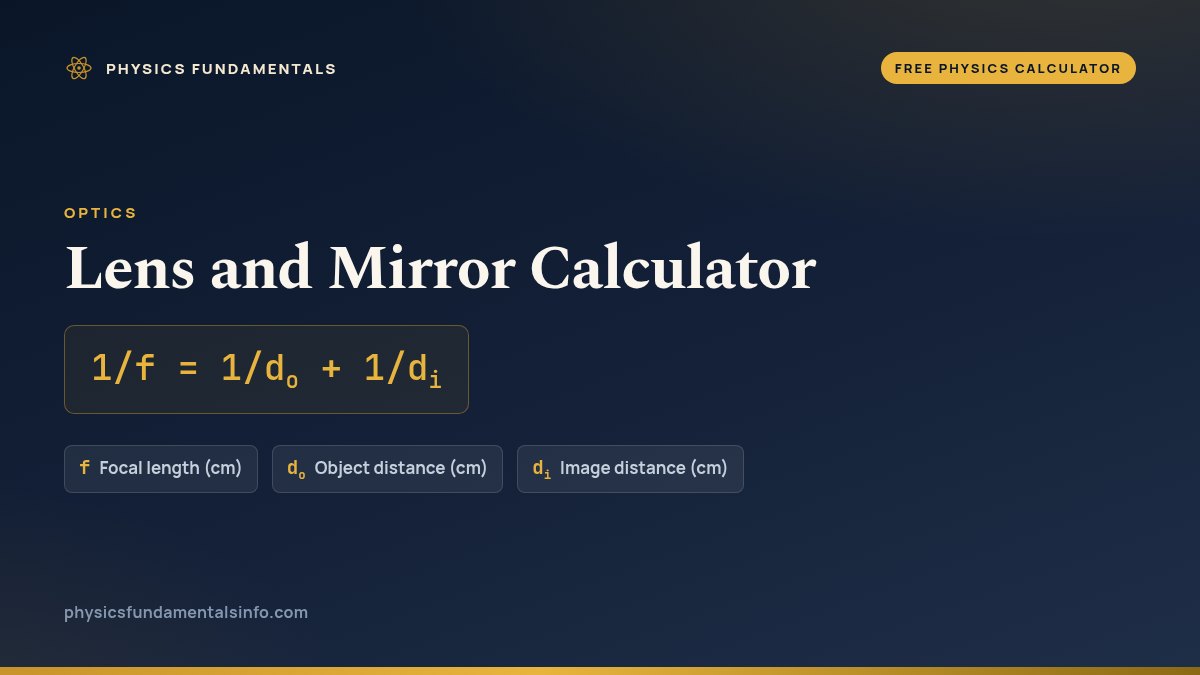
Lens & mirror equation: the thin-lens and mirror equation 1/f = 1/do + 1/di links an optic’s focal length to where an object sits and where its image forms. This free calculator solves for focal length, object distance or image distance — in any unit — and reports the magnification with every step of the working.
What Is the Lens and Mirror Calculator?
The lens and mirror calculator is a free online tool built on the formula 1/f = 1/do + 1/di. Enter the values you already know, in whichever units suit you, and it solves for focal length, distances or magnification and shows every step of the substitution. Thin-lens and mirror equation with magnification.
| Symbol | Quantity | Default unit | Also accepts | Example value |
|---|---|---|---|---|
| f | Focal length | cm | m, mm | 10 |
| do | Object distance | cm | m, mm | 30 |
| di | Image distance | cm | m, mm | 15 |
How to calculate lens and mirror images
A single equation describes image formation by any thin lens or spherical mirror: 1/f = 1/do + 1/di. Here f is the focal length, do is the distance from the optic to the object, and di is the distance to the image. Because the relationship is identical for lenses and mirrors, the same calculator handles both — you just supply the focal length with the correct sign.
There are three steps. First, decide which quantity you want — focal length, object distance or image distance — and select it in the Solve for menu. Second, enter the two distances you already know and pick their units (centimetres are typical in optics, but millimetres and metres are available); the calculator converts everything to SI metres behind the scenes. Third, read the answer together with the worked steps, which show the equation, your numbers substituted in, and the result. When you solve for an image or object distance, the calculator also reports the magnification m = −di/do.
The equation rearranges cleanly. To find the image distance, use di = 1 / (1/f − 1/do); to find the object distance, swap di for do; to find the focal length, take the reciprocal of 1/do + 1/di. Signs carry meaning: a positive di is a real image you could catch on a screen, while a negative di is a virtual image. A negative magnification means the image is inverted, and a magnitude above one means it is enlarged. For the bending of light that produces these images at a surface, see the Snell's law calculator.
Keep the sign convention consistent and the algebra does the rest. Converging lenses and concave mirrors take a positive f; diverging lenses and convex mirrors take a negative f. The most common mistake is mixing units between the two distances — letting the calculator convert removes that risk entirely.
Worked example
An object sits 30 cm in front of a converging lens with a focal length of 10 cm. The image distance is di = 1 / (1/10 − 1/30) = 1 / (0.1 − 0.0333) = 15 cm. Because di is positive, the image is real. The magnification is m = −di/do = −15/30 = −0.5, so the image is inverted and half the height of the object — exactly what a camera lens does when it projects a scene onto its sensor.
Why it matters
The lens and mirror equation is the foundation of every imaging device — eyeglasses and contact lenses, cameras and phone optics, microscopes, telescopes and the human eye. Predicting where an image forms, whether it is real or virtual, and how large it appears is the first step in designing or correcting any optical system.
Frequently asked questions
What is the thin-lens / mirror equation?
It is 1/f = 1/do + 1/di, where f is the focal length, do is the object distance and di is the image distance. The same single equation works for both thin lenses and spherical mirrors, which is why one calculator covers both. Rearranging it lets you find any one of the three quantities from the other two.
What is the sign convention for f, do and di?
Using the “real-is-positive” convention: object distance do is positive for a real object in front of the lens or mirror. A converging (convex) lens and a concave mirror have positive focal length f; a diverging (concave) lens and a convex mirror have negative f. A positive image distance di means a real image on the far side (lens) or same side (mirror) as where light actually goes; a negative di means a virtual image.
How do you calculate magnification?
Magnification is m = −di/do. A negative value means the image is inverted; a positive value means it is upright. The size of m tells you the scale: |m| greater than 1 is enlarged, less than 1 is reduced. For example di = 15 cm and do = 30 cm give m = −0.5, a real image that is inverted and half the object’s height.
Why is my image distance negative?
A negative image distance means the image is virtual — it forms on the same side as the object and cannot be projected onto a screen. This happens when an object is inside the focal length of a converging lens (a magnifying glass) or with any diverging lens or convex mirror. The calculator returns the sign for you so you can tell real images from virtual ones.
What happens when the object is at the focal point?
If do equals f, then 1/f − 1/do = 0 and the image distance becomes infinite — the rays leave parallel and no sharp image forms at any finite distance. The calculator detects this divide-by-zero case and reports that there is no valid finite solution rather than showing infinity.
Read more: Reflection and refraction of light
References & formula source
- Halliday, Resnick & Walker — Fundamentals of Physics, Chapter 34 (Images).
- Young & Freedman — University Physics with Modern Physics, Chapter 34 (Geometric Optics).
- Hecht — Optics, §5.2 (Lenses) and §5.4 (Mirrors).
- Further reading: Lens — Wikipedia