The Lorentz factor γ measures how strongly relativistic effects — time dilation and length contraction — apply at a given speed. This free calculator solves for γ from the speed, or the speed from γ, in any unit including fractions of c.
What Is the Lorentz Factor Calculator?
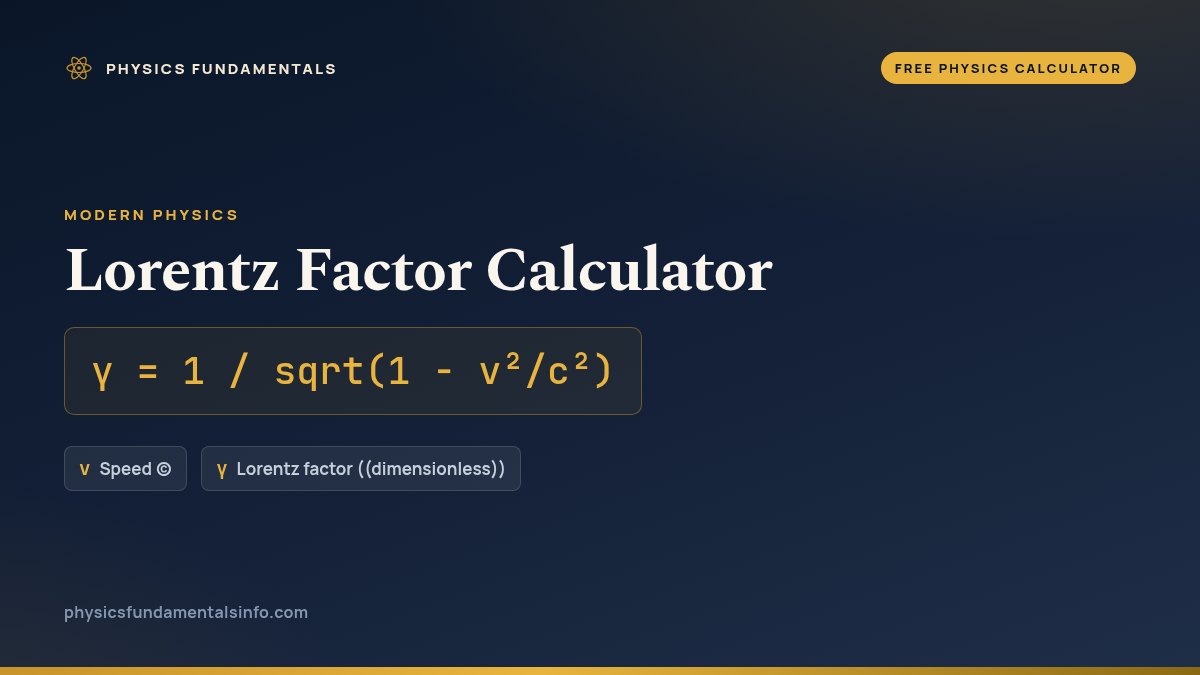
The Lorentz factor calculator is a free online tool built on the formula γ = 1 / sqrt(1 − v²/c²). Enter the values you already know, in whichever units suit you, and it solves for lorentz factor or speed and shows every step of the substitution. Lorentz Factor is the relativistic factor γ that stretches time and contracts length.
| Symbol | Quantity | Default unit | Also accepts | Example value |
|---|---|---|---|---|
| v | Speed | c | km/s, m/s, km/h | 0.8 |
| γ | Lorentz factor | (dimensionless) | — | — |
How to calculate the Lorentz factor
The Lorentz factor is found from the speed with γ = 1/sqrt(1 − (v/c)²), where β = v/c is the speed written as a fraction of the speed of light. To use it, enter the speed and — if you like — pick the unit c so you can type a fraction of light speed directly, such as 0.8. The calculator then computes β, squares it, subtracts from 1, takes the square root, and inverts to give γ.
As the speed v approaches c, the quantity 1 − β² shrinks toward zero and γ grows without limit. Note that v must be less than c: matter cannot reach or exceed the speed of light, so β always stays below 1. At low speeds γ is barely above 1, which is why the effects only become important close to light speed. The Lorentz factor is the same γ that appears in the time dilation calculator and in the energy relation of the E = mc² calculator.
Worked example
Take a particle moving at v = 0.8c, so β = 0.8. Then 1 − β² = 1 − 0.64 = 0.36, the square root of which is 0.6, giving γ = 1/0.6 ≈ 1.667. At this speed clocks run about 1.667 times slower and lengths contract to roughly 60% of their rest value. Working backwards from a target factor, γ = 2 corresponds to v = c·sqrt(1 − 1/4) = c·sqrt(0.75) ≈ 0.866c — you need over 86% of light speed just to double the factor. For the definitions of these relativity terms, see the physics glossary.
Why it matters
The Lorentz factor appears throughout special relativity. It governs time dilation Δt = γΔt0, length contraction L = L0/γ, relativistic momentum p = γmv and total energy E = γmc². It is essential for the timing corrections that keep GPS accurate, for the design of particle accelerators (where γ reaches the thousands at the LHC), and it explains why fast-moving cosmic-ray muons survive long enough to reach the ground before decaying.
Frequently asked questions
What is the Lorentz factor?
The Lorentz factor γ is a dimensionless number that is 1 at rest and grows without bound as speed approaches the speed of light. It scales relativistic time, length, momentum and energy: moving clocks slow by γ, moving lengths contract by γ, and relativistic energy is γ times the rest energy.
Why must the speed be less than the speed of light?
If v equals or exceeds c, then 1 − v^2/c^2 becomes zero or negative, and γ becomes infinite or imaginary. The speed of light c is the speed limit for matter, so v must always be less than c and β = v/c must be less than 1.
What is beta (β)?
Beta is the speed written as a fraction of the speed of light: β = v/c. It ranges from 0 at rest up to (but never reaching) 1 at light speed. In terms of β the Lorentz factor is simply γ = 1/sqrt(1 − β^2).
How large is γ at everyday speeds?
At everyday speeds γ is only negligibly above 1. A jet flying at 300 m/s has γ ≈ 1.0000000000005, an unmeasurably tiny effect. You need roughly 10% of the speed of light before γ visibly exceeds 1, which is why relativity is invisible in daily life.
How does γ relate to time dilation and E = mc^2?
Moving clocks are slowed by the Lorentz factor, Δt = γΔt0, and a moving object’s total energy is E = γmc^2. When γ = 1 (at rest) this reduces to the famous rest energy E = mc^2, so the Lorentz factor is what connects motion to the mass-energy relation.
References & formula source
- Halliday, Resnick & Walker — Fundamentals of Physics, Chapter 37 (Relativity).
- Young & Freedman — University Physics with Modern Physics, §37.3 (Relativity of Time and Length).
- Taylor & Wheeler — Spacetime Physics, Chapter 3 (The Lorentz factor).
- Further reading: Lorentz factor — Wikipedia