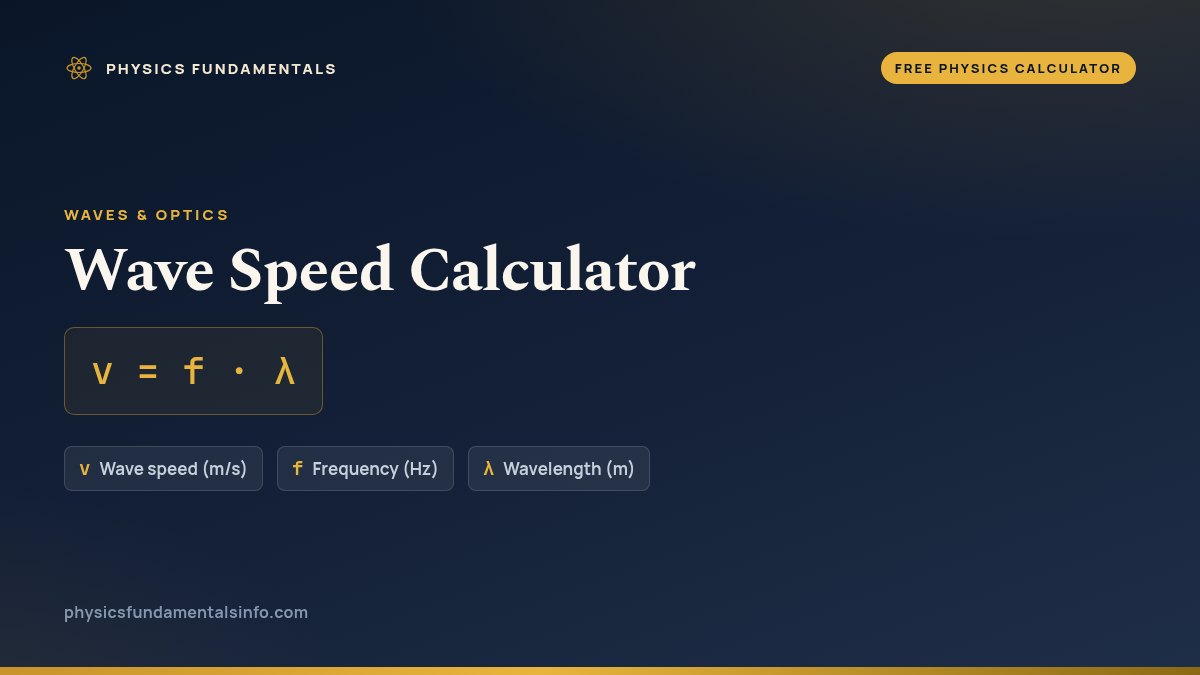
Wave speed: every wave travels at a speed equal to its frequency times its wavelength — v = f·λ. This free calculator solves for the wave speed, the frequency or the wavelength, in any unit, and shows every step of the working.
What Is the Wave Speed Calculator?
The wave speed calculator is a free online tool built on the formula v = f · λ. Enter the values you already know, in whichever units suit you, and it solves for wave speed, frequency, wavelength and shows every step of the substitution. The fundamental wave relationship.
| Symbol | Quantity | Default unit | Also accepts | Example value |
|---|---|---|---|---|
| v | Wave speed | m/s | km/s | 343 |
| f | Frequency | Hz | kHz, MHz, GHz | 256 |
| λ | Wavelength | m | cm, mm, nm | 1.34 |
How to calculate wave speed
Every wave obeys one simple relationship: v = fλ. The speed of the wave equals how many wavelengths pass a fixed point each second — the frequency f — multiplied by the length of one wavelength λ. Frequency is measured in hertz (cycles per second) and wavelength in metres, so their product is a distance per second: the wave's speed. The formula rearranges two ways: divide speed by wavelength to get frequency (f = v/λ), or divide speed by frequency to get wavelength (λ = v/f).
There are three steps. First, decide what you want — the wave speed v, or the frequency f, or the wavelength λ — and pick it in the calculator's Solve for menu. Second, enter the two values you know: frequency in Hz, kHz, MHz or GHz, wavelength in m, cm, mm or nm, and speed in m/s or km/s. Third, read the answer with the worked steps, which show the formula, your numbers substituted in, and the result in its proper units.
The key thing to feel is that, in a given medium, the speed is fixed. Sound travels at about 343 m/s in air whether it is a low rumble or a high whistle; light travels at 3 × 10⁸ m/s in vacuum for every colour. So when you change a wave's frequency, its wavelength must change in step to keep v = fλ constant — raise the frequency and the wavelength shortens, and vice versa. Change the medium instead — air to water, vacuum to glass — and the speed itself changes, which in turn reshapes the wavelength for a given frequency.
The same relationship runs right across physics. For light, the frequency that sets the speed also fixes the energy of a photon through E = hf — see the photon energy calculator. When a source or listener moves, the observed frequency shifts; that is the Doppler effect. And because sound is a travelling pressure wave, its loudness is measured as a sound level in decibels. You can look up any term in the physics glossary.
Worked example
A musical tone is played at a frequency of f = 256 Hz (close to middle C) and has a wavelength of λ = 1.34 m in air. Its speed is v = f·λ = 256 × 1.34 ≈ 343 m/s — exactly the speed of sound in air. Now suppose you keep the same air but raise the pitch an octave to 512 Hz: the speed stays 343 m/s, so the wavelength must halve to λ = v/f = 343 / 512 ≈ 0.67 m. Double the frequency, halve the wavelength — a direct illustration of the inverse relationship inside v = fλ.
Why it matters
The wave-speed relationship underpins acoustics and music, radio and antenna design (where wavelength fixes antenna size), optics and the colours of light, ultrasound imaging, sonar, seismology and telecommunications. Anywhere a signal travels as a wave — sound, light, radio or a ripple on water — v = fλ ties together how fast it moves, how often it oscillates and how long each cycle is.
Frequently asked questions
What is the wave speed formula?
The wave speed formula is v = fλ: the speed of a wave equals its frequency f multiplied by its wavelength λ. Frequency is how many wave cycles pass a point each second (in hertz), and wavelength is the distance between two successive crests (in metres). Multiplying them gives how far the wave travels per second, its speed in metres per second.
What's the difference between frequency and wavelength?
Frequency is a count of cycles per second — a property of how often the wave oscillates — while wavelength is a length, the physical distance over which the wave repeats. For a fixed wave speed they are inversely related: v = fλ means that as frequency rises, wavelength shortens, and vice versa. A high-pitched sound has a high frequency and a short wavelength; a deep bass note has a low frequency and a long wavelength.
Does wave speed depend on frequency or on the medium?
For most everyday waves, speed is set by the medium, not the frequency. Sound travels at about 343 m/s in air regardless of pitch, and light travels at 3 × 10^8 m/s in vacuum. When you change a wave's frequency in a fixed medium, its wavelength changes to keep v = fλ constant. The exception is a dispersive medium (such as light in glass), where speed varies slightly with frequency — that is what splits white light into a spectrum.
How fast does sound travel compared with light?
Sound is a mechanical wave that needs a medium: roughly 343 m/s in air, about 1,480 m/s in water and around 5,000 m/s in steel. Light is an electromagnetic wave that needs no medium and travels at 299,792,458 m/s — close to 3 × 10^8 m/s — in vacuum, slowing in glass or water. Light is therefore almost a million times faster than sound in air, which is why you see lightning before you hear thunder.
What units does the wave speed calculator use?
Wave speed is entered in metres per second (or km/s), frequency in hertz, kilohertz, megahertz or gigahertz, and wavelength in metres, centimetres, millimetres or nanometres (handy for light). The calculator converts every unit to SI internally, so you can mix units freely — enter MHz and metres, for example, and still get a correct result.
References & formula source
- Young & Freedman — University Physics with Modern Physics, Chapter 15 (Mechanical Waves).
- Halliday, Resnick & Walker — Fundamentals of Physics, Chapter 16 (Waves I).
- Hecht — Optics, Chapter 2 (Wave Motion).
- Further reading: Wavelength — Wikipedia