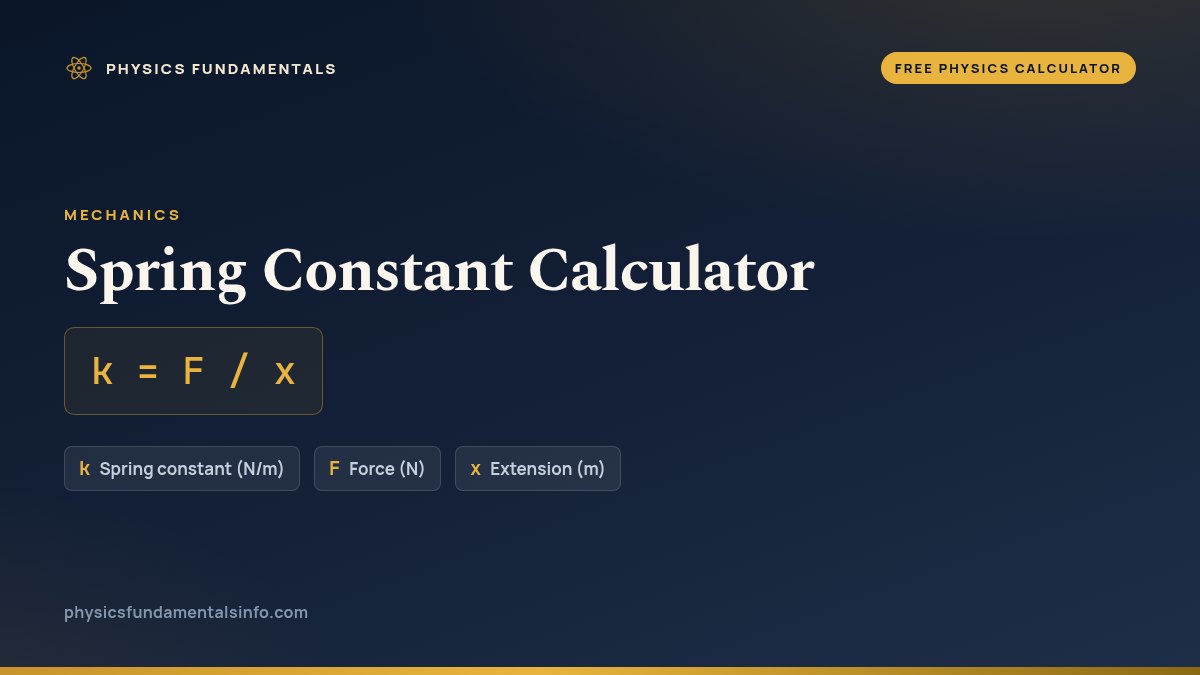
Spring constant: the spring constant (k) measures a spring’s stiffness — the force needed per metre of stretch — defined by Hooke’s law as k = F/x. This free calculator solves for the spring constant, force or extension in any unit, reports the stored elastic energy, and shows every step of the working.
What Is the Spring Constant Calculator?
The spring constant calculator is a free online tool built on the formula k = F / x. Enter the values you already know, in whichever units suit you, and it solves for spring constant, force or extension and shows every step of the substitution. Spring stiffness from force and extension, plus elastic energy.
| Symbol | Quantity | Default unit | Also accepts | Example value |
|---|---|---|---|---|
| k | Spring constant | N/m | N/cm, N/mm | — |
| F | Force | N | kN | 20 |
| x | Extension | m | cm, mm | 0.1 |
How to calculate the spring constant
The spring constant tells you how stiff a spring is. To calculate it, divide the force applied to the spring by the extension it produces — how far the spring stretches or compresses from its natural length: k = F / x. This comes straight from Hooke’s law, which states that the restoring force of a spring is proportional to its extension, F = kx. The result is quoted in newtons per metre (N/m): a larger k means a stiffer spring that resists stretching more strongly.
There are three steps. First, decide which quantity you want — the spring constant, the force or the extension — and select it in the calculator’s Solve for menu. Second, enter the two values you already know and pick their units; the calculator converts everything to SI base units (newtons and metres) behind the scenes, so a force in kilonewtons and an extension in millimetres combine correctly without any hand conversion. Third, read the answer with the worked steps, which show the formula, your numbers substituted in, and the final value with its units.
The equation rearranges easily. If you know the spring constant and the extension, the force is F = k × x. If you know the force and the spring constant, the extension is x = F ÷ k. The key rule is to keep units consistent — mixing newtons with millimetres, for instance, gives an answer that is wrong by a factor of a thousand. Letting the calculator handle the conversion removes that risk entirely.
A stretched spring also stores energy. When you solve for the spring constant, this tool reports the elastic potential energy stored in the spring, E = ½kx², in joules. That energy is released when the spring recoils — the working principle behind clothes pegs, trampolines, retracting tape measures and vehicle suspension.
Worked example
A spring stretches by 0.1 m when a 20 N force is applied. Its spring constant is k = F / x = 20 / 0.1 = 200 N/m. The elastic energy stored at that extension is E = ½kx² = ½ × 200 × 0.1² = 1 J. Reading it the other way, the same spring stretched by 50 mm (0.05 m) would need a force of F = k × x = 200 × 0.05 = 10 N — half the extension takes half the force, exactly as Hooke’s law predicts.
Why the spring constant matters
The spring constant turns a physical spring into a predictable component, so it underpins suspension and shock-absorber design, force gauges and weighing scales, the tuning of clocks and oscillators, and any system whose work or stored energy depends on a controlled, repeatable force. For a fuller walk-through of the proportionality behind it, read our guide to Hooke’s law.
Frequently asked questions
What is the formula for the spring constant?
The spring constant (k) is the restoring force per unit extension: k = F / x, from Hooke’s law F = kx. Divide the force applied to the spring by how far it stretches or compresses. The same equation rearranges to F = k·x and x = F/k, so you can solve for any one of the three quantities.
What are the units of the spring constant?
The SI unit is newtons per metre (N/m). A stiffer spring has a larger k, because it takes more force to stretch it the same distance. This calculator also accepts N/cm and N/mm and converts them to N/m for you (1 N/mm = 1000 N/m).
How do you find the force or extension from the spring constant?
Rearrange k = F/x. To get the force, multiply the spring constant by the extension: F = k × x. To get the extension, divide the force by the spring constant: x = F ÷ k. Choose the quantity you want in the “Solve for” menu and the calculator does the rearrangement automatically.
How much energy is stored in a stretched spring?
A spring stretched (or compressed) by x stores elastic potential energy E = ½kx². When you solve for the spring constant, this calculator also reports that stored energy in joules. The energy grows with the square of the extension, so doubling the stretch stores four times the energy.
Does Hooke’s law always hold?
Only within the elastic limit. Hooke’s law (and a constant k) applies while the spring or material deforms elastically and returns to its original shape. Stretch it past the elastic limit and the force is no longer proportional to extension, the spring may not recoil fully, and a single spring constant no longer describes it.
References & formula source
- Halliday, Resnick & Walker — Fundamentals of Physics, Chapter 7 (Kinetic Energy and Work) and §15.1 (Simple Harmonic Motion).
- Young & Freedman — University Physics with Modern Physics, §6.3 (Hooke’s Law and elastic potential energy).
- NIST — International System of Units (SI): the newton and the metre.
- Further reading: Hooke's law — Wikipedia