Ohm’s law states that the electric current through a conductor is directly proportional to the voltage across it, provided temperature and other physical conditions stay constant. Written as V = IR, it links voltage (volts), current (amperes) and resistance (ohms): voltage equals current multiplied by resistance. It is the foundation of almost all circuit analysis.
Flick a dimmer switch and a lamp fades; turn it back and the room brightens. Nothing about the bulb changed — you changed the circuit, and the current obediently followed. That obedience has a name.
Every charger, kettle, fuse and phone in your house is designed around one tidy relationship between voltage, current and resistance. Get comfortable with it and circuits stop being mysterious. That relationship is Ohm’s law.
What Is Ohm’s Law?
Picture water in a pipe. Pressure pushes the water along, the pipe’s narrowness fights back, and the flow rate is the result of that tug-of-war. Electricity behaves the same way: voltage is the push, resistance is the fight, and current is the flow you actually get.
Ohm’s law makes that picture precise. For many conductors held at a steady temperature, the current I is directly proportional to the potential difference V across them. Double the voltage and the current doubles; halve it and the current halves.
The constant linking them is the resistance R — a measure of how strongly the material opposes the flow of charge. A short, fat copper wire barely resists at all. A long, thin nichrome wire resists fiercely, which is exactly why heaters are made from it.
The law is named after Georg Simon Ohm, a German physicist who was teaching school in Cologne when he published his careful wire experiments in 1827. His reward, eventually, was the SI unit of resistance — the ohm (Ω) — carrying his name.

One honest caveat before the maths. Ohm’s law is an empirical relation — a pattern found by experiment — not a fundamental law of nature like conservation of energy. Plenty of materials obey it beautifully; some important ones don’t, and we will meet them below.
The Ohm’s Law Formula: V = IR
Here it is — three letters that run the electrical world.
- V — potential difference (voltage) across the component, measured in volts (V)
- I — electric current through the component, measured in amperes (A)
- R — resistance of the component, measured in ohms (Ω)
The units lock together neatly: one ohm is defined as one volt per ampere (1 Ω = 1 V/A). If a component lets 1 A flow when 1 V is applied, its resistance is exactly 1 Ω.
Because the formula has three quantities, you can rearrange it to find whichever one you’re missing. The table below is the version worth memorising.
| To find | Formula | You need to know | Units check |
|---|---|---|---|
| Voltage, V | V = I × R | current and resistance | A × Ω = V |
| Current, I | I = V ÷ R | voltage and resistance | V ÷ Ω = A |
| Resistance, R | R = V ÷ I | voltage and current | V ÷ A = Ω |
Struggling to remember which way round it goes? Use the classic Ohm’s law triangle. Cover the quantity you want with a finger, and the layout of the other two tells you the formula.
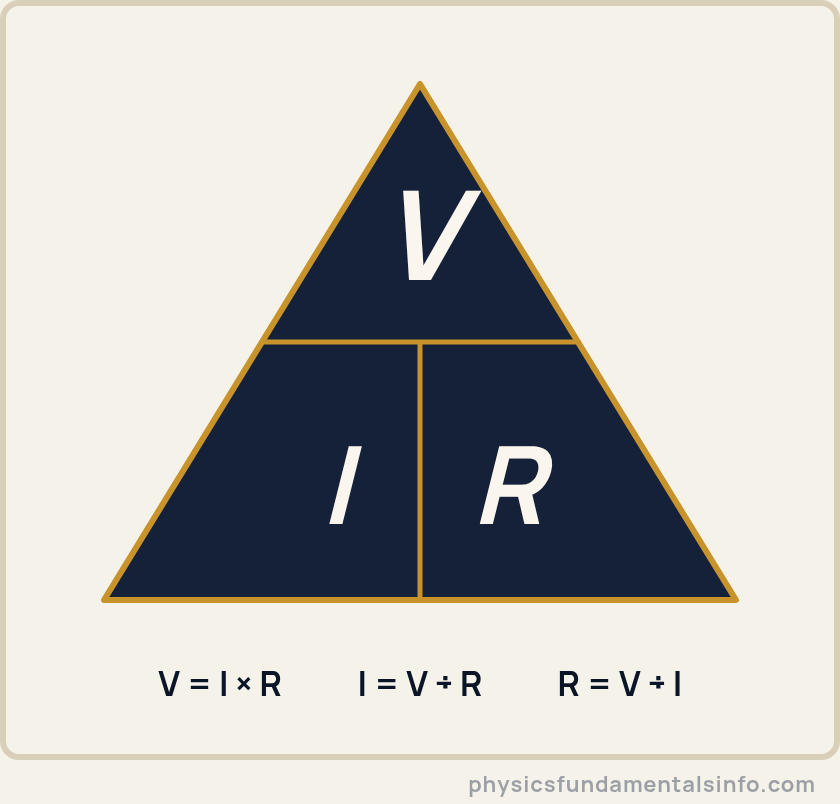
The Ohm’s law triangle: cover the quantity you want, and the remaining layout gives the formula.
In a circuit diagram, the three quantities each have their own instrument. The ammeter sits in series (in the line of flow) to read current; the voltmeter sits in parallel (across the component) to read potential difference.
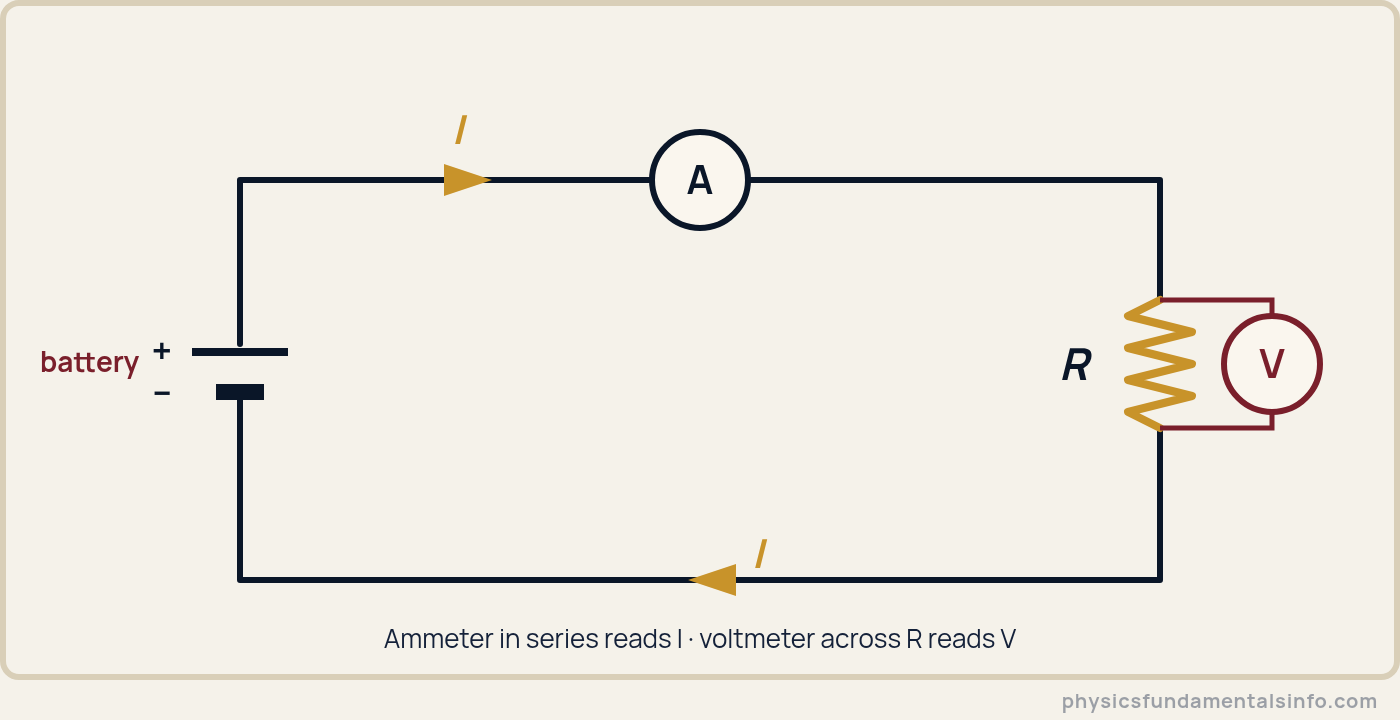
Measuring Ohm’s law: a battery drives current I through resistor R; the ammeter reads I and the voltmeter reads V across R.
How Ohm’s Law Works Inside a Wire
Why should current be proportional to voltage at all? The answer lives at the scale of atoms.
A metal is a lattice of fixed positive ions bathed in a sea of free electrons. Apply a voltage and you set up an electric field along the wire — the same kind of electrical push described by Coulomb’s law — which drags those electrons along.
But they don’t get far between collisions. Each electron accelerates briefly, smacks into a vibrating ion, loses its gained speed, and starts again — a kind of electrical friction. The net result is a slow average drift superimposed on frantic random motion.
Here’s the key: that drift velocity turns out to be proportional to the field strength. Double the push, double the drift, double the current. Proportionality between V and I — Ohm’s law — drops straight out of the microscopic picture.
Physicists write this microscopic version as:
- J — current density (current per unit cross-section), in amperes per square metre (A/m2)
- σ — electrical conductivity of the material, in siemens per metre (S/m)
- E — electric field strength inside the conductor, in volts per metre (V/m)
And a fact that surprises almost everyone: the drift itself is glacial — typically well under a millimetre per second in household wiring. The light comes on instantly because the electric field propagates along the wire at close to the speed of light, setting every electron in the loop moving at almost the same moment.
Temperature is the catch in all this. Heat a metal and its ions vibrate harder, collisions become more frequent, and resistance climbs — for copper, by roughly 0.4% per degree Celsius. That is why the law’s small print says “at constant temperature”.
Don’t just take the equation’s word for it. Drag the sliders below and watch the current respond: double the voltage, halve the resistance, and see I = V/R play out live.
Ohmic vs Non-Ohmic: When Ohm’s Law Breaks Down
Plot current against voltage for a metal wire at steady temperature and you get the most reassuring graph in physics: a straight line through the origin. The gradient is constant, so the resistance is constant. That’s an ohmic conductor.
Now try a filament lamp. As the current grows, the filament heats towards 2,500 °C and — as our guide to heat vs temperature explains — those hotter, harder-vibrating ions scatter electrons more. Resistance rises with voltage, and the graph bends over.
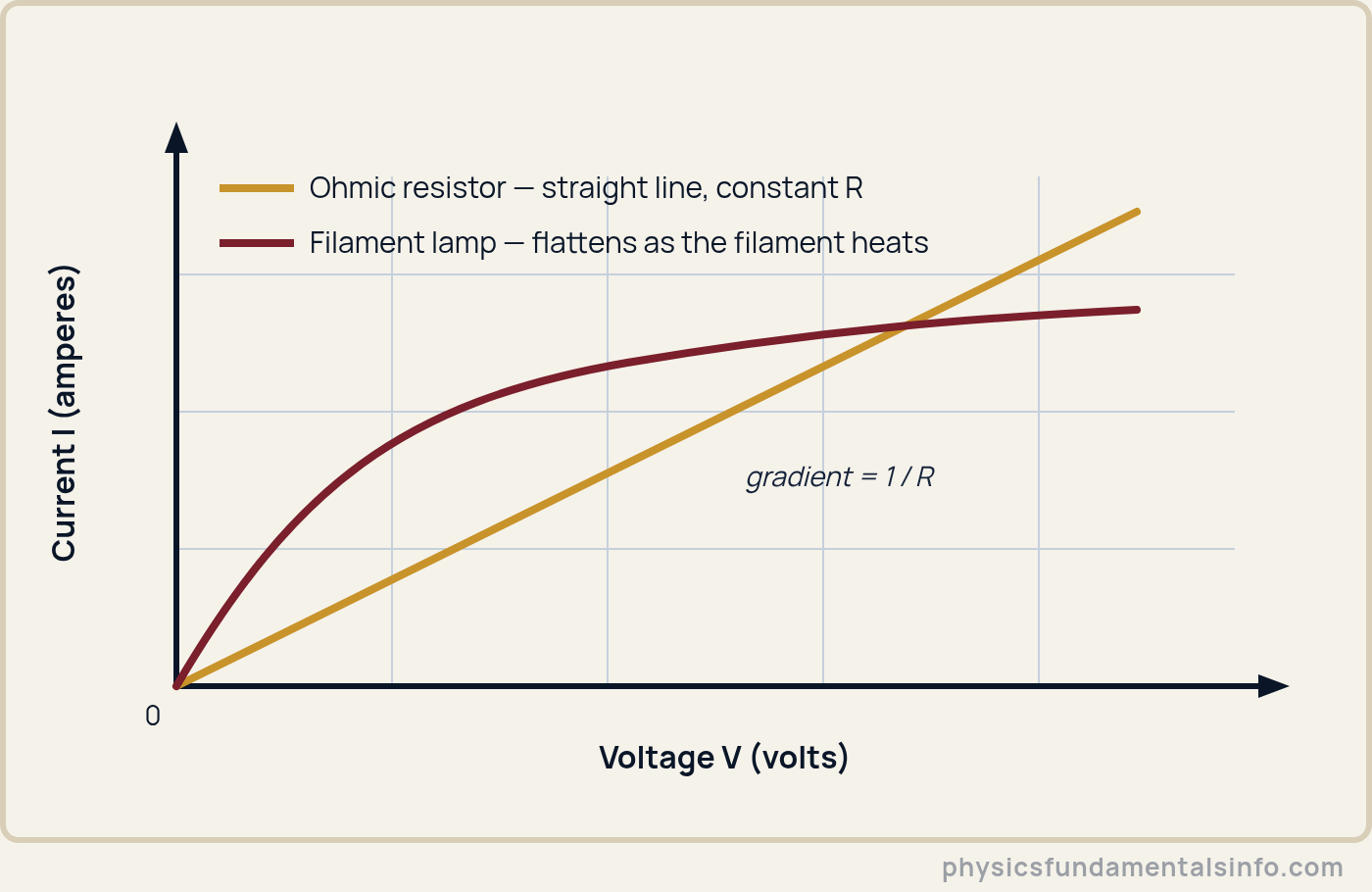
I–V characteristics: an ohmic conductor gives a straight line through the origin; a filament lamp curves as its resistance rises with temperature.
Diodes are even less cooperative — they pass almost nothing until the voltage crosses a threshold, then conduct generously, and barely conduct at all in reverse. Devices like these are non-ohmic: V = IR still defines a resistance at any instant, but that R refuses to stay constant.
| Component | I–V graph shape | Resistance behaviour | Obeys Ohm’s law? |
|---|---|---|---|
| Metal wire at constant temperature | Straight line through origin | Constant | Yes |
| Fixed resistor (carbon or wire-wound) | Straight line through origin | Constant within its power rating | Yes |
| Filament lamp | Curve that flattens | Rises as the filament heats | No |
| Semiconductor diode / LED | Near zero, then a sharp rise (one direction only) | Varies enormously with voltage and direction | No |
| Thermistor (NTC) | Curve that steepens | Falls as it warms | No |
At the extreme end sit superconductors: cool certain materials below a critical temperature and their resistance vanishes entirely. Current flows with no voltage needed to sustain it — a regime Ohm’s law simply wasn’t built for.
Resistance and Resistivity: What Actually Sets R
So what decides whether a component has 2 Ω or 2 million? Three things: what it’s made of, how long it is, and how thick it is.
- R — resistance, in ohms (Ω)
- ρ (rho) — resistivity of the material, in ohm-metres (Ω·m)
- L — length of the conductor, in metres (m)
- A — cross-sectional area, in square metres (m2)
The pipe analogy holds up perfectly here. A longer pipe resists flow more (L on top); a wider pipe resists less (A on the bottom). Resistivity ρ is the material’s own personality — the property that makes copper a conductor and glass an insulator, regardless of shape.
And the range of that personality is staggering. From silver to glass, resistivity spans more than twenty orders of magnitude — one of the widest ranges of any physical property.
| Material | Typical resistivity at 20 °C (Ω·m) | Where you meet it |
|---|---|---|
| Silver | 1.59 × 10⁻⁸ | Best metallic conductor; specialist contacts |
| Copper | 1.68 × 10⁻⁸ | Household wiring, motors, cables |
| Gold | 2.44 × 10⁻⁸ | Corrosion-proof connector plating |
| Aluminium | 2.65 × 10⁻⁸ | Overhead power lines (light and cheap) |
| Tungsten | 5.6 × 10⁻⁸ | Lamp filaments (survives white heat) |
| Nichrome (alloy) | ≈ 1.1 × 10⁻⁶ | Heating elements in kettles and toasters |
| Glass | 1010 to 1014 | Insulators on pylons and circuit boards |
Treat these as good representative figures rather than gospel — published values shift slightly with purity, alloy composition and the reference used.
Real-World Examples of Ohm’s Law
Ohm’s law isn’t exam decoration. Engineers and electricians reach for it constantly, often without writing anything down.
1. The kettle in your kitchen
A UK kettle rated at 3 kW on 230 V mains draws I = P/V ≈ 13 A, which means its nichrome element has a working resistance of about R = V/I ≈ 18 Ω. All that current does one job: dumping thermal energy into the water — specific heat capacity takes the story from there.
2. Fuses and circuit breakers
A fuse is Ohm’s law used as a bodyguard. If a fault slashes a circuit’s resistance, I = V/R says the current must surge — and the thin fuse wire melts before the cables in your walls can overheat.
3. Sizing a resistor for an LED
An LED itself is non-ohmic, but the resistor protecting it is pure Ohm’s law. Hobbyists calculate the resistor that drops the excess voltage at the LED’s safe current — worked problem 6 below does exactly this calculation.
4. Your car’s 12 V electrics
Every bulb, heated seat and sensor in a car is designed around a 12 V supply. Knowing each component’s resistance tells designers the current it draws, which fixes the wire thickness and fuse rating for every circuit in the loom.
5. Why electricians fear wet hands
Dry skin can present tens of thousands of ohms; wet skin, dramatically less. Same mains voltage, far lower R, therefore far higher current through the body — which is precisely why electrical safety rules are unforgiving about water.
Common Misconceptions About Ohm’s Law
“Voltage flows through the circuit”
It doesn’t — current flows through; voltage exists across. Voltage is a difference in electrical potential between two points, like the height difference between two ends of a slide. Nothing about a difference can “flow”.
“Ohm’s law applies to everything electrical”
Tempting, but no. It’s an experimental regularity that metals at steady temperature happen to follow superbly, while diodes, filament lamps and thermistors openly ignore it. Always ask whether the component is ohmic before trusting a constant R.
“R = V/I means resistance depends on the voltage”
This one catches a lot of students. For an ohmic resistor, R is fixed by material and geometry (ρL/A); raising V raises I in exact proportion, and the ratio V/I doesn’t budge. The equation lets you measure R — it doesn’t make R a puppet of V.
“Current gets used up as it goes around”
Charge is conserved: in a series loop, the current entering a bulb equals the current leaving it. What the bulb consumes is energy, delivered by the charges as they drop through a potential difference — the charges themselves carry on.
How Ohm’s Law Relates to Power and Circuit Analysis
Ohm’s law rarely works alone. Pair it with the power equation and you can answer almost any everyday electrical question.
- P — power dissipated, in watts (W)
- V — potential difference, in volts (V)
- I — current, in amperes (A)
- R — resistance, in ohms (Ω)
Power is energy transferred per second, so these forms tell you instantly how hard a component is working. The I2R version explains why power lines run at huge voltages: pushing the same power at higher V means lower I, and losses that scale with I2 collapse.
In bigger networks, Ohm’s law teams up with Kirchhoff’s two rules — currents into a junction balance currents out, and voltages around any closed loop sum to zero. Together they crack any series, parallel or mixed circuit; Georgia State University’s HyperPhysics walks through the trio with a handy interactive calculator.
Quick reference for combining resistors: in series, resistances simply add (R = R1 + R2 + …) and the current is the same everywhere. In parallel, the reciprocals add (1/R = 1/R1 + 1/R2 + …) and it’s the voltage that’s shared.
And alternating current? Ohm’s law survives, generalised: V = IZ, where impedance Z bundles resistance together with the frequency-dependent opposition of capacitors and inductors. For a plain resistor on AC, Z = R and nothing changes at all.
One habit worth stealing from working engineers — sanity-check magnitudes. A phone charging draws roughly 1–2 A; a kettle about 13 A. If your calculation says 400 A through a desk lamp, the physics isn’t broken; a unit conversion is.
Worked Problems
Method matters more than answers here. Write the formula, substitute with units, then solve — every time.
Show Solution
Solution:
Step 1: Current is the unknown, so use I = V / R.
Step 2: Substitute: I = 12 V ÷ 4.0 Ω.
Step 3: Solve: I = 3.0 V/Ω = 3.0 A.
Answer: I = 3.0 A
Show Solution
Solution:
Step 1: Resistance is the unknown, so use R = V / I.
Step 2: Substitute: R = 230 V ÷ 0.50 A.
Step 3: Solve: R = 460 V/A = 460 Ω.
Answer: R = 460 Ω (its hot, working resistance — cold, it would measure far less)
Show Solution
Solution:
Step 1: Convert to SI base units first — the classic slip is skipping this. 25 mA = 0.025 A and 1.2 kΩ = 1200 Ω.
Step 2: Voltage is the unknown, so use V = I × R = 0.025 A × 1200 Ω.
Step 3: Solve: V = 30 V. (Forgetting the mA conversion gives 30,000 V — a thousand times too big.)
Answer: V = 30 V
Show Solution
Solution:
Step 1: In series, resistances add: R = 6.0 Ω + 3.0 Ω = 9.0 Ω.
Step 2: Apply I = V / R to the whole circuit: I = 18 V ÷ 9.0 Ω = 2.0 A. In series, this current flows through both resistors.
Step 3: Apply V = I × R to each resistor: V1 = 2.0 A × 6.0 Ω = 12 V and V2 = 2.0 A × 3.0 Ω = 6.0 V. Check: 12 V + 6.0 V = 18 V, matching the battery.
Answer: I = 2.0 A; 12 V across the 6.0 Ω resistor and 6.0 V across the 3.0 Ω resistor
Show Solution
Solution:
Step 1: In parallel, each resistor gets the full 12 V. Apply I = V / R to each branch.
Step 2: I1 = 12 V ÷ 6.0 Ω = 2.0 A and I2 = 12 V ÷ 3.0 Ω = 4.0 A.
Step 3: Total current: I = 2.0 A + 4.0 A = 6.0 A. Check via the combined resistance: 1/R = 1/6.0 + 1/3.0 = 1/2.0, so R = 2.0 Ω and I = 12 V ÷ 2.0 Ω = 6.0 A. Consistent.
Answer: 2.0 A through the 6.0 Ω resistor, 4.0 A through the 3.0 Ω resistor, 6.0 A total
Show Solution
Solution:
Step 1: The resistor must drop the leftover voltage: V = 5.0 V − 2.0 V = 3.0 V.
Step 2: Apply R = V / I with the series current 20 mA = 0.020 A: R = 3.0 V ÷ 0.020 A = 150 Ω.
Step 3: Power in the resistor: P = V × I = 3.0 V × 0.020 A = 0.060 W, so a standard quarter-watt resistor is comfortably sufficient.
Answer: R = 150 Ω, dissipating 0.060 W
Show Solution
Solution:
Step 1: Cross-sectional area: A = πd2/4 = π × (1.0 × 10⁻³ m)2 ÷ 4 = 7.85 × 10⁻⁷ m2.
Step 2: Apply R = ρL / A = (1.68 × 10⁻⁸ Ω·m × 2.0 m) ÷ (7.85 × 10⁻⁷ m2).
Step 3: Solve: R = 3.36 × 10⁻⁸ ÷ 7.85 × 10−7 = 0.043 Ω. A sanity check: a tiny resistance, exactly as you’d hope for connecting wire.
Answer: R ≈ 0.043 Ω
Frequently Asked Questions
What is Ohm's law in simple terms?
Ohm’s law says the current through a conductor is proportional to the voltage across it, as long as its resistance stays constant: V = IR. Think of water in a pipe — more pressure gives more flow, a narrower pipe gives less. Double the voltage and the current doubles; double the resistance and the current halves.
What are the three forms of the Ohm's law formula?
The three forms are V = I × R to find voltage, I = V ÷ R to find current, and R = V ÷ I to find resistance. They are one relationship rearranged three ways. The Ohm’s law triangle — V on top, I and R below — lets you read off the right form by covering the quantity you want.
Why doesn't Ohm's law apply to all materials?
Because it is an empirical rule, not a fundamental law, and it only holds where resistance stays constant. In filament lamps, resistance rises as the filament heats; in diodes and LEDs, it varies hugely with voltage and direction; in thermistors, it falls with temperature. These non-ohmic devices give curved I–V graphs instead of straight lines.
Does Ohm's law work for AC circuits?
Yes, in a generalised form: V = IZ, where Z is the impedance — the total opposition combining resistance with the frequency-dependent effects of capacitors and inductors, measured in ohms. For a purely resistive component on AC, impedance equals resistance and the ordinary V = IR applies unchanged.
Who discovered Ohm's law and when?
Georg Simon Ohm, a German physicist, published the law in 1827 after systematic experiments on wires of different lengths and thicknesses, carried out while he taught school in Cologne. Recognition came slowly, but the SI unit of resistance — the ohm (Ω) — was later named in his honour.
What is the SI unit of resistance?
The SI unit of resistance is the ohm, symbol Ω, defined as one volt per ampere: a component has a resistance of 1 Ω if a potential difference of 1 V drives a current of 1 A through it. Larger resistances use kilohms (1 kΩ = 1,000 Ω) and megohms (1 MΩ = 1,000,000 Ω).
What happens to the current if the resistance doubles?
At a fixed voltage, doubling the resistance halves the current, because I = V ÷ R makes current inversely proportional to resistance. For example, 12 V across 4 Ω drives 3 A, but the same 12 V across 8 Ω drives only 1.5 A. Halving the resistance does the opposite and doubles the current.