Black Holes: The Physics Explained
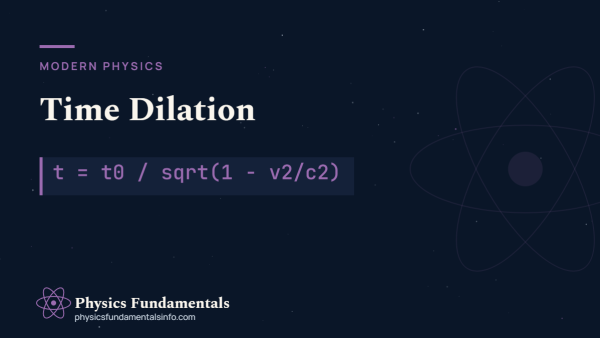
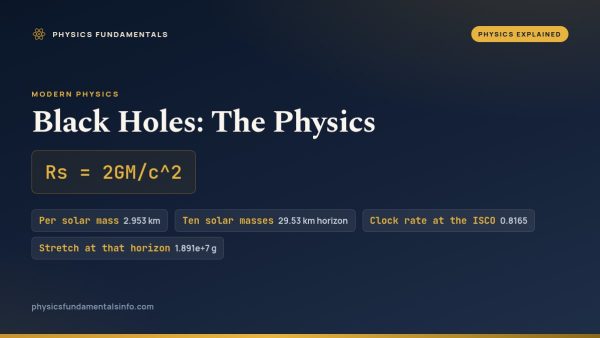
A black hole is a mass sealed inside its own event horizon, the one-way surface at R_s = 2GM/c^2, and that radius depends on the mass and on nothing else: 2.953 km for every solar mass, so ten solar masses give a horizon only 29.53 km in radius. The half most explanations leave out is what marks the horizon out, which is not its size but what it does to time: a clock held at rest a distance r from the centre ticks sqrt(1 - R_s/r) times for every far-away tick, and at the horizon that factor is exactly zero for a hole of any mass at all. This page works the formula in both directions, places the photon sphere at 1.5 R_s and the innermost stable circular orbit at 3 R_s, shows why a bigger black hole is gentler at its own horizon and stronger at a fixed distance, and works eight problems step by step - including the 1.891e+7 g that would stretch a 1.80 m body at the horizon of a ten-solar-mass hole.
20 min read