Work and power: work is the energy a force transfers when it moves something through a distance, W = F·d·cosθ, and power is how fast that work is done, P = W/t. This free calculator takes the force, distance, angle and time and returns the work in joules and the power in watts, kilowatts and horsepower, with every step of the working shown.
What Is the Work and Power Calculator?
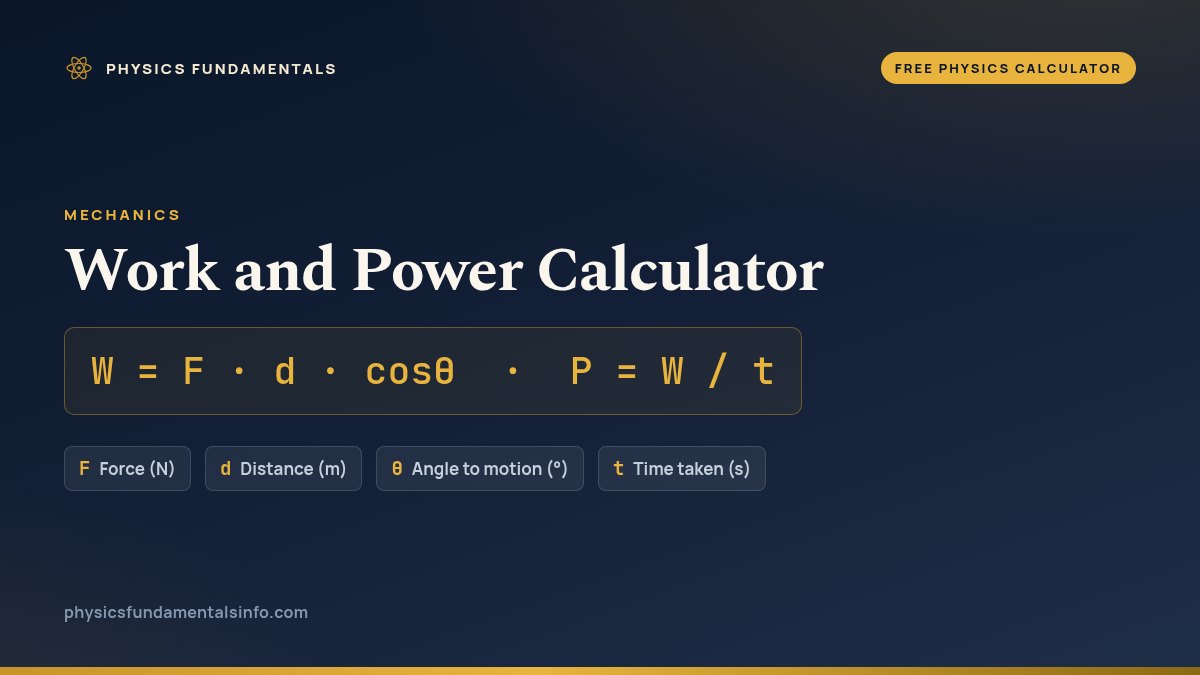
The work and power calculator is a free online tool built on the formula W = F · d · cosθ · P = W / t. Enter the values you already know, in whichever units suit you, and it solves for work, power, force, time, efficiency and shows every step of the substitution. Work done by a force and how fast it is delivered.
| Symbol | Quantity | Default unit | Also accepts | Example value |
|---|---|---|---|---|
| F | Force | N | kN, lbf | 100 |
| d | Distance | m | cm, km | 5 |
| θ | Angle to motion | ° | — | 0 |
| t | Time taken | s | min, h | 10 |
How to calculate work and power
Work is energy transferred when a force moves an object through a distance. Only the component of the force along the motion counts, so the full equation is W = F·d·cosθ, where θ is the angle between the force and the displacement. When you push straight along the direction of travel, θ = 0°, cosθ = 1, and the formula simplifies to the familiar W = F·d. The result is an amount of energy, measured in joules. Power is the rate at which that work is done — the energy transferred per second — given by P = W/t and measured in watts.
There are three steps. First, enter the force F in newtons, kilonewtons or pound-force, and the distance d in metres, centimetres or kilometres. Second, add the angle θ between the force and the motion — leave it at 0° for a force in line with the movement — and the time t in seconds, minutes or hours. Third, read the answer: the work appears in joules, and the power alongside it in watts, kilowatts and horsepower, with the worked steps showing the formula, your numbers substituted in, and the result with units.
It helps to feel the two relationships directly. Work scales with both the force and the distance — double either and the work doubles — while the cosθ term means a sideways force does no work at all (cosθ = 0 at 90°). Power, by contrast, depends on time: the same job done in half the time needs twice the power. That is the whole distinction between work and power — work is how much energy is moved, power is how fast it is moved.
Work and energy go hand in hand. The work done on an object changes its energy, so to find the energy of motion that work produces see the kinetic energy calculator, or for the energy stored by lifting a mass see the gravitational potential energy calculator. To trace the force that produced the motion in the first place, use Newton's second law, or look up a term in the physics glossary.
Worked example
A forklift pushes a crate with a steady force of F = 100 N, moving it d = 5 m along the floor in t = 10 s, with the force in line with the motion (θ = 0°). The work done is W = F·d·cosθ = 100 × 5 × cos(0°) = 500 J. The power delivered is P = W/t = 500 / 10 = 50 W — about 0.05 kW, or roughly 0.067 hp. Do the same job in half the time, t = 5 s, and the work is unchanged at 500 J, but the power doubles to 100 W. Push instead at a 60° angle to the motion and only cos(60°) = 0.5 of the force does work, halving the work to 250 J.
Why it matters
Work and power underpin the rating of engines and motors, the wattage of electrical appliances, the output of cyclists and athletes, and every comparison of how efficiently one machine delivers energy against another. Whenever you need to know how much energy a force moves, or how quickly a device can move it, W = F·d and P = W/t are where the analysis begins.
Frequently asked questions
What is the difference between work and energy?
Work is energy in transit. When a force moves an object through a distance, it transfers energy, and the amount transferred is the work done — so work and energy share the same unit, the joule. Energy is the stored capacity to do work; work is the act of moving that energy from one form or place to another. Doing 500 J of work on an object increases its energy (kinetic, potential or thermal) by 500 J.
Why is there a cosθ in the work formula?
Only the component of force that lies along the direction of motion does work. The full equation is W = F·d·cosθ, where θ is the angle between the force and the displacement. When the force is in line with the motion, θ = 0°, cosθ = 1 and W = F·d. A force at 90° to the motion (cosθ = 0) does no work at all — which is why the tension in a string does no work on a mass swung in a horizontal circle.
How are watts related to horsepower?
The watt is the SI unit of power: one watt is one joule of energy transferred per second (1 W = 1 J/s). Horsepower is an older unit still common for engines and motors. One mechanical (imperial) horsepower equals about 745.7 watts, so a 100-horsepower engine delivers roughly 74.6 kilowatts. This calculator shows the power in watts, kilowatts and horsepower at once so you can compare ratings directly.
What is the difference between work and power?
Work is how much energy is transferred; power is how fast it is transferred. Power is work divided by time, P = W/t, measured in watts. Two motors can do exactly the same 500 J of work, but a more powerful one does it in less time. Lifting a box to a shelf takes the same work whether you do it slowly or quickly — but doing it quickly demands more power.
Can work or power be negative?
Yes. Work is negative when the force opposes the motion — friction and air resistance do negative work, removing kinetic energy and turning it into heat. In the formula this shows up when θ is between 90° and 180°, making cosθ negative. Negative work means energy is taken out of the object rather than added to it.
References & formula source
- Young & Freedman — University Physics with Modern Physics, Chapter 6 (Work and Kinetic Energy) and §6.4 (Power).
- Halliday, Resnick & Walker — Fundamentals of Physics, Chapter 7 (Kinetic Energy and Work).
- Serway & Jewett — Physics for Scientists and Engineers, Chapter 7 (Energy of a System).
- Further reading: Work (physics) — Wikipedia