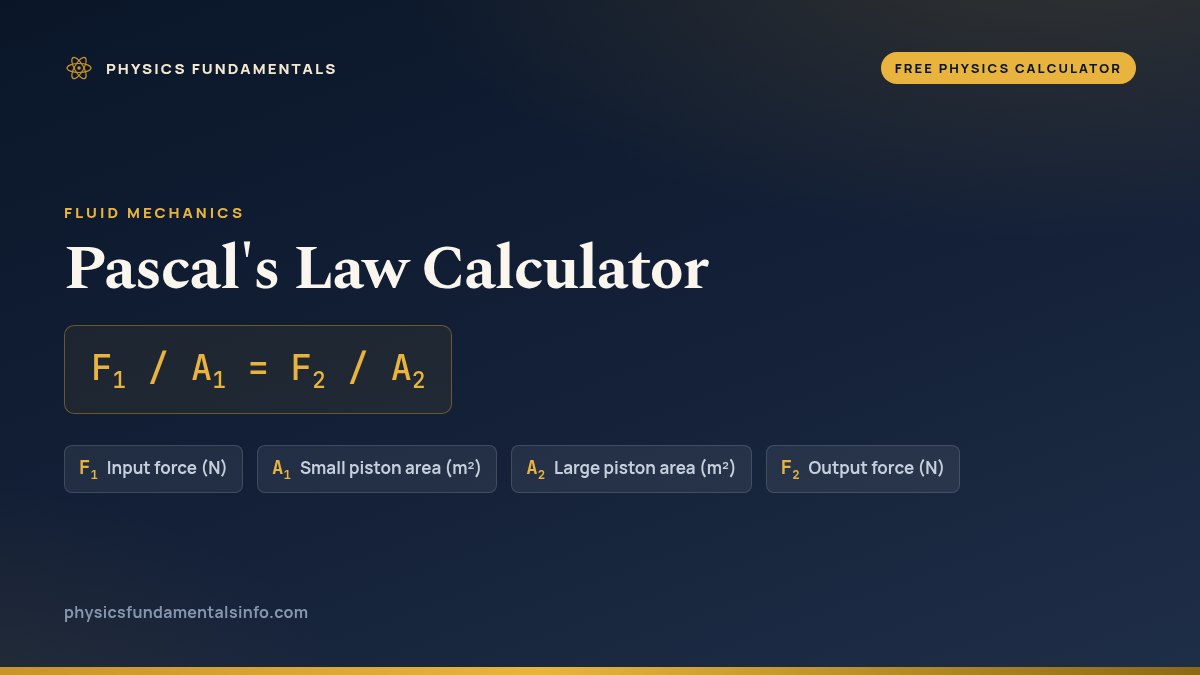
Pascal's law: pressure applied to a confined fluid is transmitted undiminished to every part of it, so a small force on a small piston can balance a large force on a large piston — F1/A1 = F2/A2. This free calculator solves for the output force, the input force, or either piston area, and also reports the fluid pressure and the mechanical advantage, with every step of the working shown.
What Is the Pascal's Law Calculator?
The Pascal's law calculator is a free online tool built on the formula F1 / A1 = F2 / A2. Enter the values you already know, in whichever units suit you, and it solves for output force, input force, or piston area and shows every step of the substitution. Pascal's Law is hydraulic-press force multiplication — F1/A1 = F2/A2, with pressure and mechanical advantage.
| Symbol | Quantity | Default unit | Also accepts | Example value |
|---|---|---|---|---|
| F1 | Input force | N | kN | 100 |
| A1 | Small piston area | m² | cm² | 0.01 |
| A2 | Large piston area | m² | cm² | 0.5 |
| F2 | Output force | N | kN | 5000 |
How to calculate hydraulic force with Pascal's law
A hydraulic press is two connected cylinders sharing one body of fluid. Push down on the small piston with force F1 and you create a pressure P = F1/A1 in the fluid. Pascal's law says that pressure is transmitted equally and undiminished throughout the fluid, so the same P pushes up under the large piston of area A2, giving an output force F2 = P·A2 = F1·(A2/A1). Because the large area is bigger, the output force is bigger — that is force multiplication.
There are three steps. First, decide what you want — the output force, or one of F1, A2 or A1 — and choose it in the calculator's Solve for menu. Second, enter the values you know: forces in newtons or kilonewtons, areas in square metres or square centimetres (convert a diameter with A = π·d²/4 first). Third, read the answer with the worked steps, plus the fluid pressure and the mechanical advantage MA = A2/A1 — the factor by which the press multiplies your force.
Two relationships are worth feeling directly. Output force is proportional to the large area and inversely proportional to the small area, so widening the output piston or narrowing the input piston both raise the advantage. But area grows with the square of diameter, so doubling a piston's diameter quadruples its area — the reason a modest change in size produces a large change in force. For the underlying pressure idea on its own, see the pressure calculator; for the buoyant force that same fluid exerts, see the buoyancy calculator, or look up a term in the physics glossary.
Worked example
A press has a small piston of area A1 = 0.01 m² and a large piston of area A2 = 0.5 m². Push on the small piston with F1 = 100 N. The fluid pressure is P = F1/A1 = 100 / 0.01 = 10,000 Pa = 10 kPa, and it acts everywhere, so the output force is F2 = P·A2 = 10,000 × 0.5 = 5,000 N — the same as F2 = F1·(A2/A1) = 100 × 50. The mechanical advantage is A2/A1 = 50: a 100 N push lifts a 5,000 N load (about 510 kg). The catch is distance — the small piston must travel 50 cm for every 1 cm the load rises, so the work you put in equals the work you get out.
Why it matters
Pascal's law is the principle behind hydraulic car jacks and lifts, the brakes in every car, excavator and loader arms, hydraulic presses that stamp and forge metal, aircraft control surfaces, and the dentist's and barber's chair. Anywhere a small effort must be turned into a large, controllable force through a fluid, this is the equation engineers start from.
Frequently asked questions
What units should I enter into the Pascal's law calculator?
Use SI units: forces in newtons (N) and areas in square metres (m²). The calculator also accepts kilonewtons and square centimetres and converts them automatically. If you measured an area in cm², divide by 10,000 to get m² (1 m² = 10,000 cm²). Fluid pressure is returned in pascals and kilopascals, and the mechanical advantage is a pure ratio with no units.
Can I enter piston diameters instead of areas?
Not directly — the calculator takes areas, so convert a diameter to an area first with A = πd²/4 (equivalently A = π·(d/2)²). This squaring step is the one people most often miss: because area depends on the square of the diameter, a large piston with twice the diameter has four times the area and therefore multiplies the force four times, not twice.
Does the calculator account for friction or leaks?
No. It models an ideal, 100%-efficient hydraulic system in which the fluid is incompressible and the pistons are frictionless, so pressure is transmitted perfectly (Pascal's principle). A real hydraulic jack or press loses some force to seal friction and fluid viscosity, so the actual output force is a little lower than the ideal value shown here.
How do I find the input force needed to lift a car?
Switch the “Solve for” menu to the input force and enter the load as the output force. The load is the weight, F = m·g: for a 1,500 kg car that is about 14,715 N. Enter your two piston areas, and the calculator returns the input force required. With a large-to-small area ratio of 50, lifting that car needs only about 294 N on the small piston — roughly the push of a car-jack handle.
If the force is multiplied, where does the extra energy come from?
Nowhere — energy is conserved, so a hydraulic press is not a free-energy machine. The force is multiplied, but the small piston must move proportionally farther than the large piston rises. Because the same volume of fluid is displaced, A1·d1 = A2·d2, so the distance ratio is the inverse of the area ratio. Multiply the force by 50 and you must push the input 50 times as far; the work in (force × distance) equals the work out.
References & formula source
- Halliday, Resnick & Walker — Fundamentals of Physics, chapter on Fluids (Pascal's principle and hydraulic systems).
- Serway & Jewett — Physics for Scientists and Engineers, chapter on Fluid Mechanics (Pascal's law).
- OpenStax — University Physics Volume 1, §14.3 “Pascal's Principle and Hydraulics”.
- Further reading: Pascal's law — Wikipedia