Impulse: impulse (J) is a force acting over a time interval, defined by J = F·t, and it equals the change in momentum (J = Δp). This free calculator solves for impulse, force or time — in any unit — and shows every step of the working.
What Is the Impulse Calculator?
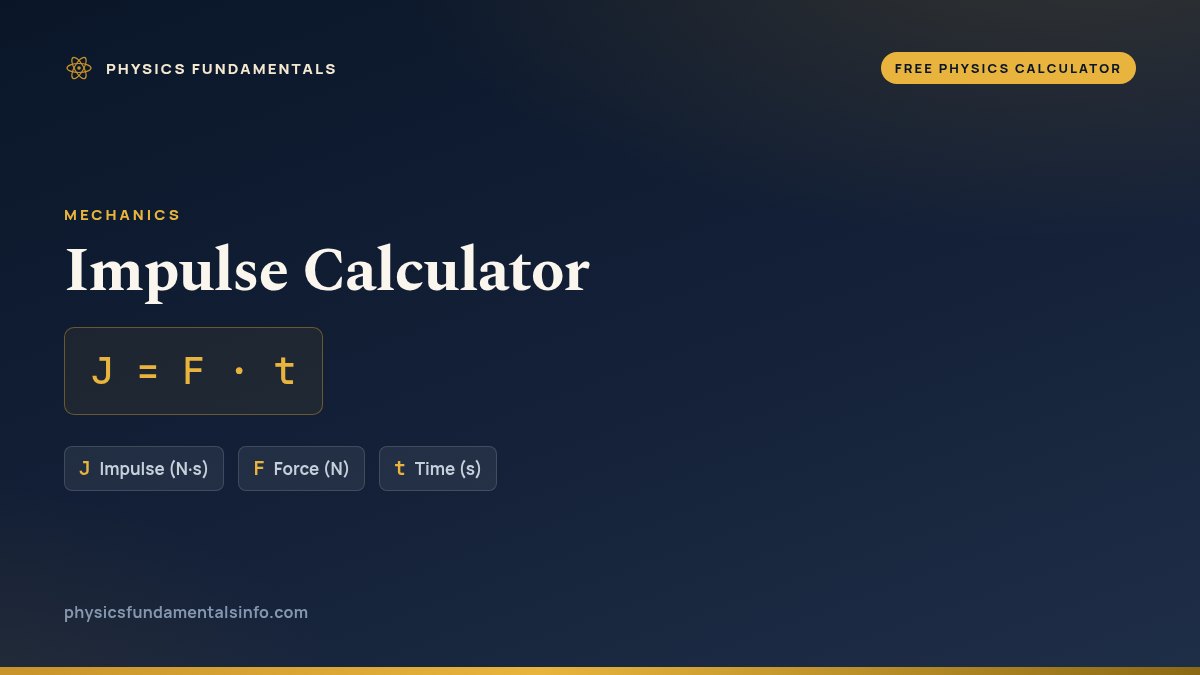
The impulse calculator is a free online tool built on the formula J = F · t. Enter the values you already know, in whichever units suit you, and it solves for impulse, force or time and shows every step of the substitution. Impulse from force and time, equal to change in momentum.
| Symbol | Quantity | Default unit | Also accepts | Example value |
|---|---|---|---|---|
| J | Impulse | N·s | kg·m/s | — |
| F | Force | N | kN | 50 |
| t | Time | s | ms | 0.2 |
How to calculate impulse
Impulse measures the total “push” a force delivers over time. To calculate it for a steady force, multiply the force by the time for which it acts: J = F · t. The result is quoted in newton-seconds (N·s), which is identical to the momentum unit kilogram-metre per second (kg·m/s) — because impulse is a change in momentum.
There are three steps. First, decide which quantity you want — impulse, force or time — and select it in the calculator’s Solve for menu. Second, enter the two values you already know and pick their units (for example newtons and milliseconds for a short impact); the calculator converts everything to SI base units behind the scenes, so you never have to convert by hand. Third, read the answer together with the worked steps, which show the formula, your numbers substituted in, and the final value with its units.
The equation rearranges easily. If you know impulse and time, the average force is F = J ÷ t. If you know impulse and force, the contact time is t = J ÷ F. The deepest result is the impulse–momentum theorem, J = Δp = mΔv: the impulse on an object equals the change in its momentum. That is why a small force acting for a long time can produce the same velocity change as a large force acting briefly.
This relationship explains everyday safety design. For a fixed momentum change, increasing the contact time lowers the force, because F = J/t. Airbags, crash crumple zones, padded gym mats and a cricketer “giving” with the catch all stretch out the stopping time to soften the force. To work with the underlying quantity, use the momentum calculator; for the force itself, see Newton’s second law. The same impulse bookkeeping drives our guide to momentum and impulse.
Worked example
A tennis racket pushes a ball with an average force of 50 N for 0.2 s. The impulse is J = F · t = 50 × 0.2 = 10 N·s, so the ball’s momentum changes by 10 kg·m/s. If the ball has a mass of 0.057 kg and started at rest, its launch speed is v = J / m = 10 / 0.057 ≈ 175 m/s. Reading it the other way, if you needed that same 10 N·s impulse but contact lasted only 0.05 s, the force would jump to F = J / t = 10 / 0.05 = 200 N — four times larger for a quarter of the time.
Why impulse matters
Impulse links force and time to momentum, so it underpins vehicle-safety engineering, sports technique, rocket and propulsion design (total impulse rates an engine), and any analysis of collisions, kicks, catches and impacts where forces act briefly but decisively.
Frequently asked questions
What is the formula for impulse?
Impulse (J) is force multiplied by the time it acts: J = F·t for a constant force, or J = FΔt over a time interval Δt. The same idea rearranges to F = J/t and t = J/F, so you can solve for any one of the three quantities.
What are the units of impulse?
The SI unit of impulse is the newton-second (N·s). Because impulse equals a change in momentum, this is exactly the same as the momentum unit kilogram-metre per second (kg·m/s): 1 N·s = 1 kg·m/s. This calculator accepts either label.
How is impulse related to momentum?
The impulse–momentum theorem states that the impulse on an object equals its change in momentum: J = Δp = mΔv = m(v − u). So a 1500 kg car slowing from 20 m/s to 0 experiences an impulse of 1500 × (0 − 20) = −30000 N·s, a momentum change of 30000 kg·m/s in magnitude.
Why does increasing the time reduce the force?
For a fixed impulse (a fixed change in momentum), force and time trade off: F = J/t. Spreading the same momentum change over a longer time gives a smaller force. That is why airbags, crumple zones and bent knees on landing reduce injury — they extend the stopping time.
Is impulse a vector?
Yes. Impulse has the same direction as the net force that produces it, and its sign follows your chosen positive direction. When forces vary, the impulse is the area under the force–time graph, i.e. the integral of force over time, J = ∫F dt.
References & formula source
- Halliday, Resnick & Walker — Fundamentals of Physics, Chapter 9 (Center of Mass and Linear Momentum).
- Young & Freedman — University Physics with Modern Physics, §8.1 (Momentum and Impulse).
- BIPM — The International System of Units (SI): the newton and the second.
- Further reading: Impulse (physics) — Wikipedia