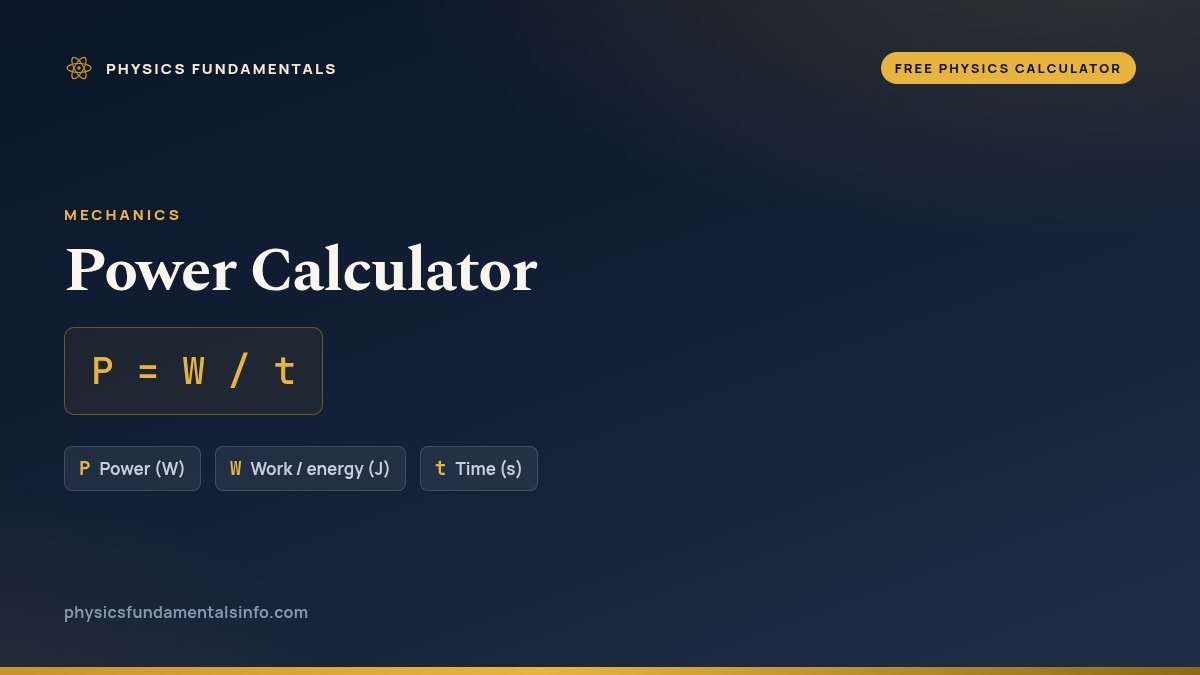
Power: power (P) is the rate at which work is done or energy is transferred, defined by P = W/t. This free calculator solves for power, work or time — in any unit — and shows every step of the working.
What Is the Power Calculator?
The power calculator is a free online tool built on the formula P = W / t. Enter the values you already know, in whichever units suit you, and it solves for power, work or time and shows every step of the substitution. Power is rate of doing work or transferring energy.
| Symbol | Quantity | Default unit | Also accepts | Example value |
|---|---|---|---|---|
| P | Power | W | kW, MW, hp | — |
| W | Work / energy | J | kJ, Wh, kWh | 1000 |
| t | Time | s | min, h | 10 |
How to calculate power
Power measures how quickly energy is used or work is done. To calculate it, divide the work done (or energy transferred) by the time taken: P = W / t. The result is measured in watts (W) in SI units, where one watt is one joule per second. For larger amounts you will see kilowatts (kW) and megawatts (MW), and mechanical power is often quoted in horsepower, where 1 hp ≈ 745.7 W.
There are three steps. First, decide which quantity you want — power, work or time — and select it in the calculator’s Solve for menu. Second, enter the two values you already know and pick their units; the calculator converts everything to SI base units (joules and seconds) behind the scenes, so you never have to convert by hand. Third, read the answer together with the worked steps, which show the formula, your numbers substituted in, and the final value with its units.
The equation rearranges easily. If you know power and time, the work done is W = P × t. If you know work and power, the time taken is t = W ÷ P. There is also a useful mechanical form: when a constant force F pushes an object moving at velocity v, the power delivered is P = F × v. This follows directly from P = W/t, because W = F·d and v = d/t, giving P = F·d/t = F·v.
Power and energy are easy to mix up. Energy (or work) is a total amount measured in joules; power is the rate at which it flows, measured in watts. The same relationship written as P = E / t is what your electricity meter uses — it tracks energy in kilowatt-hours. For a definition of the term itself, see the physics glossary, and for a fuller treatment of work and efficiency try the work and power calculator. Our guide to power in physics works through more examples.
Worked example
A motor does 1500 J of work in 5 seconds. Its power is P = W / t = 1500 / 5 = 300 W. Reading it the other way, that same 300 W motor running for 1 minute (60 s) would do W = P × t = 300 × 60 = 18 000 J of work. And if a constant 50 N force moves a load at 6 m/s, the power is P = F × v = 50 × 6 = 300 W — the same power, expressed in mechanical terms.
Why power matters
Power ratings tell you how fast a job can be done: a higher-power engine accelerates harder, a higher-wattage kettle boils faster, and a power station’s megawatt rating sets how many homes it can supply. Because energy bills charge for energy (kWh) but appliances are rated in power (watts), understanding the link between the two is the key to estimating running costs.
Frequently asked questions
What is the formula for power?
Power (P) is the rate of doing work, or transferring energy: P = W/t. Divide the work done (or energy transferred) by the time it takes. The same equation rearranges to W = P×t and t = W/P, so you can solve for any one of the three quantities.
What are the units of power?
The SI unit of power is the watt (W), where 1 watt equals 1 joule per second. Larger units include the kilowatt (1 kW = 1000 W) and megawatt (1 MW = 1,000,000 W). Mechanical power is sometimes given in horsepower, where 1 hp ≈ 745.7 W.
How is power related to force and velocity?
For a constant force acting along the direction of motion, power equals force times velocity: P = F×v. This follows from P = W/t because work is force times distance (W = F×d) and velocity is distance over time (v = d/t), so P = F×d/t = F×v.
What is the difference between energy and power?
Energy is the total capacity to do work, measured in joules; power is how fast that energy is used, measured in watts. A 100 W bulb left on for an hour uses the same energy (360,000 J, or 0.1 kWh) as a 200 W bulb for half an hour, but the 200 W bulb draws power twice as fast.
How do you convert kilowatt-hours to joules?
A kilowatt-hour is an energy unit: it is the energy used at 1 kW for one hour. Since 1 kW = 1000 W and 1 hour = 3600 s, 1 kWh = 1000 × 3600 = 3,600,000 J (3.6 MJ). This calculator accepts Wh and kWh directly and converts them to joules for you.
References & formula source
- Halliday, Resnick & Walker — Fundamentals of Physics, Chapter 7 (Kinetic Energy and Work).
- Young & Freedman — University Physics with Modern Physics, §6.4 (Power).
- BIPM — The International System of Units (SI): the watt and the joule.
- Further reading: Power (physics) — Wikipedia