Special relativity is Einstein’s 1905 theory of how space and time behave for observers moving at constant velocity relative to one another. It rests on two postulates — the laws of physics are identical in every inertial frame, and the speed of light in vacuum is the same for every observer — and it predicts time dilation, length contraction and E = mc2.
Every time your phone drops the blue dot on the correct street, you are quietly using special relativity. The atomic clocks aboard GPS satellites tick out of step with clocks on the ground, and if engineers ignored that mismatch, your map position would drift by kilometres within a single day.
Nothing you do in daily life is fast enough for you to feel time and space flexing — yet the effect is real, measured constantly, and built into technology you used this morning. By the end of this guide you will know exactly why, and you will be able to calculate it yourself.
What Is Special Relativity?
Start on a smooth, quiet train. Drop your keys and they land at your feet, exactly as they would at home — no experiment inside the carriage can tell you whether you are moving. Galileo spotted this in the 1600s: steady motion is undetectable from the inside.
Then light broke the rule. In the 1860s, James Clerk Maxwell’s equations predicted that light travels at one fixed speed — but a speed relative to what? Physicists assumed an invisible medium, the “luminiferous ether”, and in 1887 Michelson and Morley built an exquisitely sensitive experiment to detect Earth’s motion through it.
They found nothing. Light’s measured speed refused to change, however the apparatus moved. In 1905, a 26-year-old patent clerk named Albert Einstein took that stubborn result at face value and rebuilt mechanics around it.
So here is the precise definition. Special relativity is the theory describing how measurements of space, time, energy and momentum transform between inertial frames — reference frames moving at constant velocity relative to each other. Its consequences include time dilation, length contraction, the relativity of simultaneity, and the equivalence of mass and energy.
Why is it called “special”?
“Special” means special case, not “extra important”. The theory is restricted to inertial frames and ignores gravity. Einstein spent another decade extending it to gravity and acceleration — that 1915 extension is general relativity, which treats gravity as curved spacetime.
The Two Postulates of Special Relativity
The entire theory grows from just two assumptions. Everything else — every strange clock and shrunken ruler — follows from them by pure logic.
- The principle of relativity: the laws of physics are identical in every inertial frame. No experiment performed inside a uniformly moving laboratory can reveal that it is moving.
- The constancy of the speed of light: light in vacuum travels at the same speed, c, for every inertial observer — regardless of the motion of the source or the observer.
The first postulate is old news; Galileo would have nodded along. The second is the bombshell. Shine a torch from a train moving at half the speed of light, and intuition says the platform observer should measure the beam at 1.5c.
They don’t. Both the passenger and the platform observer measure exactly c. If the speed cannot give way, something else must — and that something is time and space themselves.
The Special Relativity Formulas
Four equations do most of the work in this subject. Master the first one and the rest fall into place, because it appears inside all of them.
The Lorentz factor — the master number
- γ (gamma) — the Lorentz factor; dimensionless, and always ≥ 1
- v — the relative speed between the two frames, in metres per second (m/s)
- c — the speed of light in vacuum: exactly 299,792,458 m/s, an exact constant listed in NIST’s table of fundamental physical constants
γ measures how strongly relativistic a situation is. At everyday speeds it is indistinguishable from 1, so Newtonian physics works perfectly. As v approaches c, γ explodes towards infinity — which is precisely why c is unreachable for anything with mass.
A quick sanity check worth building into your fingers: if your calculated γ ever comes out below 1, or you get a negative number under the square root, you have made an error (usually entering v > c, or forgetting to square).
Time dilation
- Δt0 — proper time: the interval measured by a clock present at both events, in seconds (s)
- Δt — the longer interval measured from a frame in which that clock is moving, in seconds (s)
In plain words: a moving clock runs slow, as judged from the frame it moves through. One second aboard a fast ship corresponds to γ seconds on Earth. And it is not just clocks — heartbeats, chemical reactions and particle decays all stretch by the same factor.
Length contraction
- L0 — proper length: the object’s length measured in its own rest frame, in metres (m)
- L — the shorter length measured from a frame in which the object moves, in metres (m)
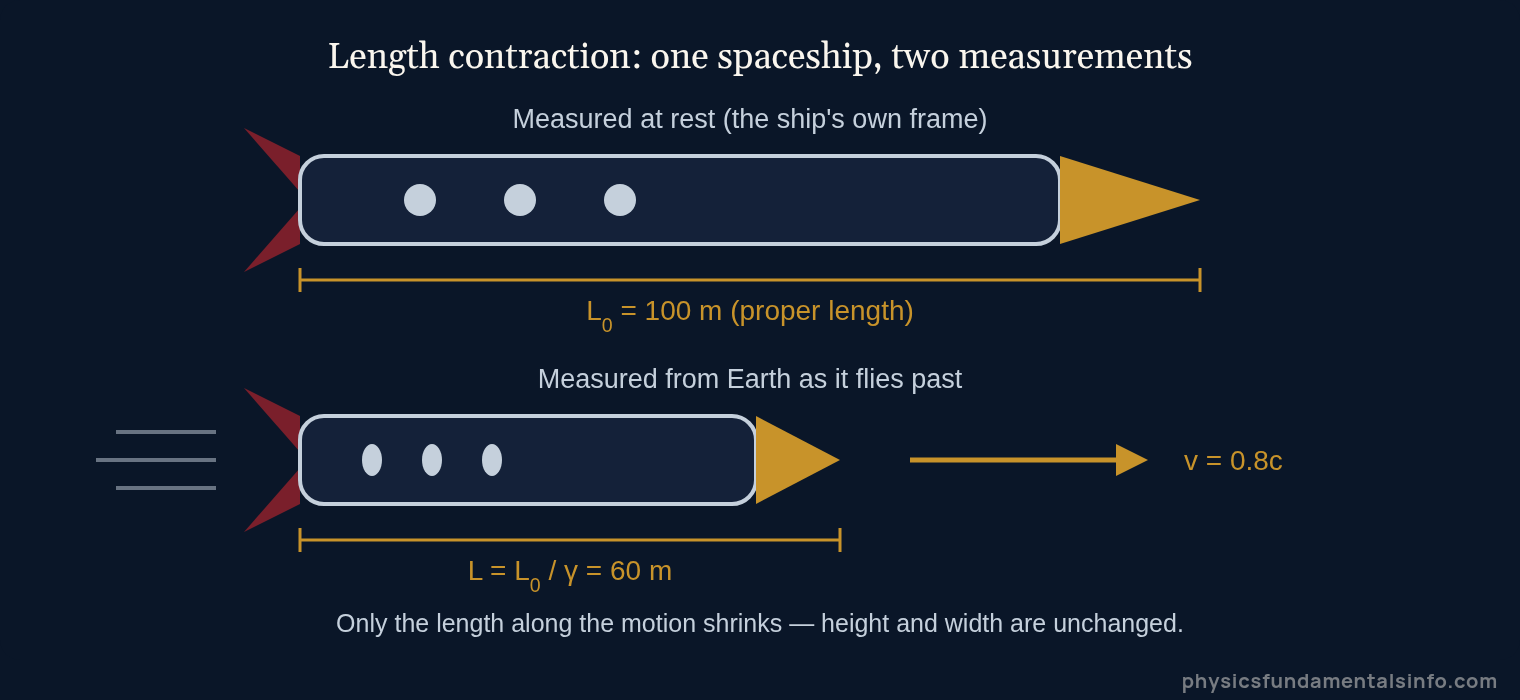
At 0.8c the Lorentz factor is 5/3, so a 100 m ship measures just 60 m from Earth — and the crew notice nothing odd on board.
Mass–energy equivalence
- E — the rest energy of an object, in joules (J)
- m — its mass, in kilograms (kg)
This is the famous one: mass is concentrated energy. Because c2 is enormous — about 9 × 10¹⁶ m2/s2 — a sugar-cube’s worth of mass stores city-flattening energy. For a moving object, the total energy is E = γmc2, and the kinetic energy is the excess above rest: KE = (γ − 1)mc2.
Relativistic momentum
- p — momentum, in kilogram-metres per second (kg·m/s)
Momentum keeps the familiar mv shape but gains a factor of γ. That single tweak is why particle accelerators must pump in ever more energy for ever smaller gains in speed.
How big does γ actually get?
Feel the numbers before you trust the algebra. Here is one second on board a moving craft, as measured from Earth.
| Speed | v / c | Lorentz factor γ | 1 s on board = (Earth-measured) |
|---|---|---|---|
| Cruising airliner (≈250 m/s) | 0.00000083 | 1 + 3.5 × 10⁻¹³ | 1.00000000000035 s |
| 30,000 km/s | 0.10 | 1.005 | 1.005 s |
| 150,000 km/s | 0.50 | 1.155 | 1.155 s |
| 260,000 km/s | 0.866 | 2.000 | 2 s exactly |
| 297,000 km/s | 0.99 | 7.09 | 7.09 s |
| 299,500 km/s | 0.999 | 22.4 | 22.4 s |
| LHC proton | 0.99999999 | ≈7,000 | ≈2 hours |
Notice the shape of that curve: nothing, nothing, nothing — then everything. Relativity hides below about a tenth of light speed, which is why nobody stumbled on it for three centuries of careful mechanics.
How Special Relativity Works: The Light Clock
Where does time dilation actually come from? You can derive it yourself with nothing but Pythagoras and a thought experiment Einstein would have loved: the light clock.
Build a clock from two parallel mirrors with a light pulse bouncing between them. Each bounce is one tick. Now put the clock on a ship and watch it from two points of view.
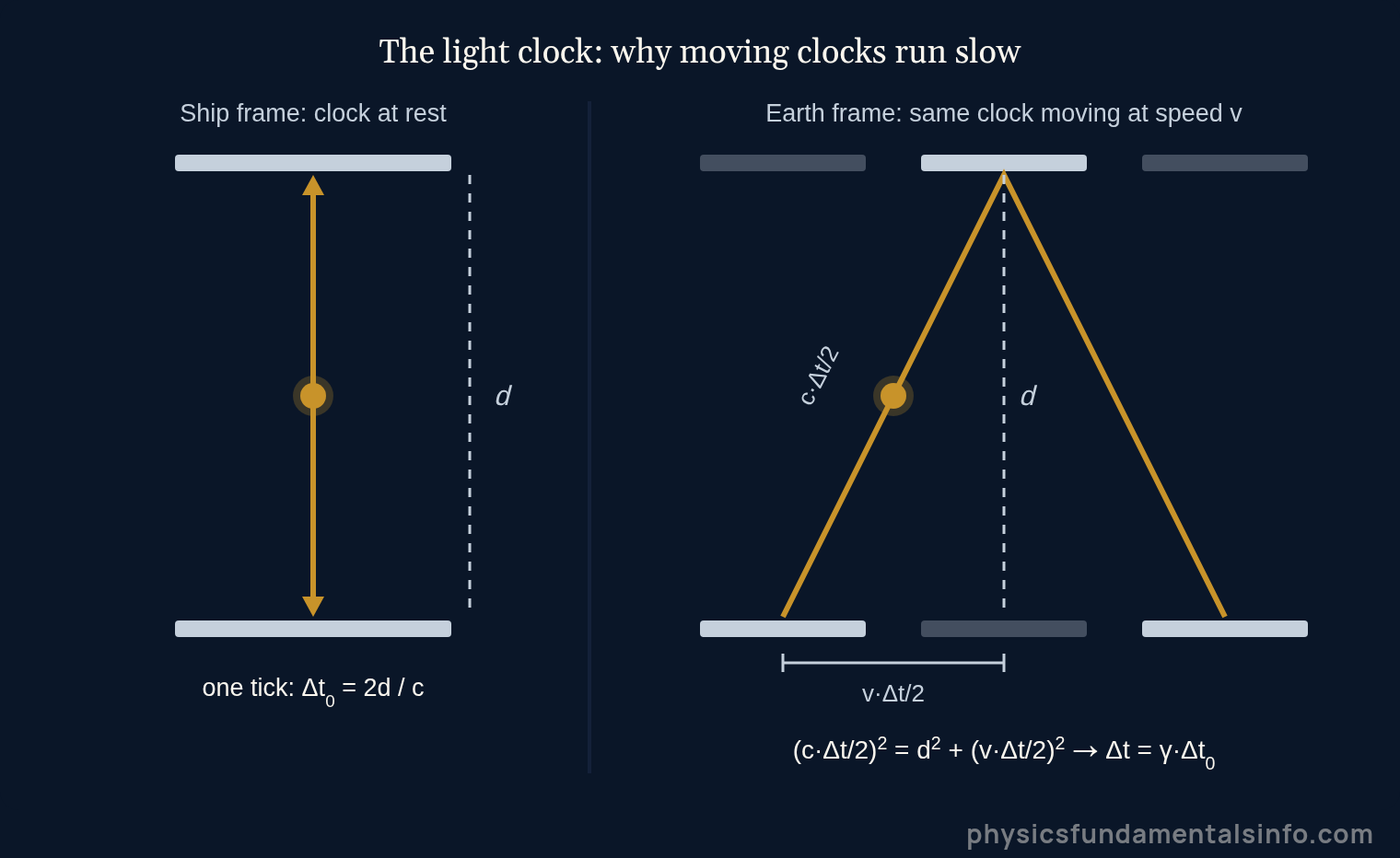
Same clock, two viewpoints. On the ship the pulse travels 2d per tick; from Earth it must cover longer diagonals at the same speed c — so the tick takes longer.
Now the derivation, step by step:
- Ship frame: the pulse goes straight up and down, a distance 2d per tick, so one tick lasts Δt0 = 2d/c.
- Earth frame: while the pulse travels, the whole clock slides sideways. The pulse must trace two diagonals — and by the second postulate it still travels at c, no faster.
- Apply Pythagoras to half a tick: the hypotenuse is c·Δt/2, the vertical side is d, the horizontal side is v·Δt/2. So (c·Δt/2)2 = d2 + (v·Δt/2)2.
- Substitute d = c·Δt0/2 and rearrange: Δt2(1 − v2/c2) = Δt02, which gives Δt = Δt0 / √(1 − v2/c2) = γ·Δt0.
That is the whole secret. Longer path, same speed of light, therefore longer tick. Time dilation is not an optical trick — it is geometry forced on us by a constant c.
And yes, it works both ways
The ship’s crew, watching Earth’s clocks fly past, see those running slow by the same factor. Both views are correct, and there is no contradiction — because the two observers also disagree about which distant events are simultaneous. Giving up a universal “now” is the price of a universal c, and it is the key that unlocks almost every relativity “paradox”.
Ready to feel it rather than read it? Drag the speed slider below and watch γ, the clocks and the ship respond — try 0.866c, where time dilation hits exactly 2.
Real-World Examples of Special Relativity
1. GPS — relativity in your pocket
GPS satellites race along at about 3.87 km/s, so special relativity makes their clocks lose roughly 7 microseconds per day. General relativity (weaker gravity up there) pushes the other way by about 45 microseconds, leaving the satellite clocks a net ~38 microseconds per day fast.
That sounds like nothing — until you remember the system works by timing light signals, and light covers 300 metres per microsecond. Uncorrected, position errors would grow by around 10 kilometres every day. Engineers deliberately set the satellite clocks to tick at a slightly offset rate before launch so that, in orbit, they match ground time.
2. Muons — particles that shouldn’t reach the ground
Cosmic rays striking the upper atmosphere, roughly 15 km up, create muons that decay after about 2.2 microseconds on average. Even at near light speed, that allows a typical journey of only ~650 metres — so essentially none should survive to sea level. Yet detectors at the ground record them constantly.
Time dilation is the reason: at 0.98c their internal clock runs five times slow, stretching their reach into kilometres. From the muon’s own frame the story flips — its clock is fine, but the atmosphere is length-contracted to a fraction of 15 km. Two descriptions, one agreed outcome: the muon arrives.
3. Particle accelerators
At the Large Hadron Collider, protons circulate at about 0.99999999c with a Lorentz factor near 7,000 — each proton carries roughly 7,000 times its rest energy. Every magnet setting and timing signal in the machine is computed relativistically; with Newtonian formulas the beam would be lost in the first microsecond. Accelerator physics is, in effect, special relativity practised as an engineering discipline.
4. The Sun’s power bill
E = mc2 is not a metaphor — it is the Sun’s accounting system. Fusion in the core converts about four million tonnes of mass into pure energy every second, and that lost mass is exactly what lights the Solar System. Nuclear power stations run on the same ledger: weigh the products of a reaction and they come up lighter than the ingredients, with the difference radiated as energy.
5. Why gold is golden
A quieter example sits on ring fingers. In heavy atoms like gold, the innermost electrons move at an appreciable fraction of c, and the resulting relativistic effects shift the orbital energies — changing which colours the metal absorbs. Strip relativity out of the quantum calculation and gold would look silvery-white; the same physics helps explain why mercury is liquid at room temperature.
The Twin Paradox, Resolved
One twin stays on Earth; the other flies to a star at 0.8c and returns at the same speed. Each sees the other’s clock run slow during the trip — so who is actually younger at the reunion? It feels like the theory contradicting itself.
It isn’t, because the situation is not symmetric. The travelling twin must turn around — firing engines, changing inertial frames — while the home twin never does. Only the traveller’s path swaps frames mid-journey, and when you account for that (the relativity of simultaneity again), both twins agree on the result: the traveller returns younger.
The numbers are clean. If Earth logs 10 years for the round trip at 0.8c, the traveller ages 10/γ = 10/(5/3) = 6 years. And this is tested physics: in 1971 the Hafele–Keating experiment flew caesium atomic clocks around the world on airliners, and the tiny time differences matched relativity’s predictions.
Common Misconceptions About Special Relativity
Few theories attract more confident nonsense than this one. Here are the four slips instructors see most — clear them now and the rest of the subject gets easier.
“Mass increases with speed”
Older textbooks taught a “relativistic mass” that grows with γ, but modern physics has largely retired the idea — see the discussion of why on HyperPhysics’ time dilation page. The cleaner statement: mass is invariant, while momentum (γmv) and energy (γmc2) grow without limit as v → c. The object never gets “heavier”; spacetime geometry simply makes further acceleration ever more expensive.
“Relativity means everything is relative”
Almost backwards. The theory is built on quantities everyone agrees on: the speed of light, an object’s rest mass, the proper time along a path, the spacetime interval between events. Einstein reportedly preferred the name “theory of invariants” — what is relative is only the bookkeeping, never the physics.
“Time dilation is just clocks misbehaving”
If it were a mechanical fault, a better clock would fix it. Nothing does, because every process slows identically — atomic transitions, chemical reactions, muon decays, heartbeats. Time itself runs at different rates between frames, which is exactly why the travelling twin returns biologically younger, not just with a slow watch.
“Special relativity can’t handle acceleration”
A common student slip. Special relativity handles accelerating objects perfectly well — accelerator physicists do it daily — by analysing them from inertial frames. What the theory leaves out is gravity; curved spacetime is where general relativity takes over.
How Special Relativity Relates to Other Physics Concepts
Relativity doesn’t demolish classical mechanics; it contains it. Set v ≪ c and γ collapses to 1: momentum γmv becomes plain mv, and Newton’s second law reappears as the low-speed limit. Even better, expand the relativistic kinetic energy (γ − 1)mc2 for small speeds and out drops ½mv2 — the familiar kinetic energy formula, exposed as an excellent approximation rather than an exact law.
The deepest connection is to energy itself. E = mc2 folds mass into the conservation ledger, so the principle explored in what energy is in physics survives intact — provided mass is counted as one of energy’s forms. Electromagnetism, meanwhile, was relativistic before relativity existed: Maxwell’s equations already respect both postulates, which is why Einstein’s 1905 paper was titled “On the Electrodynamics of Moving Bodies”, and why magnetism itself can be viewed as electricity seen from a moving frame.
Two later revolutions grew from this soil. General relativity (1915) extended the framework to gravity as curved spacetime, and merging special relativity with quantum mechanics led Dirac, in 1928, to predict antimatter — the seed of modern quantum field theory.
Worked Problems
Eight problems, easiest first. Throughout, take c = 3.00 × 10⁸ m/s and quote answers to 3 significant figures.
Show Solution
Solution:
Step 1: Use the Lorentz factor: γ = 1 / √(1 − v2/c2).
Step 2: Substitute v = 0.6c: v2/c2 = 0.36, so γ = 1 / √(1 − 0.36) = 1 / √0.64.
Step 3: √0.64 = 0.80, therefore γ = 1 / 0.80 = 1.25. Sanity check: γ ≥ 1 ✓.
Answer: γ = 1.25 (dimensionless)
Show Solution
Solution:
Step 1: Find γ: v2/c2 = 0.982 = 0.9604, so γ = 1 / √(1 − 0.9604) = 1 / √0.0396 = 1 / 0.199 = 5.03.
Step 2 (a): Time dilation: Δt = γ·Δt0 = 5.03 × 2.2 μs = 11.1 μs.
Step 3 (b): Distance = v × Δt = (0.98 × 3.00 × 108 m/s) × 11.1 × 10⁻⁶ s = 2.94 × 10⁸ m/s × 1.11 × 10⁻⁵ s ≈ 3.26 × 10³ m.
Step 4: Compare: without relativity the range would be 2.94 × 108 × 2.2 × 10−6 ≈ 650 m — too short to reach the ground from ~15 km up.
Answer: (a) Δt ≈ 11.1 μs; (b) ≈ 3.26 km on average (vs ≈ 0.65 km classically)
Show Solution
Solution:
Step 1: Find γ: v2/c2 = 0.64, so γ = 1 / √0.36 = 1 / 0.60 = 1.67 (exactly 5/3).
Step 2: Length contraction: L = L0 / γ = 100 m ÷ (5/3).
Step 3: L = 100 × 3/5 = 60 m. Only the dimension along the motion contracts; the ship’s height and width are unchanged.
Answer: L = 60.0 m
Show Solution
Solution:
Step 1: Convert mass to SI: m = 1.0 g = 1.0 × 10⁻³ kg.
Step 2: Apply E = mc2 = 1.0 × 10−3 kg × (3.00 × 108 m/s)2 = 1.0 × 10−3 × 9.00 × 1016 J/kg.
Step 3: E = 9.00 × 10¹³ J. In TNT units: 9.00 × 10¹³ ÷ 4.184 × 10¹² ≈ 21.5 kt.
Answer: E = 9.00 × 10¹³ J ≈ 21.5 kilotons of TNT — from one gram
Show Solution
Solution:
Step 1: Naive addition gives 0.7c + 0.5c = 1.2c — impossible, so use the relativistic velocity-addition formula: u = (u’ + v) / (1 + u’v/c2).
Step 2: Substitute u’ = 0.5c and v = 0.7c: u = (0.5c + 0.7c) / (1 + 0.5 × 0.7) = 1.2c / 1.35.
Step 3: u = 0.889c — below c, as it must be for any massive object.
Answer: u ≈ 0.889c (about 2.67 × 10⁸ m/s)
Show Solution
Solution:
Step 1: Find γ: v2/c2 = 0.81, so γ = 1 / √0.19 = 1 / 0.436 = 2.29.
Step 2: Relativistic momentum: p = γmv = 2.29 × 9.11 × 10−31 kg × (0.9 × 3.00 × 108 m/s).
Step 3: p = 2.29 × 9.11 × 10−31 × 2.70 × 108 ≈ 5.64 × 10⁻²² kg·m/s.
Step 4: Classical value: mv = 9.11 × 10−31 × 2.70 × 108 = 2.46 × 10⁻²² kg·m/s — the true momentum is 2.29 times larger.
Answer: p ≈ 5.64 × 10⁻²² kg·m/s, a factor γ = 2.29 above the classical prediction
Show Solution
Solution:
Step 1: Find γ: v2/c2 = 0.9025, so γ = 1 / √0.0975 = 1 / 0.312 = 3.20.
Step 2: Total energy: E = γmc2 = 3.20 × 938 MeV ≈ 3.00 × 10³ MeV = 3.00 GeV.
Step 3: Kinetic energy is the excess over rest energy: KE = (γ − 1)mc2 = 2.20 × 938 MeV ≈ 2.07 × 10³ MeV.
Answer: E ≈ 3.00 GeV; KE ≈ 2.07 GeV
Show Solution
Solution:
Step 1: For v ≪ c, the fractional slowdown is γ − 1 ≈ v2 / 2c2.
Step 2: Substitute v = 3.87 × 10³ m/s: v2 = 1.50 × 10⁷ m2/s2, and 2c2 = 1.80 × 10¹⁷ m2/s2, giving γ − 1 ≈ 8.3 × 10⁻¹¹.
Step 3: Over one day (86,400 s): lost time = 8.3 × 10−11 × 86,400 s ≈ 7.2 × 10⁻⁶ s.
Step 4: Context: general relativity adds about +45 μs/day (weaker gravity), so the net satellite clock runs ≈ 38 μs/day fast — the correction GPS applies.
Answer: ≈ 7 μs lost per day from special relativity alone
Frequently Asked Questions
What is the difference between special and general relativity?
Special relativity (1905) covers observers moving at constant velocity and ignores gravity; general relativity (1915) extends it to gravity and acceleration by treating gravity as curved spacetime. Special relativity is the “special case” that works perfectly whenever gravitational effects are negligible — which covers most particle physics and almost all everyday technology.
Why can nothing travel faster than light?
Because the energy needed to accelerate a massive object grows with the Lorentz factor γ, which becomes infinite as v approaches c — no finite energy supply can finish the job. Faster-than-light signals would also let some observers see effects occur before their causes. Only massless particles, such as photons, travel at exactly c.
Has special relativity been proven experimentally?
Yes — it is among the most thoroughly tested theories in physics. Cosmic-ray muons reach the ground only because of time dilation, particle accelerators confirm relativistic energy and momentum daily, the 1971 Hafele–Keating experiment measured the effect on atomic clocks flown around the world, and GPS must correct for it continuously to stay accurate.
Does time dilation affect astronauts on the ISS?
Yes, measurably. The International Space Station orbits at about 7.7 km/s, so an astronaut’s clock runs slightly slower than ours; after six months in orbit they have aged a few milliseconds less than people on Earth. Weaker gravity at altitude pushes the other way, but at the ISS’s height the speed effect wins.
Who discovered special relativity?
Albert Einstein published the special theory of relativity in June 1905, in a paper titled “On the Electrodynamics of Moving Bodies”. Hendrik Lorentz and Henri Poincaré had already developed much of the mathematics, but Einstein was the first to derive it all from two simple physical postulates — and to abandon absolute time.
Can special relativity be used for time travel?
Only one way: forwards. Travel close to the speed of light and your clock genuinely runs slower than Earth’s, so you return having aged less — arriving, in effect, in Earth’s future. That is real, tested physics. Travelling backwards in time would violate causality, and nothing in special relativity, or any verified physics, permits it.