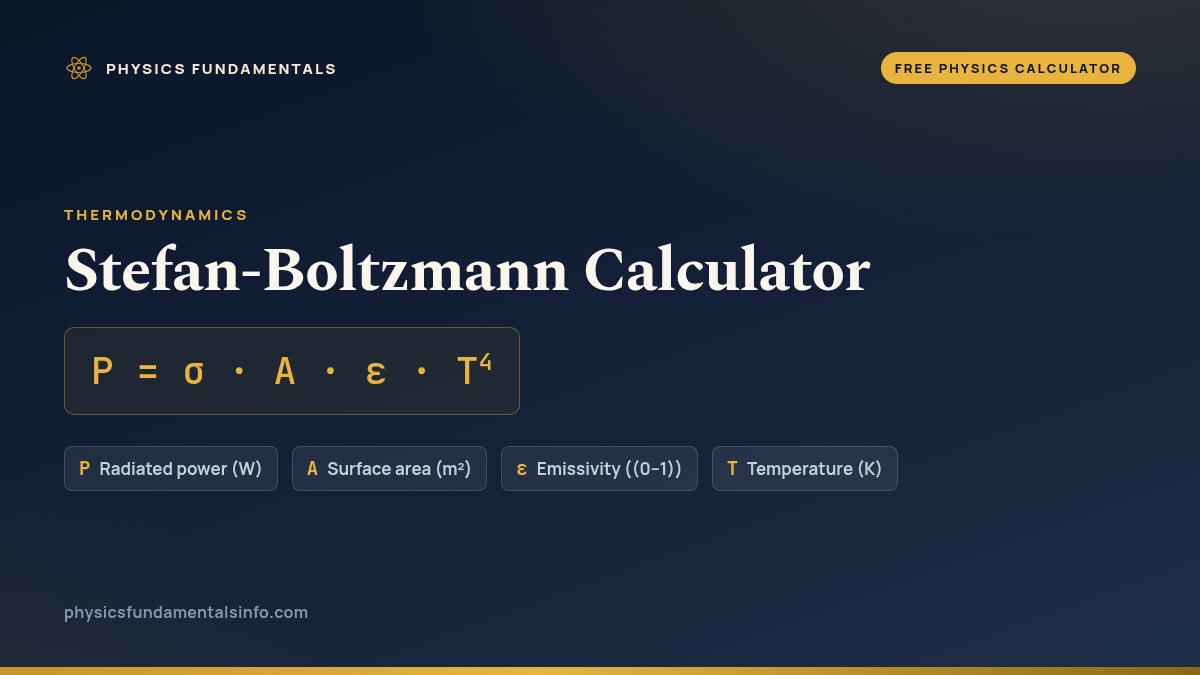
Stefan-Boltzmann law: every surface radiates thermal energy at a rate that climbs with the fourth power of its absolute temperature, P = σAεT4. This free calculator solves for the radiated power or the temperature, in any unit, and shows every step of the working.
What Is the Stefan-Boltzmann Calculator?
The Stefan-Boltzmann calculator is a free online tool built on the formula P = σ · A · ε · T4. Enter the values you already know, in whichever units suit you, and it solves for radiated power or temperature and shows every step of the substitution. Stefan-Boltzmann is power radiated by a black body, P = σAεT^4.
| Symbol | Quantity | Default unit | Also accepts | Example value |
|---|---|---|---|---|
| P | Radiated power | W | kW, MW | — |
| A | Surface area | m² | cm² | 1 |
| ε | Emissivity | (0–1) | — | 1 |
| T | Temperature | K | — | 1000 |
How to calculate radiated power
The Stefan-Boltzmann law tells you how much thermal power a hot surface gives off as electromagnetic radiation. To calculate it, multiply four things together: the Stefan-Boltzmann constant σ (5.670374×10⁻⁸ W·m-²·K-4), the radiating area A, the emissivity ε, and the absolute temperature raised to the fourth power — P = σ·A·ε·T4. The answer is a power in watts.
There are three steps. First, decide whether you want the power or the temperature, and select it in the calculator’s Solve for menu. Second, enter the values you know: the surface area (square metres or square centimetres), the emissivity, and the temperature in kelvin. The emissivity is a fraction between 0 and 1 — use 1 for an ideal black body, or a measured value for a real surface. Third, read the answer with the worked steps, which show the formula, your numbers substituted in, and the result with units.
The single most common mistake is using the wrong temperature scale. The T4 term demands an absolute temperature, so values must be in kelvin (K = °C + 273.15). Because the dependence is to the fourth power, a small error in temperature becomes a large error in power. Keeping temperatures in kelvin — as this calculator requires — avoids the problem entirely.
To go the other way and find a surface’s temperature from its emitted power, the law rearranges to T = (P / σAε)^¼. This non-contact method underlies infrared thermometers and astronomical estimates of stellar surface temperatures. For the heat needed to warm a body in the first place, see the specific heat calculator; for the term itself, see the physics glossary.
Worked example
A black-body radiator (ε = 1) has a surface area of 1 m² and is held at 1000 K. Its radiated power is P = σ·A·ε·T4 = 5.670374×10-8 × 1 × 1 × 10004 ≈ 5.67×10⁴ W, about 56.7 kW. If the temperature is doubled to 2000 K, the T4 term grows by a factor of 24 = 16, so the power leaps to roughly 907 kW — illustrating just how steeply thermal radiation rises with temperature.
Why it matters
The Stefan-Boltzmann law underpins the energy balance of stars and planets (including Earth’s climate), the design of furnaces, radiators and incandescent lamps, the calibration of infrared cameras and pyrometers, and the thermal management of spacecraft that can only shed heat by radiation.
Frequently asked questions
What is the Stefan-Boltzmann law?
The Stefan-Boltzmann law states that the thermal power radiated by a surface is proportional to the fourth power of its absolute temperature: P = σAεT^4. Here σ is the Stefan-Boltzmann constant, A is the radiating area, ε is the emissivity and T is the temperature in kelvin. Because of the T^4 term, doubling the absolute temperature increases the radiated power sixteenfold.
What is the value of the Stefan-Boltzmann constant?
The Stefan-Boltzmann constant σ is 5.670374×10^-8 W·m^-2·K^-4 (more precisely 5.670374419×10^-8). It is a fixed quantity derived from the speed of light, the Planck constant and the Boltzmann constant, and it sets the absolute scale of thermal radiation.
What does emissivity mean?
Emissivity (ε) is a number between 0 and 1 that describes how efficiently a surface radiates compared with a perfect black body. A perfect black body has ε = 1, polished metals can be as low as 0.02, and most everyday painted or oxidised surfaces fall between 0.8 and 0.95. Multiply the black-body power by ε to get the real radiated power.
Why must the temperature be in kelvin?
The T^4 term uses absolute temperature, so the zero point must be absolute zero. Use kelvin, where K = °C + 273.15. Plugging in degrees Celsius gives a badly wrong answer because the law is not linear — a small absolute-temperature error is amplified to the fourth power.
How do I find the temperature of a radiating object?
Rearrange the law to T = (P / σAε)^¼. Divide the radiated power by σ, the area and the emissivity, then take the fourth root. Select “Temperature” in the calculator’s “Solve for” menu and it performs this rearrangement automatically — this is the basis of how a pyrometer or infrared thermometer reads temperature without contact.
References & formula source
- Halliday, Resnick & Walker — Fundamentals of Physics, Chapter 18 (Temperature, Heat & the First Law of Thermodynamics).
- Young & Freedman — University Physics with Modern Physics, §17.7 (Radiation and the Stefan-Boltzmann law).
- NIST — CODATA recommended value of the Stefan-Boltzmann constant σ = 5.670374419 × 10^-8 W·m^-2·K^-4.
- Further reading: Stefan–Boltzmann law — Wikipedia