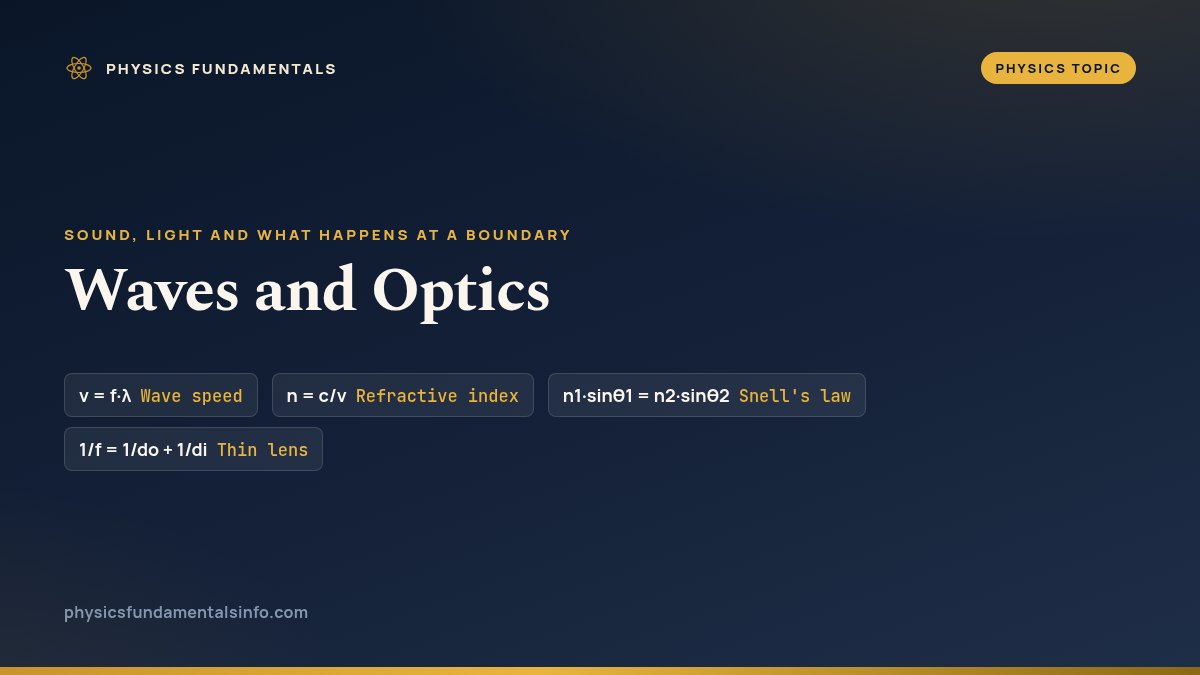
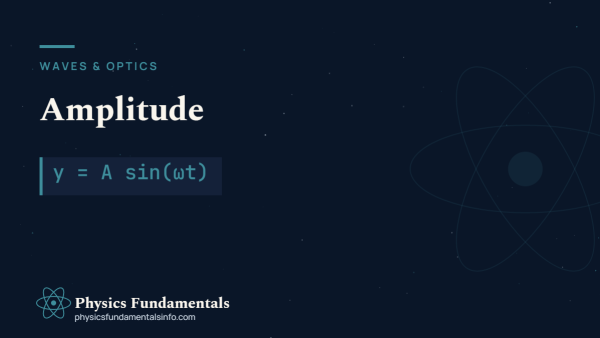
Waves & Optics
Refractive Index (n = c/v): Formula & Table
The refractive index n = c/v tells you how much a material slows light. Get the full table of 15 values from air to diamond, plus worked examples and an interactive lab.
15 min read
Oscillations, sound and light as waves: wave speed, frequency and wavelength, interference, reflection and refraction, and how waves carry energy.
The refractive index n = c/v tells you how much a material slows light. Get the full table of 15 values from air to diamond, plus worked examples and an interactive lab.
15 min read
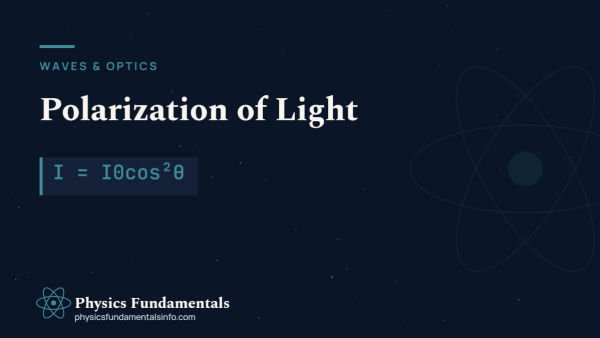
Polarization of light is the direction a light wave's electric field vibrates in. Learn Malus's law (I = I0cos²θ), Brewster's angle, real-world examples and worked problems.
14 min read
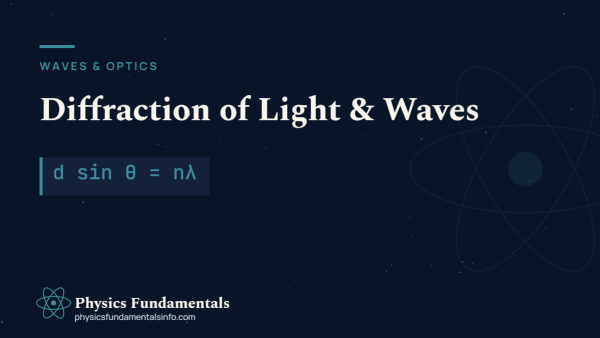
Diffraction is the bending and spreading of waves through gaps and around edges. Learn the grating formula d sin θ = nλ with six real-world examples, worked problems and an interactive lab.
15 min read
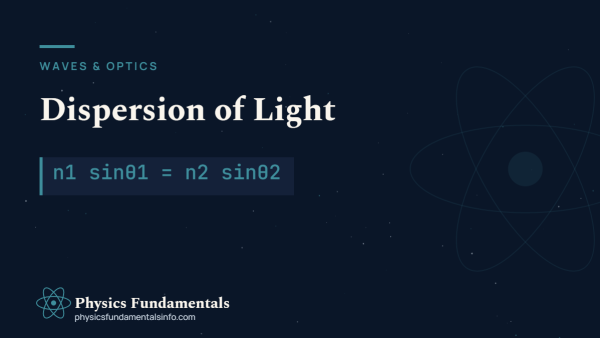
Dispersion of light is why a glass prism splits white light into a rainbow. Learn why violet bends more than red, the key formulas, and 7 real-world examples.
15 min read
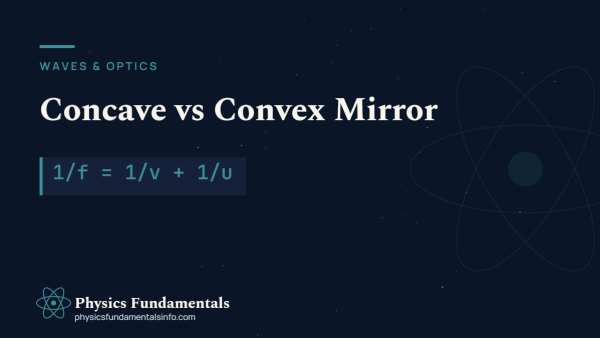
A concave mirror curves inward and converges light to a real focus; a convex mirror bulges outward and diverges it from a virtual focus behind the glass. Ray diagrams, the mirror formula, seven worked problems and the reason your wing mirror lies about distance.
18 min read
A clear comparison of concave and convex lenses: how each bends light, the images they form, the lens formula 1/f = 1/v − 1/u, worked examples and ray diagrams.
14 min read
Total internal reflection traps light inside a denser medium once it strikes a boundary beyond the critical angle (sin θc = n₂/n₁). Here's how it works, eight worked examples, and why it powers fibre optics and makes diamonds sparkle.
13 min read
A clear, complete guide to the electromagnetic spectrum: the seven bands from radio waves to gamma rays, the c = fλ relationship, photon energy, real-world examples and worked problems.
11 min read
Reflection and refraction explained simply, with the laws, Snell's law, refractive index, total internal reflection, worked examples, and an interactive lab.
6 min read
Transverse vs longitudinal waves explained simply: perpendicular vs parallel vibration, with worked examples for light, sound, water, slinkies, and earthquakes, plus the v = fλ formula.
12 min read
The Doppler effect is the change in a wave's observed frequency when the source and observer move relative to each other. Learn the formula, real examples from sirens to redshift, and try the interactive lab.
11 min read
The frequency formula, f = 1/T, gives the number of cycles per second in hertz. This guide explains how to calculate frequency from period, wavelength, and wave speed, with worked examples and the common mistakes to avoid.
10 min read