Uniform circular motion: an object moving in a circle at constant speed is constantly accelerating toward the centre at a_c = v²/r, kept on its path by an inward centripetal force F_c = m·v²/r. This free calculator takes the speed, radius and mass and returns the centripetal acceleration, the centripetal force, the angular velocity and the period, with every step of the working.
What Is the Circular Motion Calculator?
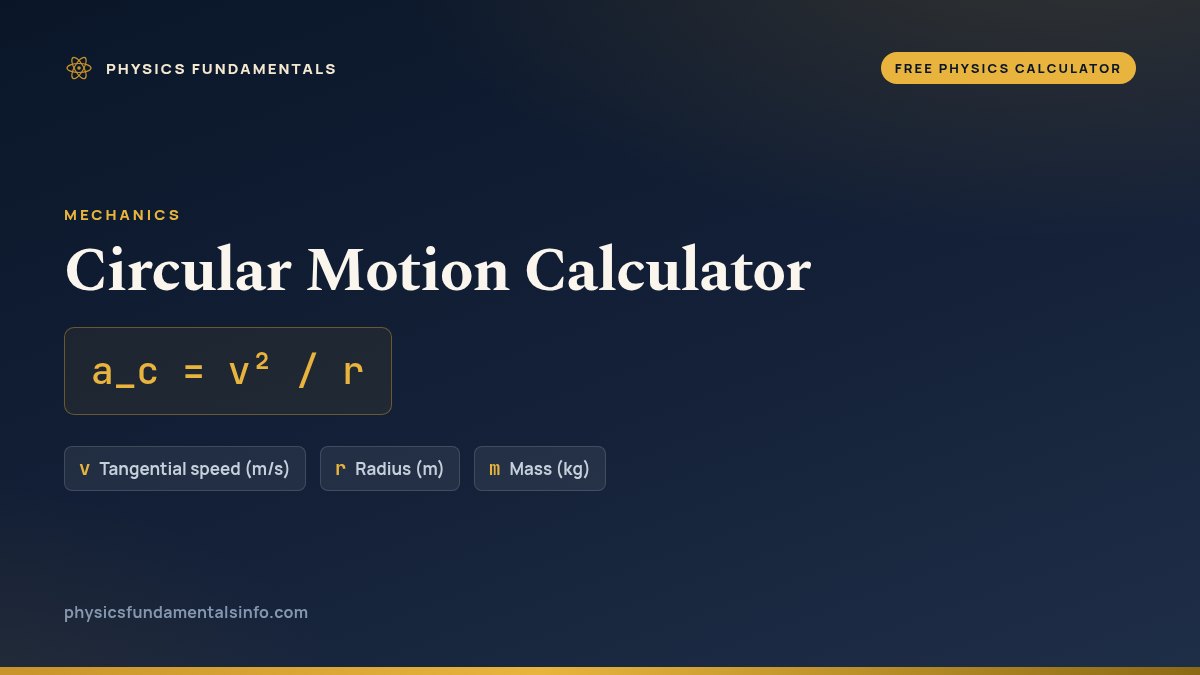
The circular motion calculator is a free online tool built on the formula a_c = v² / r. Enter the values you already know, in whichever units suit you, and it solves for centripetal force/accel, ω, period and shows every step of the substitution. Circular Motion is centripetal acceleration and force for motion in a circle.
| Symbol | Quantity | Default unit | Also accepts | Example value |
|---|---|---|---|---|
| v | Tangential speed | m/s | km/h | 10 |
| r | Radius | m | cm, km | 5 |
| m | Mass | kg | g | 2 |
How to calculate circular motion
An object moving in a circle is constantly accelerating — not because its speed changes, but because its direction does, a distinction explained in our guide on velocity versus speed. That acceleration points toward the centre and requires an inward (centripetal) force. Remove the force and the object flies off along a tangent.
The core relationship is the centripetal acceleration, a_c = v²/r: the square of the tangential speed divided by the radius of the circle. Multiply that by the mass to get the centripetal force that must be supplied to keep the object turning, F_c = m·a_c = m·v²/r. The same two inputs also give the rotation rate and the time per lap.
There are three steps. First, enter the tangential speed v in m/s or km/h. Second, enter the radius r in metres, centimetres or kilometres, and the mass m in kilograms or grams — the calculator converts everything to SI for you. Third, read the answer: the centripetal acceleration in m/s², with the centripetal force, the angular velocity and the period shown alongside, and the worked steps that substitute your numbers into each formula.
Two relationships are worth feeling directly. Centripetal acceleration grows with the square of the speed — double the speed and the acceleration (and the required force) quadruple — but falls as the radius grows, so a wider arc at the same speed is gentler. Dividing the speed by the radius also gives the angular velocity ω, the rotation rate in radians per second, and the period follows as T = 2πr/v. To find the force directly for a given mass, see the centripetal force calculator, or look up a term in the physics glossary.
Worked example
An object travels at v = 10 m/s around a circle of radius r = 5 m with a mass of m = 2 kg. The centripetal acceleration is a_c = v²/r = 10²/5 = 20 m/s², so the centripetal force is F_c = m·a_c = 2 × 20 = 40 N. Dividing the speed by the radius gives the angular velocity, ω = 10/5 = 2 rad/s, and one full revolution takes T = 2πr/v = 2π × 5 / 10 ≈ 3.14 s. Double the speed to 20 m/s and the acceleration jumps to 80 m/s² — four times as much — a direct illustration of the v² dependence.
Why it matters
Circular motion governs satellite and planetary orbits, cars cornering, centrifuges, washing-machine spin cycles and fairground rides. On a banked curve the track is tilted so that a component of the normal force supplies the centripetal force, letting vehicles corner without relying on friction. Anywhere something travels along a curved path — from an electron in a magnetic field to a hammer-thrower's swing — the centripetal acceleration v²/r is the starting point.
Frequently asked questions
Why does an object in uniform circular motion accelerate if its speed is constant?
Acceleration is the rate of change of velocity, and velocity is a vector that includes direction. In uniform circular motion the speed (the magnitude) stays fixed, but the direction of travel changes continuously, so the velocity changes and the object accelerates. That acceleration, a_c = v²/r, always points toward the centre of the circle, which is why it is called centripetal ("centre-seeking").
What is the difference between centripetal acceleration and centripetal force?
Centripetal acceleration a_c = v²/r is the inward acceleration every object in circular motion has, regardless of its mass. Centripetal force F_c = m·a_c = m·v²/r is the actual inward force needed to produce that acceleration on a particular mass. The force is supplied by something physical — tension in a string, friction on a tyre, gravity on a satellite — and if it disappears the object flies off along a tangent.
How are angular velocity and period related to speed and radius?
Angular velocity ω is how fast the angle is swept out, in radians per second, and equals the tangential speed divided by the radius: ω = v/r. The period T is the time for one full revolution: T = 2πr/v = 2π/ω. So a larger radius at the same speed means a slower rotation rate and a longer period.
What units does the circular motion calculator use?
Speed v is entered in m/s or km/h, radius r in metres, centimetres or kilometres, and mass m in kilograms or grams; all are converted to SI internally. Results come back as centripetal acceleration in m/s², centripetal force in newtons (N), angular velocity in radians per second (rad/s) and period in seconds (s).
What happens to centripetal acceleration if I double the speed or the radius?
Because a_c = v²/r, acceleration depends on the square of the speed but only inversely on the radius. Doubling the speed quadruples the centripetal acceleration (and force), while doubling the radius at the same speed halves it. This v² dependence is why cornering fast is so much more demanding than cornering slowly.
References & formula source
- Young & Freedman — University Physics with Modern Physics, §3.4 (Motion in a Circle) and §5.4 (Dynamics of Circular Motion).
- Halliday, Resnick & Walker — Fundamentals of Physics, Chapter 4 §4.7 (Uniform Circular Motion) and Chapter 6 (Force and Motion II).
- Serway & Jewett — Physics for Scientists and Engineers, Chapter 4 §4.4 and Chapter 6 (Circular Motion and Other Applications of Newton's Laws).
- Further reading: Circular motion — Wikipedia