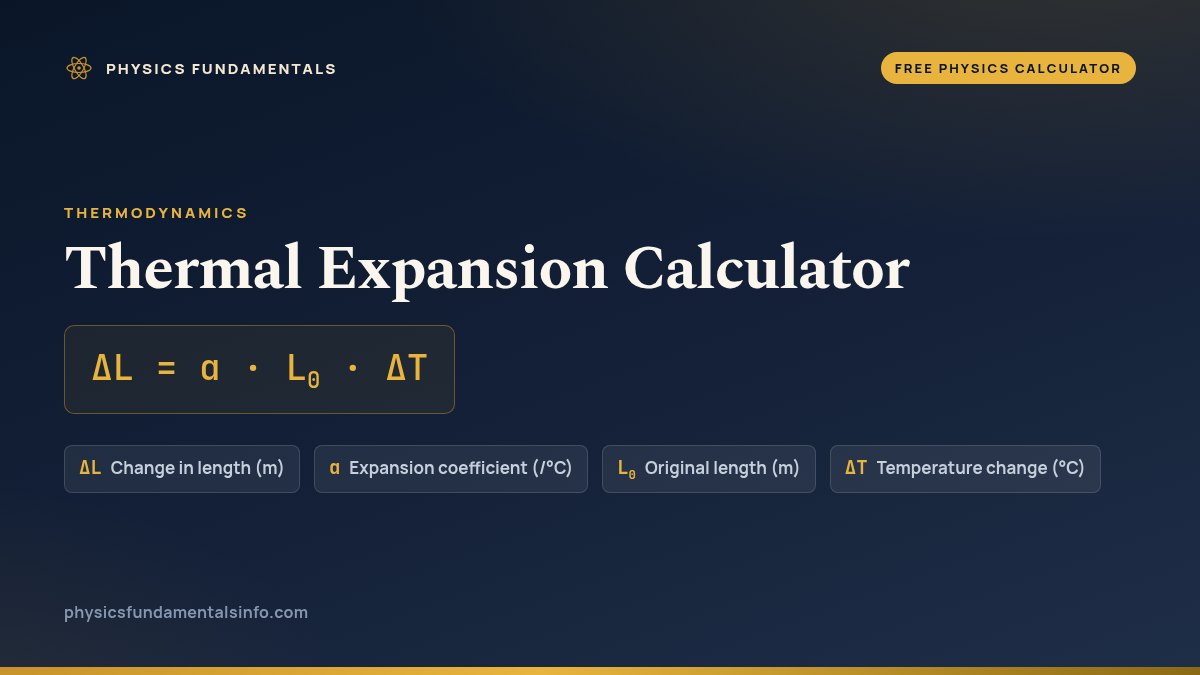
Linear thermal expansion: heat a solid and it grows, by an amount set by its expansion coefficient, its original length and the temperature change — ΔL = α·L0·ΔT. This free calculator solves for the length change, the original length or the temperature change, in any unit, with a built-in material library and full step-by-step working.
What Is the Thermal Expansion Calculator?
The thermal expansion calculator is a free online tool built on the formula ΔL = α · L0 · ΔT. Enter the values you already know, in whichever units suit you, and it solves for length/area/volume change and shows every step of the substitution. Thermal Expansion is how materials grow when heated.
| Symbol | Quantity | Default unit | Also accepts | Example value |
|---|---|---|---|---|
| ΔL | Change in length | m | mm, cm | 0.0036 |
| α | Expansion coefficient | /°C | — | 1.2e-05 |
| L0 | Original length | m | cm, km | 10 |
| ΔT | Temperature change | °C | K | 30 |
How to calculate thermal expansion
Most materials expand when heated because their atoms vibrate more vigorously and sit farther apart on average. For a solid rod, beam or rail, the change in length is captured by a single product: the material’s linear expansion coefficient α multiplied by the original length L0 and the temperature change ΔT — ΔL = α·L0·ΔT. The new length is simply L0 + ΔL. The coefficient α is tiny, of order ten parts per million per degree, which is why expansion is usually invisible until you are dealing with long spans or precise tolerances.
There are three steps. First, decide what you want — the length change ΔL, the original length L0, or the temperature change ΔT — and pick it in the calculator’s Solve for menu. Second, enter the values you know: choose a material to load its coefficient (steel, aluminium, copper, glass or concrete) or type your own α, give the original length in metres, centimetres or kilometres, and the temperature change in °C or K. Third, read the answer with the worked steps, which show the formula, your numbers substituted in, the result, and the new total length.
One unit point is worth pinning down. The coefficient is quoted per-degree, and because ΔT is a temperature difference rather than an absolute reading, a change of 1 °C is identical to a change of 1 K — so α in /°C and α in /K are the same number, and you never convert to absolute kelvin here. Adding heat and raising temperature are not the same thing, as our guide on the difference between heat and temperature explains; how far the temperature actually rises for a given amount of heat depends on the material’s specific heat capacity, and that temperature rise is what drives the expansion.
Length is only the start. For an isotropic solid, area expands at roughly twice the linear rate (ΔA ≈ 2α·A0·ΔT) and volume at roughly three times (ΔV ≈ 3α·V0·ΔT), because the small linear stretch acts in two and three directions at once. In high-temperature applications the same hot components also lose energy as thermal radiation and shed heat by conduction, so engineers account for expansion and heat flow together. You can also look up any term in the physics glossary.
Worked example
A 10 m steel beam is warmed by ΔT = 30 °C, with α = 12 × 10-6 /°C. The length change is ΔL = α·L0·ΔT = 12 × 10-6 × 10 × 30 = 0.0036 m = 3.6 mm, so the beam grows to 10.0036 m — small, but enough to require expansion joints. Swap the steel for aluminium (α ≈ 23 × 10-6 /°C) and the same beam grows about 6.9 mm instead, nearly double, because aluminium’s coefficient is almost twice as large.
Why it matters
Thermal expansion governs the design of bridge and railway expansion joints, pipeline loops, overhead power lines, and the gaps left in concrete roadways and rail track. It is the working principle behind bimetallic-strip thermostats, and a constant headache in precision instruments, glass-to-metal seals and electronics where mismatched coefficients crack joints. Anywhere a structure spans a distance and sees a temperature swing, ΔL = αL0ΔT is the first calculation an engineer reaches for.
Frequently asked questions
What is the formula for linear thermal expansion?
Linear thermal expansion is ΔL = α·L0·ΔT: the change in length equals the material’s linear expansion coefficient α multiplied by the original length L0 and the temperature change ΔT. The new length is L0 + ΔL. Area expands at roughly twice this rate (ΔA ≈ 2α·A0·ΔT) and volume at roughly three times (ΔV ≈ 3α·V0·ΔT).
What units does the thermal expansion calculator use?
The expansion coefficient α is in per-degree (/°C), which is numerically identical to per-kelvin (/K) because both are based on a temperature difference. Lengths can be entered in metres, centimetres, millimetres or kilometres, and the temperature change ΔT in °C or K. Because ΔT is a difference rather than an absolute reading, a change of 1 °C equals a change of 1 K, so no conversion is needed between them.
What is the linear expansion coefficient of steel, aluminium and other materials?
The calculator’s presets give typical values near room temperature: steel about 12 × 10^-6 /°C, aluminium about 23 × 10^-6 /°C, copper about 17 × 10^-6 /°C, glass about 9 × 10^-6 /°C and concrete about 12 × 10^-6 /°C. Aluminium expands roughly twice as much as steel for the same temperature rise, which is why mixed-metal assemblies must allow for differential movement.
Why do bridges and railway tracks need expansion joints?
A long steel span grows measurably when the sun heats it: a 100 m rail warming by 30 °C lengthens by about 36 mm. Without somewhere to go, that expansion builds up enormous compressive forces that can buckle the track or crack the structure. Expansion joints, sliding bearings and gaps between rail sections give the metal room to grow and shrink safely through the seasons.
Do area and volume expand at the same rate as length?
No — they expand faster. For an isotropic material the area expansion coefficient is about 2α and the volume coefficient about 3α, so a heated cube’s surface grows at roughly twice, and its volume at roughly three times, the linear rate. These factors follow from expanding (1 + αΔT) squared and cubed and keeping the leading term, which is accurate whenever αΔT is small.
References & formula source
- Young & Freedman — University Physics with Modern Physics, §17.4 (Thermal Expansion).
- Halliday, Resnick & Walker — Fundamentals of Physics, Chapter 18 (Temperature, Heat & the First Law of Thermodynamics).
- Serway & Jewett — Physics for Scientists and Engineers, Chapter 19 (Temperature: Thermal Expansion of Solids and Liquids).
- Further reading: Thermal expansion — Wikipedia