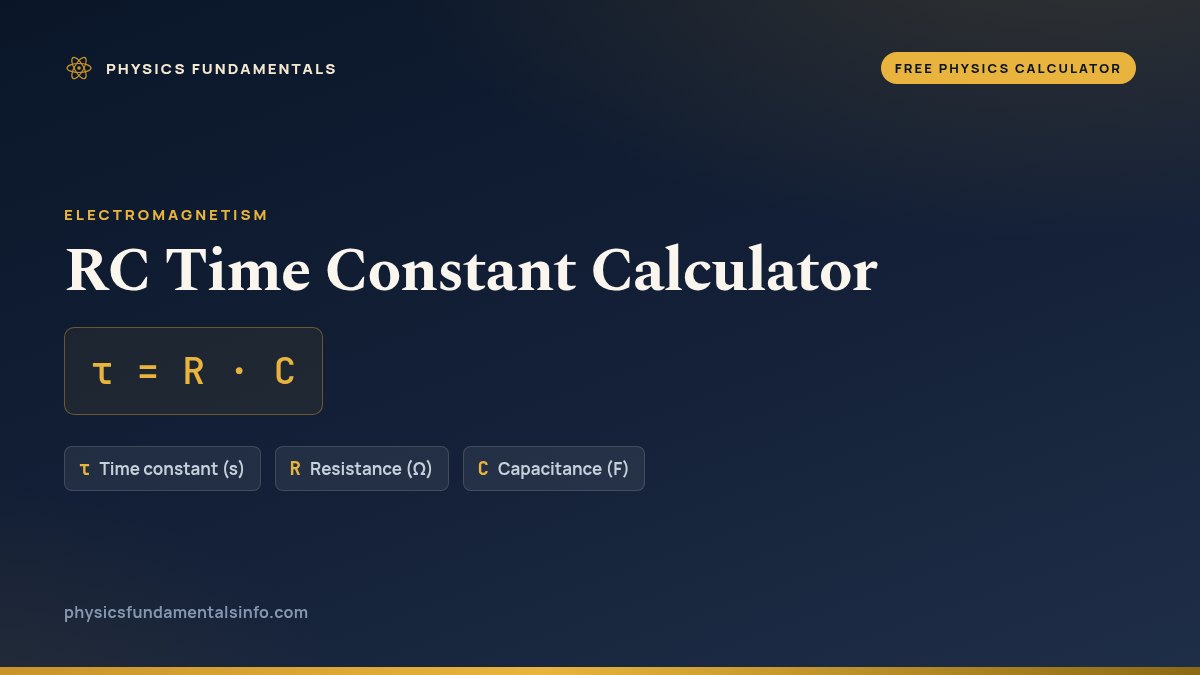
RC time constant: the time constant (τ) of a resistor–capacitor circuit is the product of its resistance and capacitance, τ = R·C. It sets how quickly the capacitor charges or discharges. This free calculator solves for τ, R or C — in any unit — and shows every step of the working.
What Is the RC Time Constant Calculator?
The RC time constant calculator is a free online tool built on the formula τ = R · C. Enter the values you already know, in whichever units suit you, and it solves for time constant, resistance or capacitance and shows every step of the substitution. Charging time constant of an RC circuit, τ = RC.
| Symbol | Quantity | Default unit | Also accepts | Example value |
|---|---|---|---|---|
| τ | Time constant | s | ms, µs | — |
| R | Resistance | Ω | kΩ, MΩ | 1000 |
| C | Capacitance | F | mF, µF, nF | 1 |
How to calculate the RC time constant
The time constant of a series resistor–capacitor (RC) circuit measures how fast it responds. To calculate it, multiply the resistance by the capacitance: τ = R × C. With resistance in ohms (Ω) and capacitance in farads (F), the time constant τ comes out in seconds. Because the farad is a large unit, real circuits usually use microfarads (µF) or nanofarads (nF), and resistors are often quoted in kilohms (kΩ) or megohms (MΩ).
There are three steps. First, decide which quantity you want — the time constant, the resistance or the capacitance — and select it in the calculator’s Solve for menu. Second, enter the two values you already know and pick their units; the calculator converts everything to SI base units (ohms, farads and seconds) behind the scenes, so you never have to convert powers of ten by hand. Third, read the answer together with the worked steps, which show the formula, your numbers substituted in, and the final value with its units.
The equation rearranges directly. If you know the time constant and the capacitance, the resistance is R = τ ÷ C. If you know the time constant and the resistance, the capacitance is C = τ ÷ R. The physical meaning of τ is the same in every case: after one time constant a charging capacitor reaches about 63.2% of the supply voltage, and after about five time constants (5τ) it is treated as fully charged at roughly 99.3%. When you solve for τ, the calculator also reports both of those times for you.
The time constant only describes the timing — it does not by itself tell you the steady current or voltage. For those, pair it with Ohm’s law to find the initial charging current from the supply voltage and resistance, and use the resistor calculator when several resistors combine to set the effective R.
Worked example
A 10 kΩ resistor charges a 100 µF capacitor from a battery. Converting to SI, R = 10 000 Ω and C = 0.0001 F, so the time constant is τ = R × C = 10000 × 0.0001 = 1 s. The capacitor therefore reaches about 63% of the supply voltage after 1 second, and is effectively fully charged after 5τ = 5 s. Halve the resistor to 5 kΩ and τ drops to 0.5 s, so the circuit charges twice as fast.
Why the time constant matters
The RC time constant sets the timing of countless everyday circuits: it shapes the delay in timers and flash circuits, the cutoff of audio and signal filters, the debounce on switches, and the smoothing of power supplies. Knowing τ tells an engineer how quickly a circuit will settle, switch or react. To brush up on the resistor side of the equation, our guide to Ohm’s law and resistance walks through how voltage, current and resistance work together.
Frequently asked questions
What is the RC time constant?
The RC time constant, written with the Greek letter tau (τ), is the product of resistance and capacitance: τ = R × C. It is the time, in seconds, for the voltage on a charging capacitor to reach about 63% of its final value, or to fall to about 37% when discharging. A larger τ means a slower circuit.
What is the formula for the time constant?
τ = R × C, where R is in ohms (Ω) and C is in farads (F), giving τ in seconds. The equation rearranges to R = τ / C and C = τ / R, so if you know the time constant and either component you can find the other. Choose the quantity you want in the “Solve for” menu and the calculator does the rearrangement for you.
How long does it take a capacitor to fully charge?
A capacitor never charges to exactly 100%, but after 5 time constants (5τ) it has reached about 99.3% of the supply voltage, which is treated as “fully charged” in practice. After 1τ it is at ~63.2%, after 2τ ~86.5%, after 3τ ~95.0% and after 4τ ~98.2%.
What units should I use for R and C?
In SI, resistance is in ohms (Ω) and capacitance is in farads (F), giving the time constant in seconds. Real components are often in kΩ or MΩ and µF or nF, so this calculator lets you enter those directly and converts to SI before computing. For example 10 kΩ with 100 µF gives τ = 1 s.
Is the time constant the same for charging and discharging?
Yes. For a simple series RC circuit the time constant τ = R × C governs both charging and discharging. While charging, the voltage rises toward the supply as V = V0(1 − e^(−t/τ)); while discharging it decays as V = V0 e^(−t/τ). The same τ sets the speed in both directions.
References & formula source
- Halliday, Resnick & Walker — Fundamentals of Physics, Chapter 27 (RC Circuits).
- Young & Freedman — University Physics with Modern Physics, §26.4 (R-C Circuits).
- NIST — The International System of Units (SI): the ohm, the farad and the second.
- Further reading: RC time constant — Wikipedia