E = mc²: Einstein’s mass–energy equivalence says a mass (m) holds a rest energy (E) equal to that mass times the speed of light squared, E = mc². This free calculator solves for energy or mass, in any unit, and shows every step — plus the answer in tons of TNT and kilowatt-hours.
What Is the E = mc² Calculator?
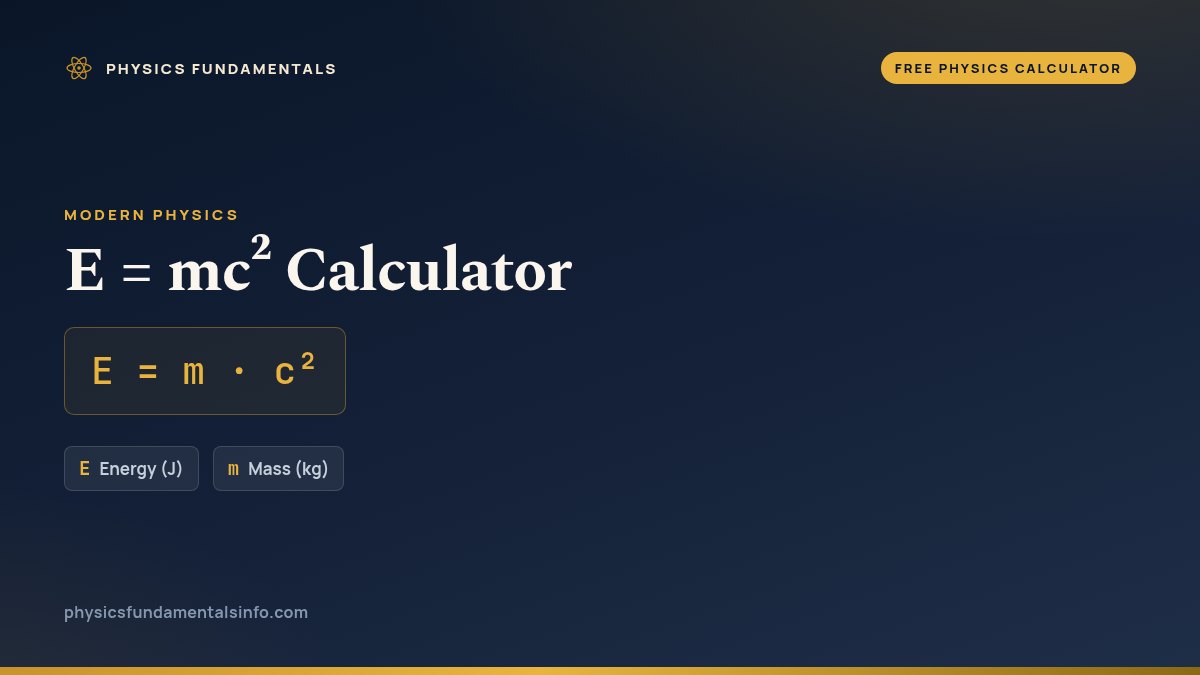
The E = mc² calculator is a free online tool built on the formula E = m · c². Enter the values you already know, in whichever units suit you, and it solves for energy or mass and shows every step of the substitution. E = mc² is einstein’s mass–energy equivalence — the energy locked inside a mass.
| Symbol | Quantity | Default unit | Also accepts | Example value |
|---|---|---|---|---|
| E | Energy | J | kJ, MJ, GJ, kWh | 1 |
| m | Mass | kg | g, mg | 1 |
How to calculate E = mc²
The most famous equation in physics is short but profound: E = m · c². It says that mass and energy are interchangeable. To find the energy locked inside a mass, multiply the mass (in kilograms) by the square of the speed of light, c = 299,792,458 m/s. Because c² is about 8.99 × 10¹6 m²/s², even a gram of matter corresponds to a staggering amount of energy.
There are two ways to use the calculator. To find energy, choose Energy in the Solve for menu, enter the mass and pick its unit (kg, g or mg), and read the result in joules — with optional conversions to tons of TNT and kilowatt-hours. To find mass, choose Mass instead and enter the energy in joules, kilojoules, megajoules, gigajoules or kilowatt-hours; the calculator rearranges the formula to m = E / c² for you. Every value is converted to SI base units behind the scenes, so you never have to juggle units by hand.
The arithmetic is one multiplication or one division, but the scale is what makes it remarkable. Dividing by c² when solving for mass means even an enormous energy maps onto a minuscule mass — which is why we never “notice” mass changes in chemical reactions, even though they release real energy. Mass and energy are simply two ways of measuring the same underlying quantity, linked by this constant. For the energy of a moving object instead of its rest mass, see the related kinetic energy calculator, and for stored height energy the gravitational potential energy calculator.
If you want the deeper background — why the speed of light sets the conversion factor and how this falls out of relativity — read our explainer on special relativity.
Worked example
How much energy is stored in 1 gram of matter? First convert: 1 g = 0.001 kg. Then apply the formula: E = m · c² = 0.001 · (299792458)² ≈ 8.99 × 10¹³ J. That single gram holds about 90 trillion joules — roughly 21,500 tons of TNT, or about 25 million kilowatt-hours of electricity. Converting the full 1 kilogram instead gives close to 9 × 10¹6 J, comparable to a multi-megaton nuclear weapon. This is why nuclear reactions, which convert only a fraction of a percent of mass, release such immense energy.
Why E = mc² matters
Mass–energy equivalence underpins nuclear power and weapons, explains how the Sun and stars shine, accounts for the energy released in particle physics and antimatter annihilation, and forces us to treat mass and energy as a single conserved quantity. It is one of the cornerstones of modern physics.
Frequently asked questions
What does E = mc² mean?
E = mc² is Einstein’s mass–energy equivalence: a mass m has an intrinsic rest energy E equal to that mass multiplied by the square of the speed of light, c. Because c² is enormous (about 9 × 10^16 m²/s²), even a tiny mass corresponds to a huge amount of energy. It tells us mass and energy are two forms of the same thing.
How much energy is in 1 kg of mass?
Converting 1 kg entirely to energy gives E = 1 × (299792458)² ≈ 8.99 × 10^16 joules. That is roughly 21.5 megatons of TNT, or about 25 billion kilowatt-hours of electricity — enough to power millions of homes for a year. In practice only a small fraction of mass is ever converted.
What is the value of c in E = mc²?
The constant c is the speed of light in a vacuum, defined exactly as 299,792,458 metres per second. It is a fixed value in the SI system. In E = mc² it is squared, so c² ≈ 8.988 × 10^16 m²/s², which is why the energy yielded by even a small mass is so large.
Does E = mc² apply to all the mass of an object?
E = mc² gives the total rest energy of a mass, but everyday processes release only a sliver of it. Chemical reactions convert about a billionth of the mass to energy; nuclear fission and fusion convert roughly 0.1% to 0.7%; only matter–antimatter annihilation converts essentially all of it.
How do you calculate mass from energy?
Rearrange the equation to m = E / c². Divide the energy in joules by the speed of light squared (8.988 × 10^16 m²/s²). Because you are dividing by such a large number, even a vast amount of energy corresponds to a very small mass. Select “Mass” in the Solve for menu and the calculator does this for you.
References & formula source
- Einstein, A. (1905) — “Does the inertia of a body depend upon its energy-content?” Annalen der Physik.
- Halliday, Resnick & Walker — Fundamentals of Physics, Chapter 37 (Relativity).
- Young & Freedman — University Physics with Modern Physics, §37.8 (Relativistic energy).
- BIPM / NIST — defined value of the speed of light, c = 299,792,458 m/s.
- Further reading: Mass–energy equivalence — Wikipedia