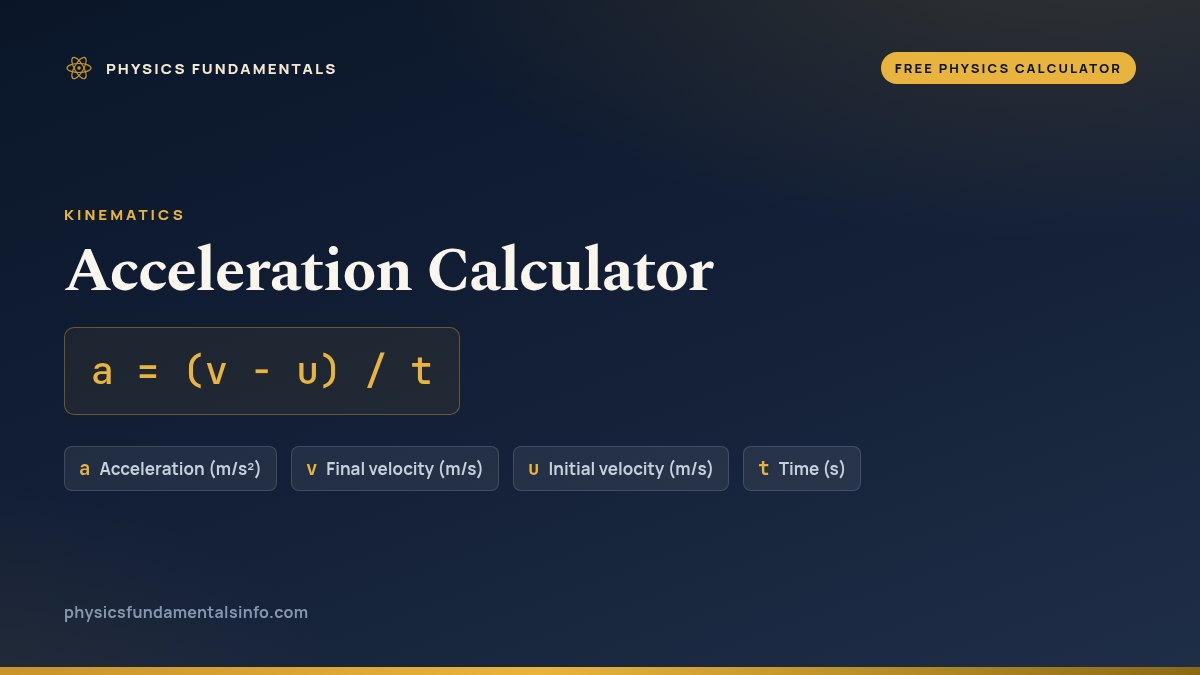
Acceleration: acceleration (a) is the rate at which velocity changes over time, defined by a = (v − u)/t. This free calculator solves for acceleration, final velocity, initial velocity or time — in any unit — and shows every step of the working, plus the equivalent g-force.
What Is the Acceleration Calculator?
The acceleration calculator is a free online tool built on the formula a = (v − u) / t. Enter the values you already know, in whichever units suit you, and it solves for acceleration, velocity or time and shows every step of the substitution. Acceleration is the rate at which velocity changes over time.
| Symbol | Quantity | Default unit | Also accepts | Example value |
|---|---|---|---|---|
| a | Acceleration | m/s² | ft/s², g | 2 |
| v | Final velocity | m/s | km/h, mph | 30 |
| u | Initial velocity | m/s | km/h, mph | 10 |
| t | Time | s | min | 10 |
How to calculate acceleration
Acceleration measures how quickly an object’s velocity changes. To calculate it, subtract the initial velocity from the final velocity to get the change in velocity, then divide by the time that change took: a = (v − u) / t. The result is quoted in metres per second squared (m/s²) — the number of metres per second that the velocity gains (or loses) every second.
There are three steps. First, decide which quantity you want — acceleration, final velocity, initial velocity or time — and select it in the calculator’s Solve for menu. Second, enter the three values you already know and pick their units; the calculator converts everything to SI base units (metres, seconds) behind the scenes, so you can mix km/h, mph and seconds without converting by hand. Third, read the answer alongside the worked steps, which show the formula, your numbers substituted in, and the final value with its units. When you solve for acceleration the result also appears in g, multiples of standard gravity (1 g = 9.80665 m/s²), which is handy for vehicles, rides and aircraft.
The equation rearranges easily, which is why the calculator can solve for any variable. Knowing initial velocity, acceleration and time gives the final velocity from v = u + a·t; knowing the velocities and the acceleration gives the time from t = (v − u) / a. A negative answer is perfectly valid — it simply means the object is slowing down (deceleration) or moving in the opposite direction.
Acceleration also appears in two other key forms. Newton’s second law links it to force and mass through a = F / m, so a larger force or a smaller mass produces a greater acceleration. And an object moving in a circle is always accelerating toward the centre, even at constant speed, with a centripetal acceleration of a = v² / r. For the underlying definition of how fast and where, see the velocity calculator or the physics glossary.
Worked example
A car accelerates from rest to 27 m/s (about 97 km/h) in 9.0 seconds. Its acceleration is a = (v − u) / t = (27 − 0) / 9 = 3.0 m/s². Dividing by 9.80665 gives roughly 0.31 g, so the occupants feel about a third of their own weight pressing them back into the seats. Reading the equation the other way, if that same 3.0 m/s² is held for 12 seconds from a standstill, the final velocity is v = u + a·t = 0 + 3.0 × 12 = 36 m/s.
Why acceleration matters
Acceleration is the bridge between forces and motion, so it underpins vehicle performance and braking distances, the structural loads on rockets and aircraft, the g-forces felt on a roller coaster, and every constant-acceleration problem in mechanics, from a falling apple to an orbiting satellite.
Frequently asked questions
What is the formula for acceleration?
Acceleration (a) is the change in velocity divided by the time taken: a = (v − u) / t, where v is the final velocity and u is the initial velocity. The same equation rearranges to v = u + a·t, u = v − a·t and t = (v − u) / a, so you can solve for any one of the four quantities.
What are the units of acceleration?
The SI unit is metres per second squared (m/s²) — how many metres per second the velocity changes each second. This calculator also reports the result in feet per second squared (ft/s²) and in g, multiples of standard gravity, where 1 g = 9.80665 m/s².
How do you calculate acceleration from a change in speed?
Subtract the starting speed from the final speed to get the change in velocity, then divide by the time the change took. For example, going from 0 to 27 m/s in 9 seconds gives a = 27 ÷ 9 = 3 m/s². Make sure both speeds use the same unit before subtracting; the calculator handles that conversion for you.
Is acceleration the same as deceleration?
Deceleration is simply acceleration in the opposite direction to motion, so it appears as a negative value. If a car slows from 30 m/s to 10 m/s in 5 s, the acceleration is (10 − 30) / 5 = −4 m/s². The minus sign tells you the object is slowing down rather than speeding up.
What is the difference between acceleration and velocity?
Velocity is how fast something moves and in which direction, measured in m/s. Acceleration is how quickly that velocity changes, measured in m/s². An object can have a high velocity with zero acceleration (cruising at constant speed) or zero velocity with large acceleration (the instant it starts to move).
Read more: Acceleration in physics — a plain-English guide.
References & formula source
- Halliday, Resnick & Walker — Fundamentals of Physics, Chapter 2 (Motion Along a Straight Line).
- Young & Freedman — University Physics with Modern Physics, §2.3 (Average and Instantaneous Acceleration).
- BIPM — The International System of Units (SI): the metre and the second.
- NIST — standard acceleration of gravity, g = 9.80665 m/s² (defined value).
- Further reading: Acceleration — Wikipedia