Tune a radio to 98.5 and you are choosing a frequency — the number of times each second the broadcast wave wobbles up and down. Push a child on a swing, and the steady rhythm of each return is a frequency too.
Frequency hides in the pitch of a voice, the colour of light, and the clock ticking inside your phone. Put a number on that rhythm and you can predict it, tune it, and control it. That number comes from one short formula.
What Is the Frequency Formula?
How many times does it happen each second? That single question is what frequency answers, and the frequency formula turns the answer into a number.
Frequency is the rate at which a repeating event occurs. Count the cycles that pass in one second, and you have the frequency, measured in hertz (Hz).
The core idea could hardly be simpler. Frequency is one divided by the time for a single cycle. If one cycle takes half a second, two cycles fit into a second — a frequency of 2 Hz.
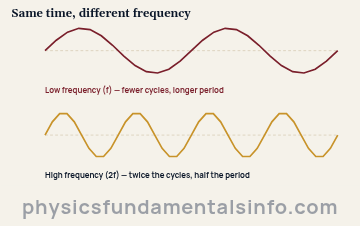
Figure 1: Both waves last the same length of time. The gold wave fits in twice as many cycles, so it has double the frequency and half the period of the wine wave.
Why is frequency measured in hertz?
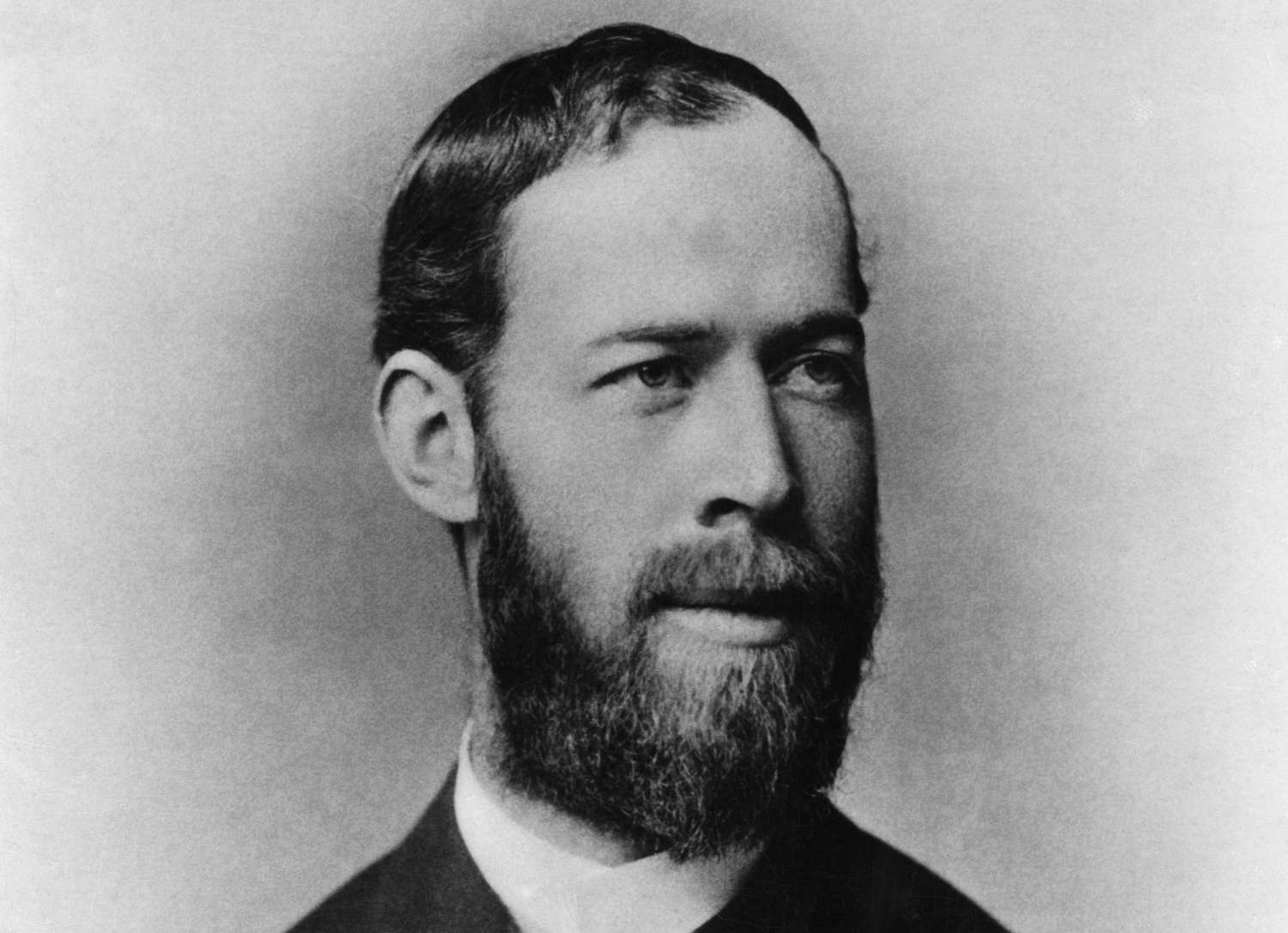
One hertz means one cycle per second, so 50 Hz is fifty cycles every second. The unit honours Heinrich Hertz, the German physicist who first produced and detected radio waves in the late 1880s.
The Frequency Formula and Its Key Variations
There is not one frequency formula but a small family of them, each suited to a different situation. They all describe the same quantity — cycles per second — from a different starting point.
Frequency from the period
This is the definition most exam boards expect you to know by heart. Frequency and period are exact reciprocals of one another.
- f — frequency, in hertz (Hz)
- T — period, the time for one complete cycle, in seconds (s)
Rearranged, the very same relationship hands you the period from the frequency:
Frequency of a wave
For any travelling wave, frequency is tied to how fast the wave moves and how long each wave is.
- v — wave speed, in metres per second (m/s)
- λ — wavelength, the length of one full wave, in metres (m)
This drops straight out of the wave equation v = fλ. For light travelling through a vacuum, v is the speed of light c, so the frequency of a colour is f = c/λ.
Angular frequency
Rotations and oscillations are often described in radians rather than whole cycles. Angular frequency repackages the same rate for that maths.
- ω — angular frequency, in radians per second (rad/s)
- f — frequency, in hertz (Hz)
- 2π — the number of radians in one full cycle (≈ 6.283)
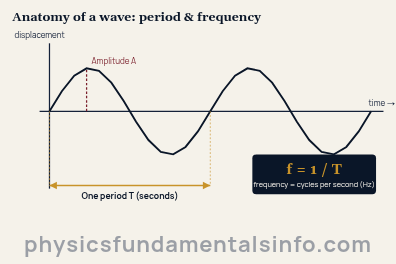
Figure 2: On a displacement–time graph, one full cycle spans the period T. Frequency is simply how many of these cycles fit into one second.
How to Calculate Frequency: Step by Step
Whatever the context, finding a frequency follows the same short routine.
- Identify what you are given. A period in seconds points to f = 1/T. A speed and a wavelength point to f = v/λ.
- Convert units first. Put time in seconds, speed in m/s, and wavelength in metres before substituting. Milliseconds and nanometres are the usual traps.
- Substitute and divide. Frequency is always a division — one over a time, or a speed over a length.
- Check the size. A musical note sits in the hundreds of hertz; visible light sits near 1014 Hz. If your answer is wildly off that scale, hunt for a unit slip.
In practice, the single most common student error is leaving the period in milliseconds. A period of 20 ms is 0.020 s, which gives 50 Hz — not the 0.05 Hz you would get by forgetting to convert.
Frequency, Period, and Wavelength: How They Connect
Frequency rarely travels alone. It sits inside a web of four quantities that all describe the same oscillation, and knowing any two usually fixes the rest.
Period is the mirror image of frequency: as one rises, the other falls. Wavelength is decided jointly by the frequency and the speed the wave can manage in its medium.
| Quantity | Symbol | Formula | SI unit | What it measures |
|---|---|---|---|---|
| Frequency | f | f = 1/T | hertz (Hz) | Cycles completed each second |
| Period | T | T = 1/f | second (s) | Time for one complete cycle |
| Angular frequency | ω | ω = 2πf | rad/s | How fast the phase advances |
| Wavelength | λ | λ = v/f | metre (m) | Length of one complete wave |
| Wave speed | v | v = fλ | m/s | How fast the wave travels |
Georgia State University’s HyperPhysics offers an interactive view of how these travelling-wave quantities depend on one another.
One subtle point trips up many learners: changing the frequency of a wave does not change its speed. The medium fixes the speed; a higher frequency simply squeezes the wavelength shorter to compensate, exactly as f = v/λ demands.
Real-World Examples of Frequency
Frequency is one of those quantities you meet dozens of times a day without ever naming it.
Mains electricity
The alternating current in a wall socket reverses direction in a steady rhythm — 50 Hz across most of the world, 60 Hz in North America. That single number shapes the design of every transformer and motor on the grid.
Musical pitch
Pitch is frequency you can hear. The orchestral tuning note A is fixed at 440 Hz, and doubling the frequency to 880 Hz raises it by exactly one octave.
Human hearing
A healthy young ear responds from roughly 20 Hz up to 20,000 Hz. Anything above that is ultrasound — silent to us, but routine work for a bat or a medical scanner.
Wi-Fi and radio
Your router broadcasts near 2.4 GHz or 5 GHz — billions of cycles every second. An FM station sitting at 98.5 on the dial is transmitting at 98.5 MHz.
The colour of light
Colour is the frequency of light. Red light oscillates near 4.3 × 10¹⁴ Hz, while violet runs almost twice as fast, around 7.5 × 10¹⁴ Hz.
Common Misconceptions About Frequency
“A higher frequency means a faster wave”
Speed and frequency are independent. The medium sets the speed; raising the frequency shortens the wavelength instead, because v = fλ must still balance.
“Frequency and amplitude are the same thing”
Amplitude is the size of each oscillation — loudness for sound, brightness for light. Frequency is how often it repeats — pitch or colour. A whisper and a shout can share the same frequency.
“Hertz is a unit of speed”
Hertz counts cycles per second (1/s), not metres per second. It measures how often something repeats, never how fast it travels through space.
“You can set the period and frequency independently”
They are locked together as reciprocals, f = 1/T. Fix one and the other is decided for you — there is no freedom to choose both.
How Frequency Relates to Energy and the Electromagnetic Spectrum
For light and other electromagnetic waves, frequency is not just a label. It carries the energy.
The higher the frequency, the more energetic each packet of light. Each photon’s energy follows E = hf, where h is the Planck constant (≈ 6.63 × 10⁻³⁴ J·s). If you are shaky on what energy in physics actually means, that companion guide unpacks it.
This is why ultraviolet can burn your skin while gentler, lower-frequency radio waves pass straight through you unnoticed. Lay every electromagnetic wave out in order of frequency and you get the electromagnetic spectrum, from low-frequency radio to high-frequency gamma rays. The wave equation v = fλ then ties each band’s frequency to its wavelength.
| Band | Approx. frequency | Approx. wavelength | Everyday example |
|---|---|---|---|
| Radio | below 3 × 10⁸ Hz | above 1 m | Broadcasting, mobile signals |
| Microwave | 3 × 10⁸ – 3 × 10¹¹ Hz | 1 m – 1 mm | Wi-Fi, radar, ovens |
| Infrared | 3 × 10¹¹ – 4.3 × 10¹⁴ Hz | 1 mm – 700 nm | Heat, TV remotes |
| Visible light | 4.3 × 10¹⁴ – 7.5 × 10¹⁴ Hz | 700 – 400 nm | Everything you see |
| Ultraviolet | 7.5 × 10¹⁴ – 3 × 10¹⁶ Hz | 400 – 10 nm | Sunburn, sterilisers |
| X-ray | 3 × 10¹⁶ – 3 × 10¹⁹ Hz | 10 nm – 10 pm | Medical imaging |
| Gamma ray | above 3 × 10¹⁹ Hz | below 10 pm | Cancer therapy, astrophysics |
Band boundaries are approximate and overlap; the values mark the usual teaching divisions.
The same frequency that sets a wave’s energy also sets how it behaves in matter — which is why a dentist reaches for X-rays and a chef reaches for microwaves.
Worked Problems
Show Solution
Solution:
Step 1: Use the definition f = 1/T.
Step 2: Substitute T = 2.0 s → f = 1 ÷ 2.0 s.
Step 3: f = 0.50 s−1.
Answer: f = 0.50 Hz
Show Solution
Solution:
Step 1: Rearrange to T = 1/f.
Step 2: Substitute f = 50 Hz → T = 1 ÷ 50.
Step 3: T = 0.020 s.
Answer: T = 0.020 s (20 ms)
Show Solution
Solution:
Step 1: Use the wave form f = v/λ.
Step 2: Substitute → f = 343 m/s ÷ 0.50 m.
Step 3: f = 686 s−1.
Answer: f = 686 Hz
Show Solution
Solution:
Step 1: The number of cycles is N = f × t.
Step 2: Substitute → N = 440 Hz × 3.0 s.
Step 3: N = 1320.
Answer: 1320 oscillations
Show Solution
Solution:
Step 1: Use ω = 2πf.
Step 2: Substitute → ω = 2π × 5.0 Hz.
Step 3: ω = 31.4 rad/s.
Answer: ω ≈ 31.4 rad/s
Show Solution
Solution:
Step 1: For light, f = c/λ.
Step 2: Convert 550 nm = 5.50 × 10⁻⁷ m, then f = (3.00 × 10⁸) ÷ (5.50 × 10⁻⁷).
Step 3: f = 5.45 × 10¹⁴ Hz.
Answer: f ≈ 5.45 × 10¹⁴ Hz
Show Solution
Solution:
Step 1: Rearrange v = fλ to λ = c/f.
Step 2: Convert 100 MHz = 1.00 × 10⁸ Hz, then λ = (3.00 × 10⁸) ÷ (1.00 × 10⁸).
Step 3: λ = 3.0 m.
Answer: λ = 3.0 m
Show Solution
Solution:
Step 1: The period of a simple pendulum is T = 2π√(L/g).
Step 2: T = 2π√(1.0 ÷ 9.81) = 2π × 0.319 s = 2.01 s.
Step 3: f = 1/T = 1 ÷ 2.01 s.
Answer: f ≈ 0.50 Hz
Frequently Asked Questions
What is the frequency formula?
How do you calculate frequency from the period?
What is the SI unit of frequency?
How are frequency and wavelength related?
What is the difference between frequency and angular frequency?
Can frequency be zero or negative?
Further Reading
Keep building with what energy is in physics — the quantity a light wave’s frequency actually carries — and velocity vs speed, which sharpens the difference between how fast a wave travels and how often it oscillates. Master the frequency formula and the rest of wave physics starts to click into place.