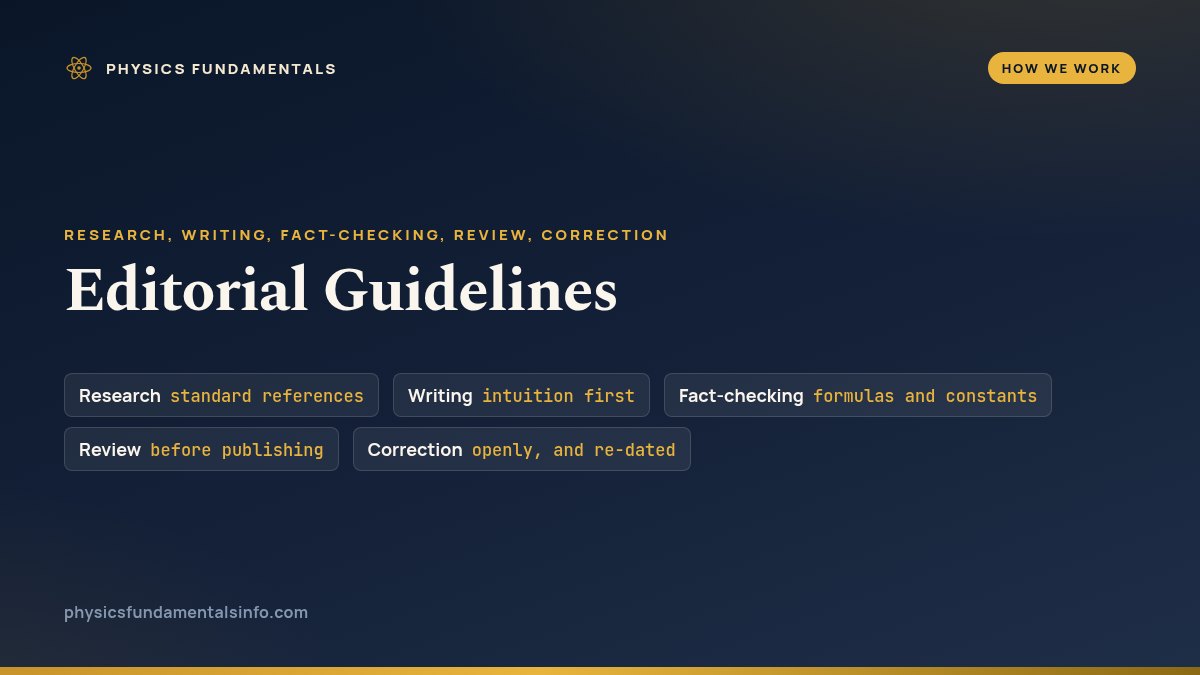
Who Writes and Reviews
Articles carry a collective byline — the Physics Fundamentals editorial team — because no piece is the work of one person alone. The person who researches a topic is not the person who signs off on its formulas, and every calculator is tested by someone other than the person who wrote it.
Which Sources We Accept
Physics does not need novel sources; it needs correct ones. In descending order of preference we use:
- Primary reference data — NIST for physical constants and material properties, IUPAC and CODATA where relevant.
- Standard undergraduate textbooks — Halliday, Resnick & Walker; Young & Freedman; Serway & Jewett; Tipler.
- University teaching resources — HyperPhysics (Georgia State), MIT OpenCourseWare, and departmental notes from recognised institutions.
Every article that quotes a formula names the source it was checked against, in a References & formula source block at the foot of the page. We do not cite content farms, AI-generated summaries or unattributed web pages.
How We Handle Formulas, Constants and Units
Formulas are quoted in the form and sign convention used by the cited source, and the convention is stated when more than one is common — thin lenses and thermodynamic work sign conventions being the usual offenders. Constants are quoted to the precision the calculation needs, with the CODATA value used internally. Every calculator converts inputs to SI base units before solving, so mixing km/h with seconds is safe.
How Calculators and Labs Are Tested
Each calculator is checked against worked examples from the cited textbook, then against edge cases: zero and negative inputs, the boundaries of each valid range, and each direction the equation can be solved in. Interactive labs are additionally checked for the physics staying correct across the whole slider range, not just at the default position.
Corrections Policy
If you find an error, email contact@physicsfundamentalsinfo.com with the page URL and what looks wrong. We check reports quickly and fix confirmed errors as a priority. Substantive corrections — anything that changes a result, a formula or a conclusion — are made in the article itself and the page’s updated date is changed. We would rather be corrected than be wrong.
Independence and Advertising
We do not accept payment for coverage, links or favourable mentions, and no article is written to order for a sponsor. Where a page recommends a tool, it is because we use it. If that ever changes, the relationship will be disclosed on the page itself.
Accessibility and Plain Language
Explanations are written to be understood on first reading by someone meeting the topic for the first time: short sentences, defined terms, and no jargon that has not been introduced. Interactive labs carry text labels and ARIA descriptions so their readouts are usable without seeing the animation.
Contributing
We accept guest articles that meet these standards — see Write For Us. Submissions go through the same five stages as our own work, and we edit for clarity and accuracy before publishing.