Kinematics
Free Fall Physics: Formula & Real Examples
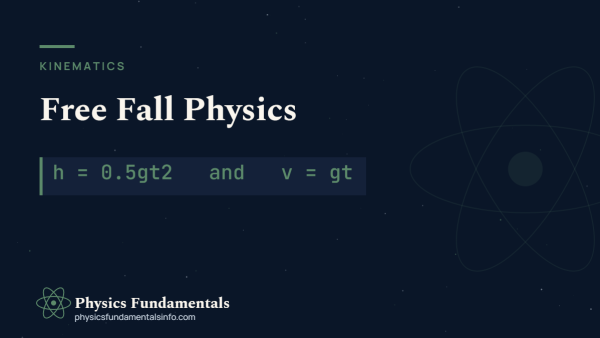
Free fall is motion under gravity alone. Learn the h = 0.5gt² and v = gt formulas, why every object falls at the same rate, and how to solve free-fall problems step by step.
18 min read
Kinematics: position, velocity and acceleration — the mathematical language for describing how things move through space and time, before you ask what causes it.
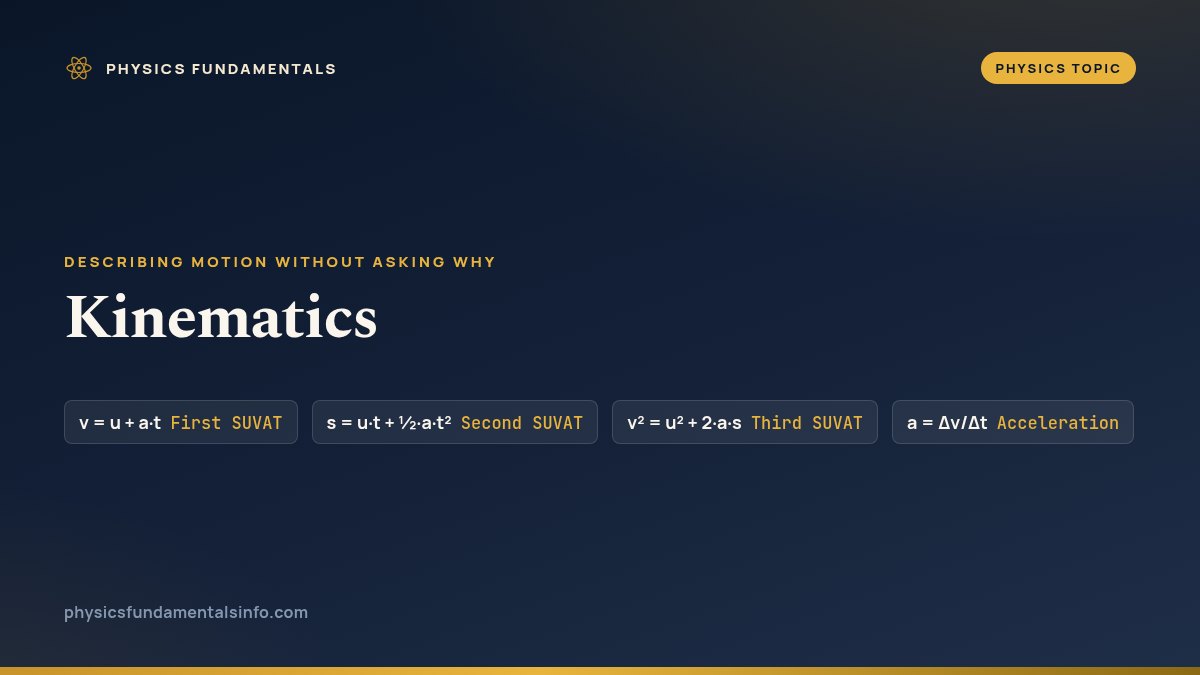
Kinematics is the branch of mechanics that describes motion — position, velocity and acceleration — without asking what causes it. Get these five equations straight and most of introductory physics stops being guesswork.
| Relationship | Equation | What it tells you |
|---|---|---|
| Average velocity | v = Δs / Δt | Displacement per unit time |
| Acceleration | a = Δv / Δt | Rate of change of velocity |
| First SUVAT | v = u + a·t | Final velocity from acceleration and time |
| Second SUVAT | s = u·t + ½·a·t² | Displacement under constant acceleration |
| Third SUVAT | v² = u² + 2·a·s | Velocity without needing the time |
| Projectile range | R = v²·sin(2θ) / g | Horizontal range of a projectile |