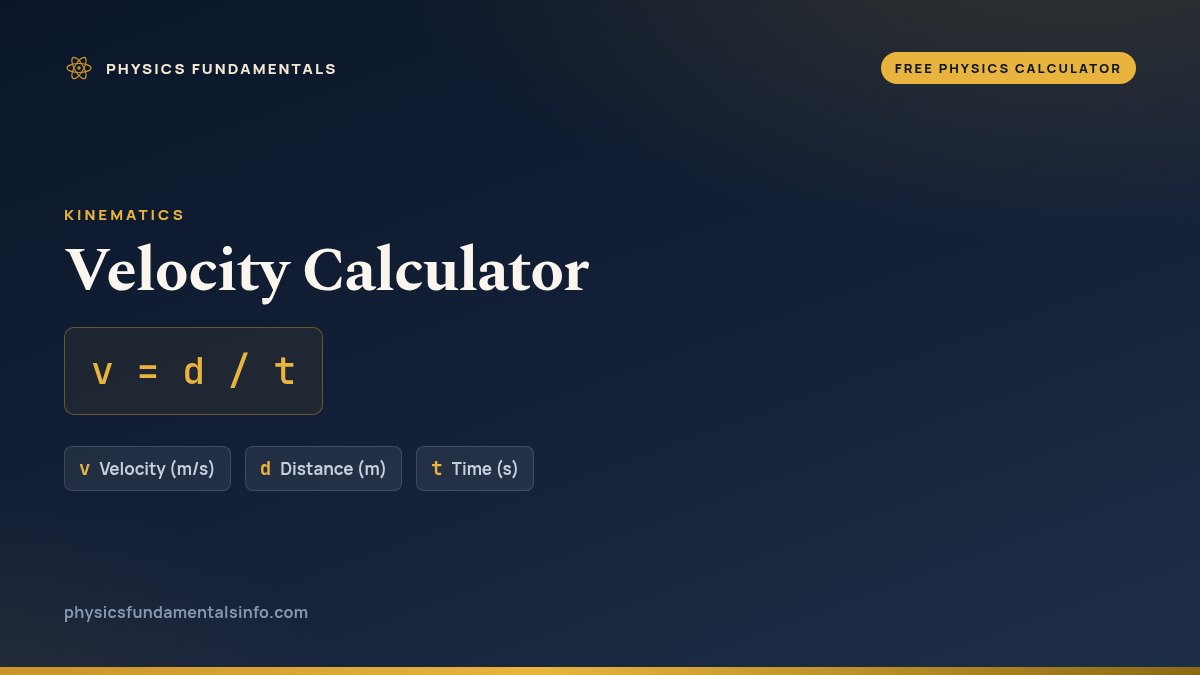
Velocity: average velocity (v) is how far something travels in a given time, defined by v = d/t. This free calculator solves for velocity, distance or time — in any unit — and shows every step of the working.
What Is the Velocity Calculator?
The velocity calculator is a free online tool built on the formula v = d / t. Enter the values you already know, in whichever units suit you, and it solves for velocity, distance or time and shows every step of the substitution. Average velocity is distance travelled divided by the time taken.
| Symbol | Quantity | Default unit | Also accepts | Example value |
|---|---|---|---|---|
| v | Velocity | m/s | km/h, mph | 10 |
| d | Distance | m | km, mi | 100 |
| t | Time | s | min, h | 10 |
How to calculate velocity
Average velocity tells you how quickly an object changes position. To calculate it, divide the distance travelled by the time taken: v = d / t. The result is usually quoted in metres per second (m/s) in physics, but everyday speeds are often given in kilometres per hour (km/h) or miles per hour (mph), where 1 m/s equals 3.6 km/h.
There are three steps. First, decide which quantity you want — velocity, distance or time — and select it in the calculator’s Solve for menu. Second, enter the two values you already know and pick their units; the calculator converts everything to SI base units (metres and seconds) behind the scenes, so you never have to convert by hand. Third, read the answer together with the worked steps, which show the formula, your numbers substituted in, and the final value with its units.
The equation rearranges easily. If you know velocity and time, the distance is d = v × t. If you know distance and velocity, the time is t = d ÷ v. Strictly, velocity is a vector — it has a direction as well as a size — which is what separates it from plain speed; for more on that distinction see our guide on velocity vs speed.
One important limit: v = d/t gives the average velocity, which is only the whole story when the motion is steady. When an object speeds up or slows down at a constant rate, the final velocity instead comes from v = u + at, where u is the initial velocity, a is the acceleration and t is the time. If you know the distance rather than the time, use v² = u² + 2as. These are two of the constant-acceleration equations of motion — solve them with the SUVAT calculator, and find the acceleration itself with the acceleration calculator.
Worked example
A car covers 150 km in 2 hours of steady driving. Its average velocity is v = d / t = 150 km / 2 h = 75 km/h, which is about 20.8 m/s. Reading the equation the other way, at that same 75 km/h the car would cover d = v × t = 75 × 3 = 225 km in 3 hours. Because the calculator works in SI internally, you can mix units freely — enter the distance in kilometres and the time in hours, and still read the answer back in m/s if you prefer.
Why velocity matters
Velocity is the starting point of nearly all of mechanics: it feeds directly into momentum (p = mv) and kinetic energy, it sets the range and flight time in projectile motion, and its rate of change defines acceleration. From traffic planning and sport to spacecraft trajectories, getting velocity right is the first step in describing how things move.
Frequently asked questions
What is the formula for velocity?
Average velocity (v) is distance divided by time: v = d/t. Divide the distance travelled by the time it took. The same equation rearranges to d = v × t and t = d ÷ v, so you can solve for any one of the three quantities.
What is the difference between speed and velocity?
Speed is a scalar — how fast something moves with no direction. Velocity is a vector — speed together with a direction, defined as the rate of change of displacement. On a straight path they have the same size, but a runner on a 400 m lap returns to the start, so the average velocity over the lap is zero even though the average speed is not.
How do I convert m/s to km/h or mph?
Multiply metres per second by 3.6 to get kilometres per hour, or by about 2.237 to get miles per hour. So 10 m/s = 36 km/h ≈ 22.37 mph. This calculator does the conversion for you — just pick the unit you want from each menu.
What is the difference between average and instantaneous velocity?
Average velocity uses the total displacement over a whole time interval (v = d/t). Instantaneous velocity is the velocity at one exact moment — the value your speedometer shows. This calculator finds average velocity; for motion with constant acceleration, use the SUVAT equations instead.
How do you find final velocity with acceleration?
When acceleration is constant, average velocity no longer equals d/t. Use v = u + at to find the final velocity from the initial velocity u, acceleration a and time t, or v² = u² + 2as to find it from a distance s. These are the SUVAT equations of motion.
References & formula source
- Halliday, Resnick & Walker — Fundamentals of Physics, Chapter 2 (Motion Along a Straight Line).
- Young & Freedman — University Physics with Modern Physics, §2.1–2.2 (Displacement, Time and Average Velocity).
- BIPM — The International System of Units (SI): the metre and the second.
- Further reading: Velocity — Wikipedia