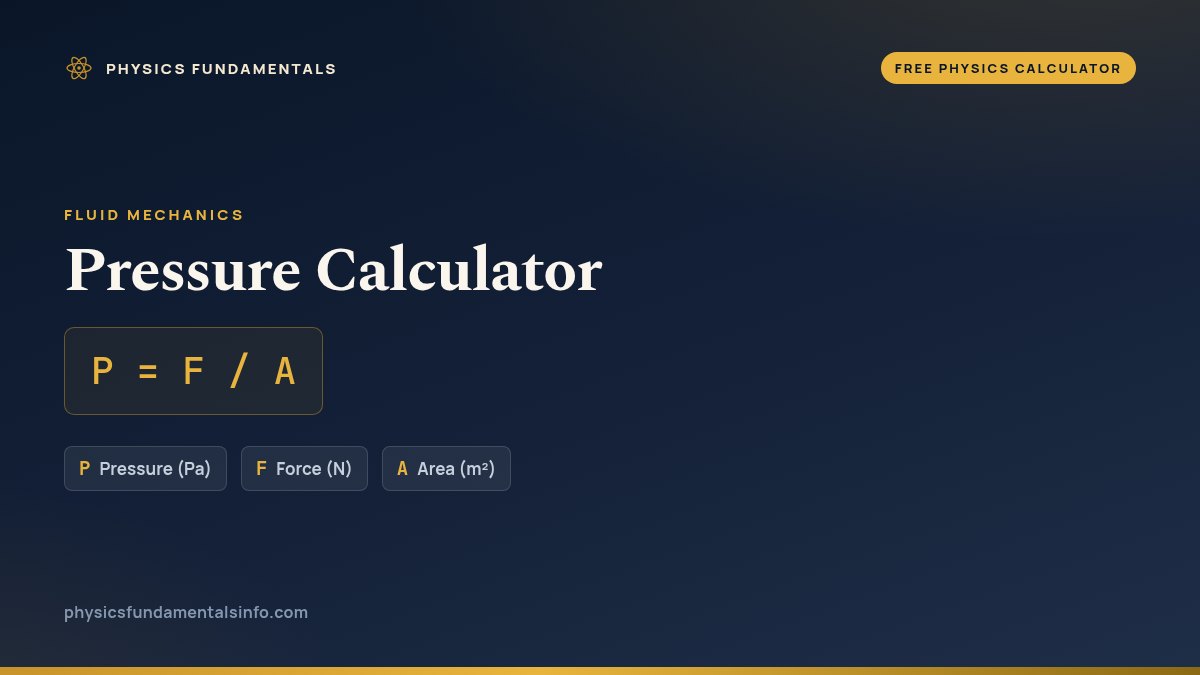
Pressure: pressure (P) is the force pressing on a surface divided by its area, defined by P = F/A. This free calculator solves for pressure, force or area — in any unit — and shows every step of the working.
What Is the Pressure Calculator?
The pressure calculator is a free online tool built on the formula P = F / A. Enter the values you already know, in whichever units suit you, and it solves for pressure, force or area and shows every step of the substitution. Pressure as force over area, plus fluid pressure with depth.
| Symbol | Quantity | Default unit | Also accepts | Example value |
|---|---|---|---|---|
| P | Pressure | Pa | kPa, bar, atm, psi | 10000 |
| F | Force | N | kN | 100 |
| A | Area | m² | cm², mm² | 0.01 |
How to calculate pressure
Pressure measures how concentrated a force is. To calculate it, divide the force pushing perpendicular to a surface by the area over which that force is spread: P = F / A. The SI unit is the pascal (Pa), where one pascal is one newton per square metre. Because a pascal is tiny, everyday pressures are quoted in kilopascals (kPa), bar, atmospheres (atm) or pounds per square inch (psi).
There are three steps. First, decide which quantity you want — pressure, force or area — and select it in the calculator’s Solve for menu. Second, enter the two values you already know and pick their units; the calculator converts everything to SI base units (newtons and square metres) behind the scenes, so you never convert by hand. Third, read the answer together with the worked steps, which show the formula, your numbers substituted in, and the final value with its units.
The equation rearranges easily. If you know pressure and area, the force is F = P × A. If you know force and pressure, the contact area is A = F ÷ P. The key insight is that the same force produces a much larger pressure when it acts on a smaller area — which is why a drawing pin pierces a board while your thumb does not.
A second, equally common case is the pressure inside a fluid. The pressure a liquid exerts at depth comes from the weight of fluid above it, given by P = ρ g h, where ρ is the fluid’s density, g ≈ 9.81 m/s² and h is the depth. To work out ρ first, use the density calculator; to turn the resulting pressure difference into an upward force, use the buoyancy calculator. For a plain-English definition of the term, see the physics glossary.
Worked example
A box weighing 200 N rests on a base measuring 0.5 m by 0.4 m, an area of 0.2 m². The pressure on the floor is P = F / A = 200 / 0.2 = 1000 Pa (1 kPa). Turn the box onto a smaller face of just 0.05 m² and the same 200 N now gives P = 200 / 0.05 = 4000 Pa — four times the pressure for exactly the same weight, because the contact area shrank by a factor of four.
Why pressure matters
Pressure governs how forces act on real surfaces: it sets tyre and hydraulic-system performance, explains why deep-sea vessels need thick hulls, drives weather through atmospheric pressure differences, and underlies everything from blood pressure to how a knife cuts and how a foundation supports a building.
Frequently asked questions
What is the formula for pressure?
Pressure (P) is force divided by area: P = F/A. Divide the force acting perpendicular to a surface by the area it is spread over. The same equation rearranges to F = P × A and A = F/P, so you can solve for any one of the three quantities.
What are the units of pressure?
The SI unit is the pascal (Pa), which is one newton per square metre (N/m²). Because a pascal is small, larger units are common: 1 kPa = 1000 Pa, 1 bar = 100,000 Pa, 1 atm = 101,325 Pa, and 1 psi ≈ 6894.76 Pa. This calculator converts between all of them.
How do you calculate fluid pressure from depth?
For a liquid at rest, the gauge pressure at depth h is P = ρgh, where ρ is the fluid density, g ≈ 9.81 m/s², and h is the depth below the surface. Add atmospheric pressure (about 101 kPa) to get the absolute pressure. Pressure increases with depth because more fluid weighs down from above.
Why does a sharp knife cut more easily than a blunt one?
Because pressure is force divided by area. A sharp blade concentrates the same force onto a much smaller contact area, so the pressure is far higher and the material gives way. The same idea explains why nails are pointed and why snowshoes spread weight to stop you sinking.
What is the difference between absolute and gauge pressure?
Absolute pressure is measured relative to a perfect vacuum, while gauge pressure is measured relative to the surrounding atmosphere. Gauge pressure = absolute pressure − atmospheric pressure. A tyre gauge reading 200 kPa means about 301 kPa absolute, because roughly 101 kPa of atmosphere is already pushing on everything.
References & formula source
- Halliday, Resnick & Walker — Fundamentals of Physics, Chapter 14 (Fluids: pressure and Pascal’s principle).
- Young & Freedman — University Physics with Modern Physics, §12.2 (Pressure in a Fluid).
- BIPM — The International System of Units (SI): the pascal as the derived unit of pressure.
- NIST — Guide for the Use of the International System of Units (SI): pressure unit conversions.
- Further reading: Pressure — Wikipedia