Time dilation: a moving clock runs slow. Special relativity stretches a proper time (t0) into a dilated time (t = γ·t0), where the Lorentz factor γ = 1/sqrt(1 − β²) and β = v/c. Enter a proper time and a speed — even as a percentage of light speed — and this free calculator returns the dilated time, the Lorentz factor, and every step of the working.
What Is the Time Dilation Calculator?
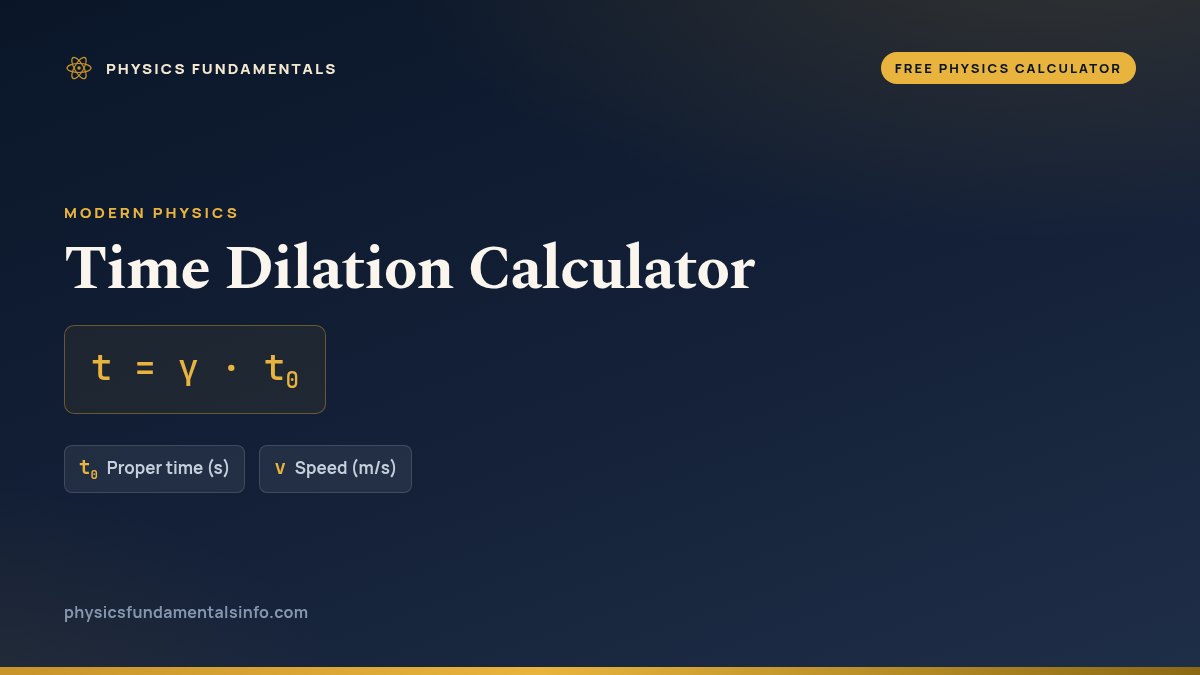
The time dilation calculator is a free online tool built on the formula t = γ · t0. Enter the values you already know, in whichever units suit you, and it solves for dilated time and Lorentz factor and shows every step of the substitution. Relativistic time dilation at high speed.
| Symbol | Quantity | Default unit | Also accepts | Example value |
|---|---|---|---|---|
| t0 | Proper time | s | min, h, years | 1 |
| v | Speed | m/s | km/s, % of c | 90 |
How to calculate time dilation
Time dilation is one of the strangest, most fun results in physics: the faster something moves, the slower its clock ticks compared with yours. To work it out you need two things — the proper time t0 (the time the moving clock records for itself) and the speed v at which it is moving relative to you. The dilated time you measure is t = γ · t0.
The whole effect lives in the Lorentz factor, γ = 1 / sqrt(1 − β²), where β = v/c is the speed as a fraction of the speed of light c = 299,792,458 m/s. There are three steps. First, divide the speed by c to get β. Second, square β, subtract from one, take the square root and invert to get γ. Third, multiply the proper time by γ. Because γ is always at least 1, the dilated time is always longer than the proper time — the moving clock has fallen behind.
Using the calculator is quick. Enter the proper time and choose a unit (seconds, minutes, hours or years), then enter the speed. The most fun option is to set the speed unit to % of c and type a number like 90, meaning 90% of light speed. The result shows the dilated time alongside the Lorentz factor γ and the speed as a percentage of c, so you can see at a glance how dramatic the slowdown has become.
At ordinary speeds γ is so close to 1 that nothing seems to happen — your everyday velocity leaves clocks essentially in step. The effect only becomes large near light speed. For the deeper background on why moving clocks run slow and how this follows from a constant speed of light, read our explainer on special relativity, and for the companion result linking mass and energy try the E = mc² calculator.
Worked example
An astronaut travels for what feels to her like 1 year (t0 = 1 year) at 90% of the speed of light. First find β: β = v/c = 0.9. Then the Lorentz factor: γ = 1/sqrt(1 − 0.9²) = 1/sqrt0.19 ≈ 2.29. The time measured back on Earth is t = γ·t0 = 2.29 × 1 = 2.29 years. So while she ages one year, more than two years pass at home. Push the speed to 99% of c and γ climbs to about 7.09 — her single year becomes over seven years for everyone she left behind.
Why time dilation matters
Time dilation is not science fiction: it is built into GPS, which corrects for relativistic timing or navigation would drift kilometres per day; it explains how fast-moving cosmic-ray muons reach the ground before decaying; and it sets the hard cosmic speed limit, since γ runs to infinity as speed approaches c. It also powers the famous twin paradox — the thought experiment in which a space-traveling twin returns younger than the one who stayed home.
Frequently asked questions
What is time dilation?
Time dilation is a prediction of Einstein’s special relativity: a clock moving relative to you ticks more slowly than one at rest. The faster it moves, the larger the effect. The moving clock’s own elapsed time is the proper time t0; the time you measure for it is the dilated time t = γ·t0, where γ ≥ 1. At everyday speeds γ is almost exactly 1, so the effect is unnoticeable.
What is the time dilation formula?
The dilated time is t = γ·t0, where t0 is the proper time and γ is the Lorentz factor. The Lorentz factor is γ = 1/sqrt(1 − β²) with β = v/c, where v is the relative speed and c is the speed of light (299,792,458 m/s). Because γ is always at least 1, the moving clock always runs slow compared with the observer’s clock.
What is the Lorentz factor γ?
The Lorentz factor γ = 1/sqrt(1 − v²/c²) measures how strongly relativity stretches time and contracts length. At v = 0 it equals 1 (no effect). At 90% of light speed γ ≈ 2.29, at 99% it is about 7.09, and at 99.9% roughly 22.4. As v approaches c, γ shoots toward infinity, which is why reaching the speed of light is impossible for anything with mass.
Is time dilation real or just theoretical?
It is very real and measured routinely. Atomic clocks flown on aircraft tick slightly differently from clocks left on the ground; fast-moving muons created in the upper atmosphere survive long enough to reach the surface only because their internal clocks run slow; and GPS satellites must correct for relativistic time effects or navigation would drift by kilometres a day.
How fast do you need to go for time dilation to matter?
It depends on how much accuracy you care about. At 1% of light speed (about 3,000 km/s) γ is only 1.00005, a 0.005% slowdown. You need to reach a substantial fraction of c — tens of percent — before the effect becomes large. That is why time dilation is dramatic for particles in accelerators and hypothetical starships, but negligible for cars, planes and rockets.
References & formula source
- Einstein, A. (1905) — “On the Electrodynamics of Moving Bodies,” Annalen der Physik.
- Halliday, Resnick & Walker — Fundamentals of Physics, Chapter 37 (Relativity).
- Young & Freedman — University Physics with Modern Physics, §37.3 (Relativity of Time Intervals).
- BIPM / NIST — defined value of the speed of light, c = 299,792,458 m/s.
- Further reading: Time dilation — Wikipedia