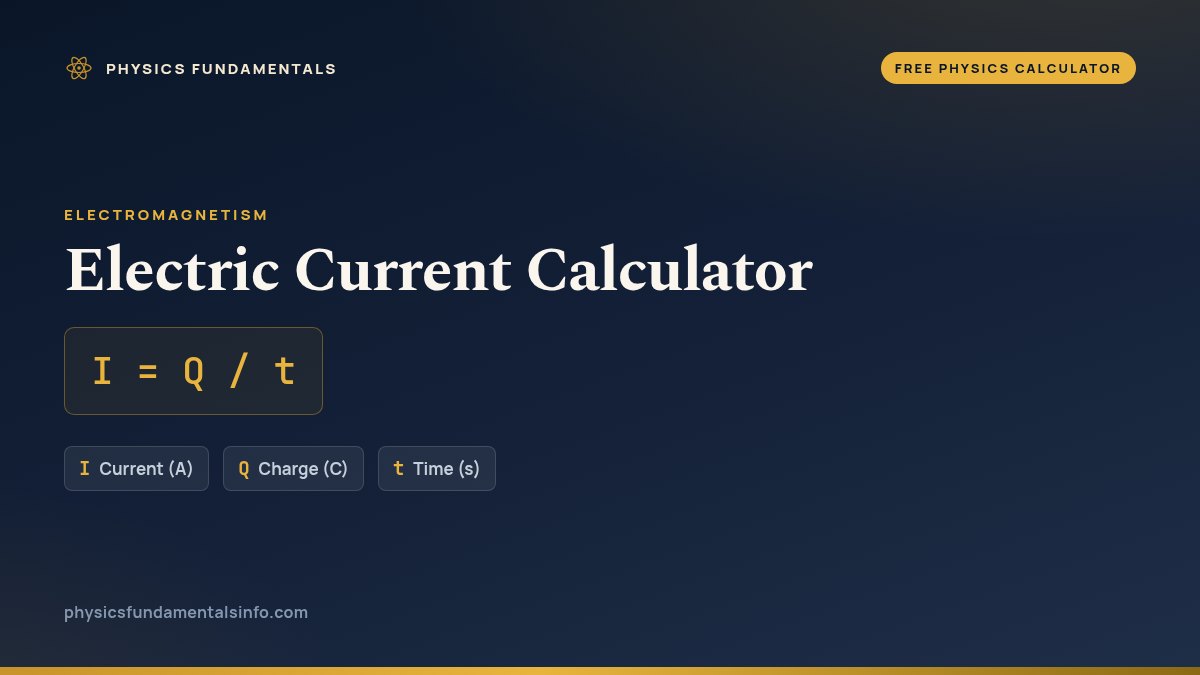
Electric current is the rate at which charge flows past a point: I = Q/t, measured in amperes — one coulomb per second. This free calculator solves for the current, the charge or the time, converts minutes and hours automatically, and reports how many electrons the charge represents.
What Is the Electric Current Calculator?
The electric current calculator is a free online tool built on the formula I = Q / t. Enter the values you already know, in whichever units suit you, and it solves for current, charge or time and shows every step of the substitution. Electric Current is current as the rate of charge flow, I = Q/t, with the electron count.
| Symbol | Quantity | Default unit | Also accepts | Example value |
|---|---|---|---|---|
| I | Current | A | mA | 2 |
| Q | Charge | C | mC | 60 |
| t | Time | s | min, h | 30 |
How to calculate electric current with I = Q/t
Current is not "how much electricity" — it is how fast charge is delivered. Divide the charge that passes a cross-section by the time it takes and you have the current: I = Q/t. The same equation rearranges to Q = I·t (how much charge a current delivers) and t = Q/I (how long a delivery takes).
Three steps: choose the quantity to solve for, enter the other two, read the result with its working. The classic trap is time units — 60 C in 2 minutes is 0.5 A, not 30 A — so the time field accepts minutes and hours and converts to seconds for you. The result panel also reports the electron count N = Q/e, a reminder that even a small everyday charge is an astronomical number of electrons, each carrying just 1.602 × 10^-19 C. You can watch the flow itself respond to both sliders in the interactive electric current simulator.
Keep this page distinct from Ohm's law in your head: I = Q/t defines current from charge and time, while V = IR predicts current from a voltage across a resistance. In a circuit problem you usually reach for Ohm's law; in a charge-transfer problem — capacitor discharge, electrolysis, a lightning strike — you reach for this one, perhaps alongside the capacitance calculator.
Worked example
A charge of Q = 60 C flows through a wire in t = 30 s. The current is I = Q/t = 60 / 30 = 2 A. Cross-checks: that current for that time returns Q = I·t = 2 × 30 = 60 C, and the delivery time is t = Q/I = 60 / 2 = 30 s. The electrons involved: N = 60 / 1.602×10^-19 = 3.74 × 10^20.
Why it matters
I = Q/t sits under battery ratings (an amp-hour is a charge), electroplating and electrolysis calculations, fuse and wire sizing, defibrillator dosing, and the definition of the ampere itself — since 2019 fixed by giving the elementary charge an exact value. Whenever charge moves, this is the equation that clocks it.
Frequently asked questions
What units does the electric current calculator use?
Charge Q is in coulombs (or millicoulombs), time t in seconds (with minutes and hours converted automatically) and current I in amperes or milliamperes. One ampere is exactly one coulomb of charge passing a point every second, so the three units lock together through I = Q/t.
How do I solve for charge instead of current?
Set "Solve for" to Q and enter the current and the time; the calculator returns Q = I·t. A 2 A current flowing for 30 s delivers Q = 60 C. This rearrangement is how battery capacity works: a battery rated 3600 C (one amp-hour) can supply 1 A for one hour.
What is the most common mistake with I = Q/t?
Forgetting to convert time into seconds. A charge of 60 C in 2 minutes is 60/120 = 0.5 A, not 30 A. This calculator sidesteps the trap: choose "min" or "h" as the time unit and the conversion to seconds happens automatically before the division.
How is this different from Ohm's law?
I = Q/t is the definition of current — how much charge passes per second — and involves no circuit at all. Ohm's law, V = IR, describes how much current a particular resistance lets flow for a given voltage. Use this page when you know charge and time; use the Ohm's law calculator when you know voltage and resistance.
How many electrons make up the charge?
Divide by the elementary charge: N = Q/e with e = 1.602 × 10^-19 C. Even one coulomb is about 6.24 × 10^18 electrons, which is why the calculator reports the count in scientific notation. The huge number is the point: currents are vast swarms of tiny charges, each carrying almost nothing.
References & formula source
- Young & Freedman — University Physics with Modern Physics, chapter on Current, Resistance and Electromotive Force.
- Halliday, Resnick & Walker — Fundamentals of Physics, chapter on Current and Resistance.
- NIST — SI Redefinition, "Ampere: The Future" (nist.gov).
- Further reading: Electric current — Wikipedia