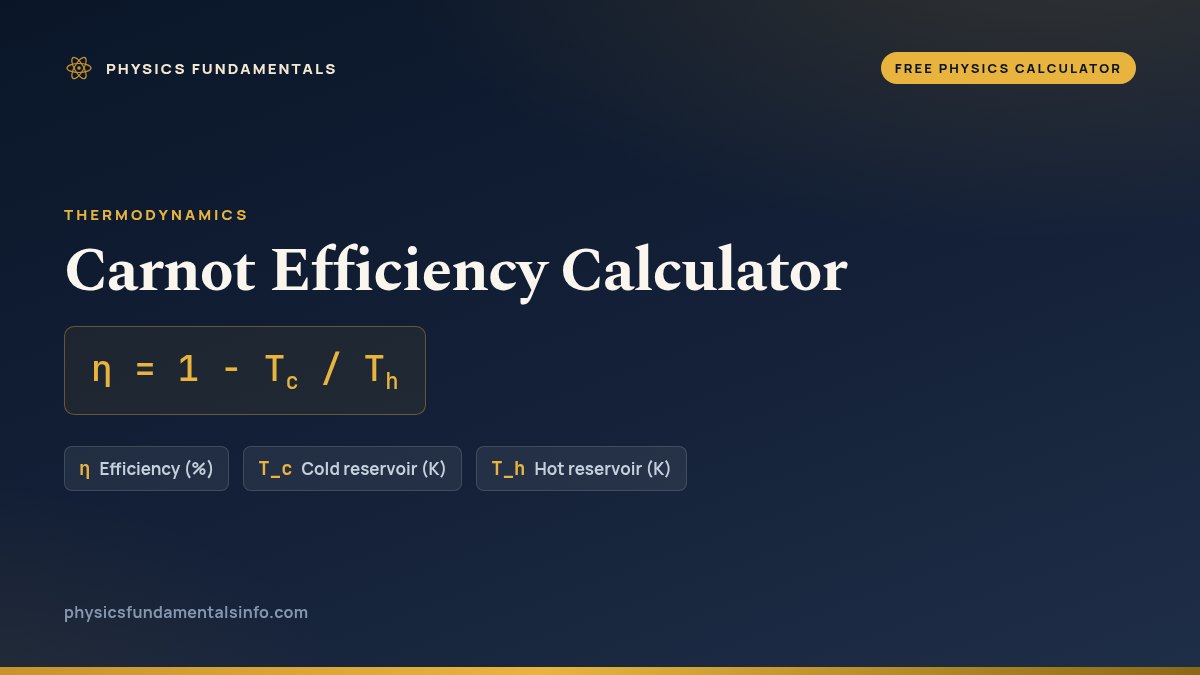
Carnot efficiency: the Carnot efficiency (η) is the maximum fraction of heat that any engine running between a hot reservoir at T_h and a cold reservoir at T_c can turn into useful work, given by η = 1 − T_c/T_h with both temperatures in kelvin. This free calculator solves for the efficiency or either reservoir temperature and shows every step.
What Is the Carnot Efficiency Calculator?
The Carnot efficiency calculator is a free online tool built on the formula η = 1 − Tc / Th. Enter the values you already know, in whichever units suit you, and it solves for efficiency or reservoir temperature and shows every step of the substitution. Carnot Efficiency is maximum efficiency of a heat engine between two temperatures.
| Symbol | Quantity | Default unit | Also accepts | Example value |
|---|---|---|---|---|
| η | Efficiency | % | — | — |
| T_c | Cold reservoir | K | °C | 300 |
| T_h | Hot reservoir | K | °C | 600 |
How to calculate Carnot efficiency
The Carnot efficiency sets a hard ceiling on how well any heat engine can perform. It depends on just two numbers: the absolute temperature of the hot reservoir the engine draws heat from (T_h) and the absolute temperature of the cold reservoir it dumps waste heat into (T_c). The efficiency is η = 1 − T_c/T_h, a pure fraction between 0 and 1 that is usually quoted as a percentage.
There are three steps. First, choose what you want to find — the efficiency, the cold reservoir temperature, or the hot reservoir temperature — in the Solve for menu. Second, enter the two values you know. Both temperatures must be on the absolute (kelvin) scale, because the formula uses their ratio; if you prefer Celsius, select °C and the calculator adds 273.15 to convert to kelvin for you. Third, read the answer with the worked steps, which show the formula, your numbers substituted in, and the result with its units.
The equation rearranges easily. To find the cold reservoir temperature for a target efficiency, use T_c = T_h(1 − η). To find the hot reservoir temperature, use T_h = T_c/(1 − η). In every case the efficiency must satisfy 0 < η < 1 and the temperatures must obey T_h > T_c > 0 — a valid engine cannot reject heat to a reservoir hotter than its source, and no real reservoir reaches absolute zero.
The result is an upper limit, not a prediction of real performance. A genuine engine loses energy to friction, turbulence and finite-rate heat transfer, so it always falls short of the Carnot value. Raising T_h or lowering T_c widens the temperature gap and pushes the limit higher — the reason power stations run on superheated steam. For the heat moved in or out of a working substance, pair this with the specific heat calculator.
Worked example
A steam turbine takes in heat at T_h = 600 K and rejects it to cooling water at T_c = 300 K. The Carnot efficiency is η = 1 − T_c/T_h = 1 − 300/600 = 0.5, or 50%. So even a perfect, frictionless engine between these temperatures could convert at most half of the incoming heat into work; the other half must be discarded to the cold reservoir. A real turbine on the same temperatures might manage around 40%, comfortably below the Carnot ceiling.
Why Carnot efficiency matters
The Carnot efficiency is the benchmark against which every real engine, refrigerator and power plant is measured. It is a direct consequence of the second law of thermodynamics, explains why waste heat is unavoidable, and guides engineers toward the design lever that matters most — the temperature difference between the hot source and the cold sink.
For a step-by-step tour of the principles behind this formula, see our guide to the laws of thermodynamics. Carnot sets the ceiling on how much heat can become work; the first law of thermodynamics is what guarantees the books balance in the first place.
Frequently asked questions
What is the Carnot efficiency formula?
The Carnot efficiency is η = 1 − Tc/Th, where Tc is the absolute temperature of the cold reservoir and Th is the absolute temperature of the hot reservoir. Both temperatures must be in kelvin. It gives the maximum fraction of heat input that any engine working between those two temperatures can convert into work.
Why must the temperatures be in kelvin?
The formula uses a ratio of absolute temperatures, so it only works on a scale that starts at absolute zero. Using degrees Celsius would give nonsense — for example, a 0 °C reservoir is not a zero in the ratio. Convert by adding 273.15 to a Celsius value to get kelvin; this calculator does that for you if you select °C.
Can a real engine reach the Carnot efficiency?
No. The Carnot efficiency is an ideal upper limit set by the second law of thermodynamics, achievable only by a reversible engine with no friction, no heat leakage and infinitely slow operation. Real engines lose energy to friction, turbulence and finite-rate heat transfer, so their efficiency is always lower.
How can I make a heat engine more efficient?
Increase the temperature difference: raise the hot reservoir temperature Th or lower the cold reservoir temperature Tc. As Tc/Th gets smaller, the efficiency approaches 1 (100%). This is why power-station turbines run on very hot, high-pressure steam and reject heat to the coolest sink available.
Why can the Carnot efficiency never reach 100%?
Reaching 100% would require Tc/Th = 0, meaning the cold reservoir is at absolute zero (0 K) or the hot reservoir is infinitely hot. Both are impossible, so some heat must always be rejected to the cold reservoir. This is a direct statement of the second law of thermodynamics.
References & formula source
- Halliday, Resnick & Walker — Fundamentals of Physics, Chapter 20 (Entropy and the Second Law of Thermodynamics).
- Young & Freedman — University Physics with Modern Physics, §20.6 (The Carnot Cycle).
- NIST — Reference data and definitions for temperature on the thermodynamic (kelvin) scale.
- Further reading: Carnot heat engine — Wikipedia