Escape velocity is the minimum speed an object needs to break free of a body’s gravity and never fall back — v = sqrt(2GM/r). This free calculator solves for the escape speed, the body’s mass M or its radius r, in any unit, with planet presets and full step-by-step working.
What Is the Escape Velocity Calculator?
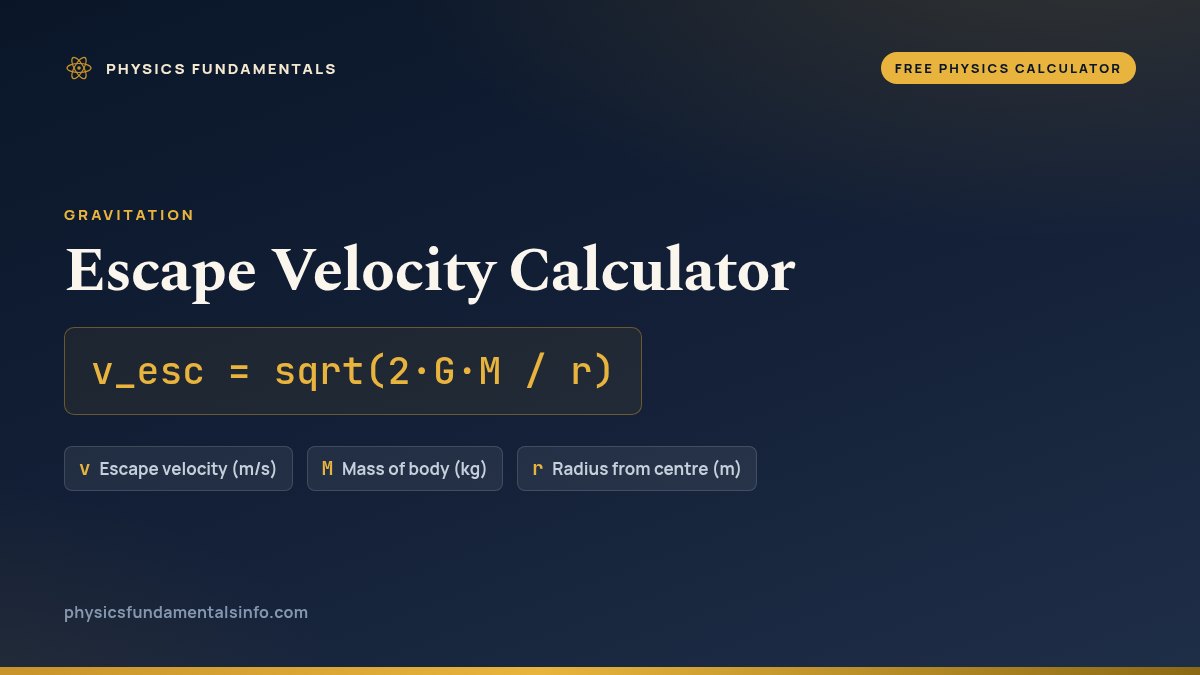
The escape velocity calculator is a free online tool built on the formula v_esc = sqrt(2·G·M / r). Enter the values you already know, in whichever units suit you, and it solves for escape speed, mass, radius and shows every step of the substitution. Escape Velocity is minimum speed to break free of a body’s gravity.
| Symbol | Quantity | Default unit | Also accepts | Example value |
|---|---|---|---|---|
| v | Escape velocity | m/s | km/s | 11180 |
| M | Mass of body | kg | — | 5970000000000000281018368 |
| r | Radius from centre | m | km | 6370000 |
How to calculate escape velocity
Escape velocity is the minimum speed at which an object can leave a body’s gravity and never fall back, with no further propulsion. The formula comes from giving the object just enough kinetic energy to overcome its gravitational potential energy: setting ½mv² equal to GMm/r and cancelling the object’s mass m gives v = sqrt(2·G·M / r). The answer is a speed, here returned in metres per second and kilometres per second.
There are three steps. First, decide what you want — the escape velocity, or one of the body’s mass M or radius r — and pick it in the calculator’s Solve for menu. Second, enter the values you know: the mass in kilograms and the radius from the centre in metres or kilometres, or simply choose a planet preset (Moon, Mars, Earth, Jupiter or Sun) to fill both at once. Third, read the answer with the worked steps, which show the formula, your numbers substituted in, and the result with units.
The single most important fact is what is not in the formula: the mass of the escaping object. It cancels out, so a pebble and a rocket need the same escape speed from a given point. Escape velocity depends only on the body’s mass and radius — increase M and it rises as sqrtM; increase r and it falls as 1/sqrtr. That is why a more massive world is harder to leave, but the same world is easier to escape from farther out, where its grip has weakened.
Escape velocity is closely related to, but larger than, orbital speed. The speed to hold a circular orbit at radius r is sqrt(GM/r), so escape velocity is exactly sqrt2 ≈ 1.41 times faster. For more on the gravity behind it, see the gravitational force calculator, or compare each world’s pull with the weight on other planets calculator. To look up a term, try the physics glossary.
Worked example
For Earth, mass M = 5.97 × 10²4 kg and radius r = 6.37 × 10⁶ m. The escape velocity is v = sqrt(2·G·M / r) = sqrt(2 × 6.674e−11 × 5.97e24 / 6.37e6) ≈ 11,180 m/s (11.2 km/s). Move out to four Earth radii (r ≈ 2.55 × 10⁷ m) and the speed halves to about 5.6 km/s, since v scales as 1/sqrtr. By contrast the Moon, with far less mass, needs only about 2.4 km/s — which is exactly why it could never hold on to an atmosphere.
Why it matters
Escape velocity sets the energy budget for every rocket launch and interplanetary mission, and explains planetary science from the ground up: which worlds keep atmospheres, why small moons and asteroids do not, and how gravity scales across the solar system. Pushed to the extreme, where the escape velocity reaches the speed of light, the same idea gives the radius of a black hole’s event horizon.
Frequently asked questions
What is escape velocity?
Escape velocity is the minimum speed at which an object can leave a body’s gravity and never fall back, with no further propulsion. It is found by giving the object just enough kinetic energy to cancel its gravitational potential energy, which gives v = sqrt(2GM/r), where G is the gravitational constant, M the body’s mass and r the distance from its centre. Earth’s escape velocity at the surface is about 11.2 km/s.
Does escape velocity depend on the escaping object’s mass?
No. The mass of the escaping object cancels out of the energy balance, so a pebble and a spacecraft need the same escape speed from a given point. Escape velocity depends only on the mass M and radius r of the body you are leaving — which is why we can quote a single figure of 11.2 km/s for Earth regardless of what is escaping.
What is the difference between escape velocity and orbital speed?
Orbital speed is the speed needed to stay in a circular orbit, v_orb = sqrt(GM/r); escape velocity is the speed needed to leave entirely, v_esc = sqrt(2GM/r). Escape velocity is exactly sqrt2 ≈ 1.41 times the circular orbital speed at the same radius. For low Earth orbit the orbital speed is about 7.9 km/s, while escaping outright needs about 11.2 km/s.
Why can small bodies like the Moon not hold an atmosphere?
A body retains gas only if its escape velocity is well above the typical thermal speeds of the gas molecules. The Moon’s escape velocity is only about 2.4 km/s, so over geological time light, fast-moving molecules drift away into space and any atmosphere is lost. Larger, more massive worlds with higher escape velocities, such as Earth (11.2 km/s) and Jupiter (about 60 km/s), hold on to their atmospheres far more easily.
What units does the escape velocity calculator use?
Mass M is entered in kilograms, the radius r in metres or kilometres, and the escape velocity is returned in metres per second with a kilometres-per-second value alongside. The gravitational constant G = 6.674 × 10^-11 N·m²/kg² is built in, so you never enter it. Planet presets set realistic mass and radius values for the Moon, Mars, Earth, Jupiter and the Sun.
References & formula source
- Young & Freedman — University Physics with Modern Physics, §13.6 (Spacecraft and Satellite Motion; Escape Speed).
- Halliday, Resnick & Walker — Fundamentals of Physics, Chapter 13 (Gravitation: Potential Energy and Escape Speed).
- Carroll & Ostlie — An Introduction to Modern Astrophysics, Chapter 2 (Celestial Mechanics and the Two-Body Problem).
- Further reading: Escape velocity — Wikipedia