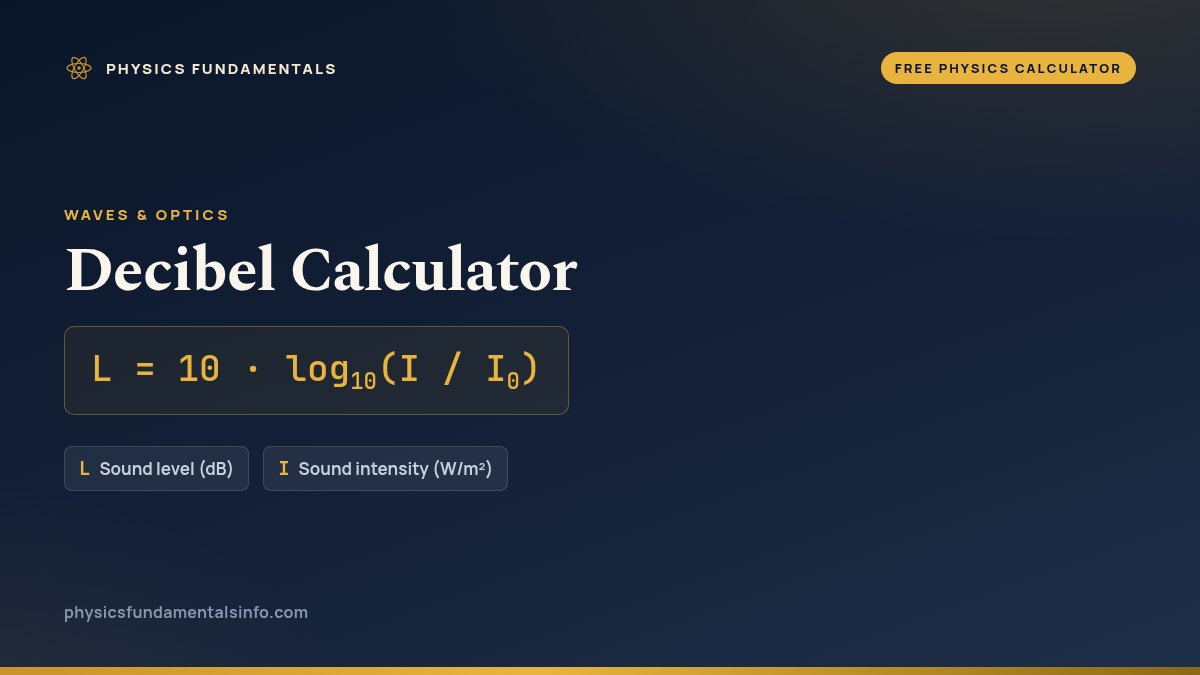
Decibel: the decibel (dB) measures sound level on a logarithmic scale relative to the threshold of hearing, defined by L = 10·log10(I / I0) with I0 = 10-¹² W/m². This free calculator converts between sound intensity and decibels — in both directions — and shows every step of the working.
What Is the Decibel Calculator?
The decibel calculator is a free online tool built on the formula L = 10 · log10(I / I0). Enter the values you already know, in whichever units suit you, and it solves for sound level or intensity and shows every step of the substitution. Decibel is sound level in decibels from intensity.
| Symbol | Quantity | Default unit | Also accepts | Example value |
|---|---|---|---|---|
| L | Sound level | dB | — | 60 |
| I | Sound intensity | W/m² | — | 1e-06 |
How to calculate decibels
The decibel turns a huge range of sound intensities into a compact, ear-friendly scale. The sound level is L = 10 · log10(I / I0), where I is the sound intensity in watts per square metre and I0 = 10-¹² W/m² is the reference intensity at the threshold of human hearing. Because the formula takes the base-10 logarithm of the ratio I / I0, a sound at the threshold measures exactly 0 dB, and every factor of ten in intensity adds 10 dB.
There are two steps. First, choose what you want in the calculator’s Solve for menu — the level in decibels or the intensity in W/m². Second, enter the value you know; the built-in reference intensity I0 does the rest. The calculator shows the worked steps — the formula, your number substituted in, and the answer with units — and also reports how many times more intense the sound is than the hearing threshold.
To reverse the calculation and recover the intensity from a decibel reading, raise ten to the power of one-tenth of the level: I = I0 · 10^(L / 10). This is how a measured 60 dB conversation maps back to an intensity of 10-6 W/m². The key habit is to keep intensity in W/m² and remember that the decibel is a ratio: it always describes one intensity relative to the reference, never an absolute amount of energy on its own.
The same wave physics that sets a sound’s intensity also governs how it travels and changes pitch — find a wave’s speed with the wave speed calculator, or the frequency shift of a moving siren with the Doppler effect calculator. For a plain-language definition of the term, see the physics glossary.
Worked example
A normal conversation has a sound intensity of about I = 10-6 W/m². Its level is L = 10 · log10(10-6 / 10-¹²) = 10 · log10(106) = 10 · 6 = 60 dB. The sound is therefore one million times more intense than the threshold of hearing. If the intensity rose tenfold to 10-5 W/m², the level would climb by just 10 dB to 70 dB — the logarithmic scale at work.
Why decibels matter
Decibels are the standard language of sound everywhere it is measured: workplace noise limits and hearing-protection rules, audio engineering and loudspeaker design, environmental and traffic-noise surveys, and the specification of microphones and amplifiers. The same logarithmic idea also describes signal gain in electronics and light levels in optics.
Frequently asked questions
What is the decibel formula?
The sound level in decibels is L = 10 · log10(I / I0), where I is the sound intensity in watts per square metre and I0 = 10^-12 W/m² is the reference intensity at the threshold of hearing. To go the other way, intensity is I = I0 · 10^(L/10). This calculator solves for whichever quantity you choose.
Why is the decibel scale logarithmic?
Human hearing spans an enormous range of intensities — from about 10^-12 W/m² at the threshold to 1 W/m² at the pain limit, a factor of a trillion. A logarithmic scale compresses that range into manageable numbers (0 to 120 dB) and matches the way our ears perceive loudness, where each step feels roughly proportional rather than additive.
What does a 10 dB increase mean?
Every increase of 10 dB corresponds to ten times the sound intensity, because the scale is base-10 logarithmic. So 70 dB carries ten times the intensity of 60 dB, and 80 dB is one hundred times the intensity of 60 dB. Perceptually, a 10 dB rise is often described as sounding roughly twice as loud.
What is the reference intensity I0?
I0 = 1 × 10^-12 W/m² is the standard reference intensity for sound in air, chosen because it is close to the quietest sound a healthy young ear can detect at 1 kHz. A sound at exactly I0 measures 0 dB. Intensities below the threshold give negative decibel values, which the formula handles correctly.
How many decibels are everyday sounds?
Typical levels are about 0 dB at the threshold of hearing, 30 dB for a quiet library, 60 dB for normal conversation, 85 dB where prolonged exposure risks hearing damage, 110 dB for a rock concert, and around 120 dB at the threshold of pain. Doubling the distance from a point source drops the level by about 6 dB.
References & formula source
- Halliday, Resnick & Walker — Fundamentals of Physics, Chapter 17 (Waves — II: Sound).
- Young & Freedman — University Physics with Modern Physics, §16.3 (Sound Intensity).
- NIST — Reference on sound pressure level and acoustic intensity quantities.
- Further reading: Decibel — Wikipedia