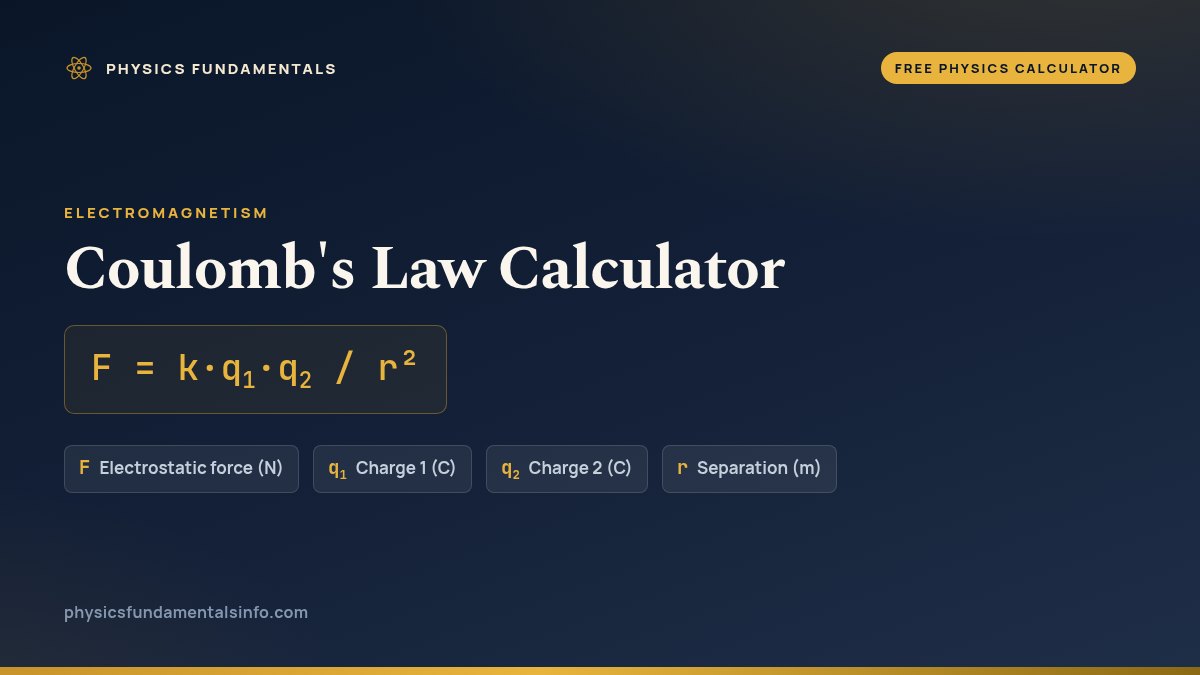
Coulomb's law: the electrostatic force between two point charges is F = k·q1·q2/r², where k ≈ 8.988 × 10⁹ N·m²/C². This free calculator solves for the force, either charge or the separation — in any unit — and shows every step of the working.
What Is the Coulomb's Law Calculator?
The Coulomb's law calculator is a free online tool built on the formula F = k·q1·q2 / r². Enter the values you already know, in whichever units suit you, and it solves for force, charge or separation and shows every step of the substitution. Coulomb's Law is electrostatic force between two point charges.
| Symbol | Quantity | Default unit | Also accepts | Example value |
|---|---|---|---|---|
| F | Electrostatic force | N | kN, mN | — |
| q1 | Charge 1 | C | mC, µC, nC | 1 |
| q2 | Charge 2 | C | mC, µC, nC | 1 |
| r | Separation | m | cm, mm | 10 |
How to calculate the Coulomb force
Coulomb's law describes the electrostatic force between two charged objects. To calculate it, multiply the two charges together, multiply by Coulomb's constant k ≈ 8.988 × 10⁹ N·m²/C², and divide by the square of the distance between them: F = k·q1·q2 / r². The result is a force in newtons (N).
There are three steps. First, decide which quantity you want — the force, one of the charges, or the separation — and select it in the calculator's Solve for menu. Second, enter the values you already know and pick their units; charges are usually in microcoulombs (µC) or nanocoulombs (nC), and separations in centimetres or millimetres. The calculator converts everything to SI base units (coulombs and metres) behind the scenes, so you never have to convert by hand. Third, read the answer together with the worked steps, which show the formula, your numbers substituted in, and the final value with its units.
The equation rearranges easily. To find the separation from a known force, use r = sqrt(k·q1·q2 / F). To find one charge, use q1 = F·r² / (k·q2). Because the force depends on 1/r², distance matters enormously: doubling the separation cuts the force to a quarter, and halving it multiplies the force by four. Keeping units consistent is essential — mixing centimetres with coulombs would throw the answer off by orders of magnitude, which is exactly why letting the calculator handle conversion removes the risk.
One detail to remember: Coulomb's law as written here gives the magnitude of the force. Whether the force is attractive or repulsive depends on the signs of the charges — like charges repel, opposite charges attract. The same inverse-square structure appears in gravitation; for the electrical analogue of circuit behaviour, see the Ohm's law calculator, or look up the term in the physics glossary.
Worked example
Two point charges of q1 = q2 = 1 µC are placed r = 10 cm apart. Converting to SI gives 1 × 10⁻⁶ C and 0.1 m, so the force is F = k·q1·q2 / r² = (8.988 × 10⁹)(10-6)(10-6) / (0.1)² = 0.899 N. Move the charges to 20 cm apart and the force drops to one quarter of that — about 0.225 N — because the force falls off as the square of the distance.
Why Coulomb's law matters
Coulomb's law is the foundation of electrostatics. It explains why electrons bind to atomic nuclei, governs the forces inside capacitors and electronic components, underpins chemistry through the attraction between ions, and sets the scale for everything from static cling to particle accelerators.
Frequently asked questions
What is the formula for Coulomb's law?
Coulomb's law states that the electrostatic force between two point charges is F = k·q1·q2 / r², where q1 and q2 are the charges, r is the distance between them, and k is Coulomb's constant, about 8.988 × 10^9 N·m²/C². The force acts along the line joining the charges.
What is the value of Coulomb's constant k?
Coulomb's constant k is approximately 8.988 × 10^9 N·m²/C², often rounded to 8.99 × 10^9 or 9 × 10^9 for quick estimates. It equals 1 / (4πε0), where ε0 is the permittivity of free space, 8.854 × 10^-12 F/m.
Is the Coulomb force attractive or repulsive?
Like charges (both positive or both negative) repel each other, while opposite charges attract. The magnitude is the same in both cases — only the direction differs. This calculator works with the magnitude of the force; the sign of the charges tells you whether it pushes the charges apart or pulls them together.
How does the force change with distance?
Coulomb's law is an inverse-square law: the force is proportional to 1/r². Doubling the separation reduces the force to one quarter, and tripling it reduces the force to one ninth. Halving the distance multiplies the force by four.
How is Coulomb's law similar to Newton's law of gravitation?
Both are inverse-square laws with the same mathematical form. Coulomb's law uses the product of charges and constant k, while gravitation uses the product of masses and constant G. The key difference is that gravity is always attractive, whereas the electrostatic force can attract or repel.
Read more: What is Coulomb's law?
References & formula source
- Halliday, Resnick & Walker — Fundamentals of Physics, Chapter 21 (Coulomb's Law).
- Young & Freedman — University Physics with Modern Physics, §21.3 (Coulomb's Law).
- NIST — CODATA recommended values: Coulomb's constant and the permittivity of free space.
- BIPM — The International System of Units (SI): the coulomb and the ampere.
- Further reading: Coulomb's law — Wikipedia