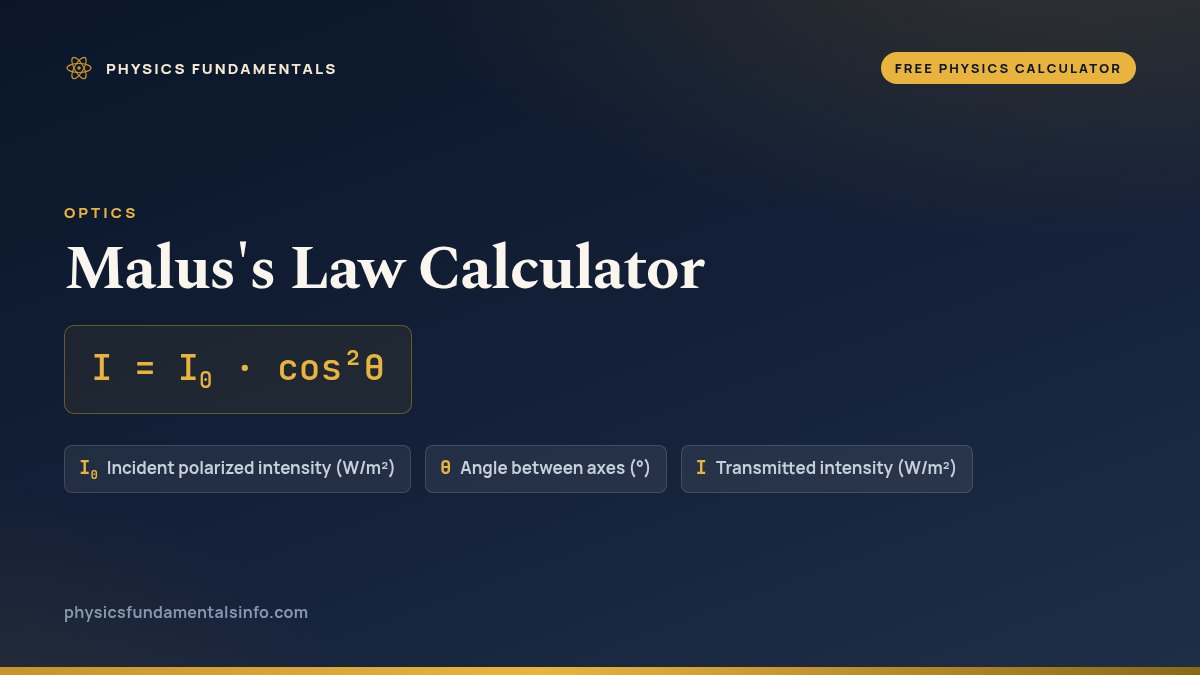
Malus's law: when polarized light meets an analyzer whose axis sits at angle θ to its polarization, the transmitted intensity is I = I0cos²θ. This free calculator solves for the transmitted intensity, the incident intensity or the angle, shows cos²θ and the percentage passed, and flags the impossible cases.
What Is the Malus's Law Calculator?
The Malus's law calculator is a free online tool built on the formula I = I0 · cos²θ. Enter the values you already know, in whichever units suit you, and it solves for intensity, incident intensity or angle and shows every step of the substitution. Malus's Law is transmitted intensity of polarized light through an analyzer.
| Symbol | Quantity | Default unit | Also accepts | Example value |
|---|---|---|---|---|
| I0 | Incident polarized intensity | W/m² | kW/m² | 500 |
| θ | Angle between axes | ° | — | 30 |
| I | Transmitted intensity | W/m² | kW/m² | 375 |
How to calculate transmitted intensity with Malus's law
A polarizing filter passes only the component of the light's electric field along its transmission axis. For light already polarized at angle θ to that axis, the field is cut by cosθ — and because intensity goes as the field squared, the intensity is cut by cos²θ. That is the whole law: I = I0·cos²θ.
Three steps: pick the quantity to solve for, enter the other two, read the answer with its working. Two cautions are built in. First, an unpolarized source must be halved before the law applies — an ideal polarizer keeps exactly half of unpolarized light, whatever its orientation. Second, the rearrangements have physical limits: solving for θ needs I ≤ I0, and I0 cannot be recovered from a reading taken at exactly 90°, where every source gives zero. The calculator rejects both instead of returning nonsense. You can watch the law play out live in the interactive polarization simulator.
The cos² shape is worth internalising: the curve is flat near 0°, falls fastest around 45° (where exactly half the light survives) and touches zero only at 90°. Polarization is also produced by reflection — glare off water is horizontally polarized near Brewster's angle, which is set by the refractive index and links this law to Snell's law refraction.
Worked example
Polarized light of I0 = 500 W/m² meets an analyzer at θ = 30°. Then cos²30° = 0.750, so I = 500 × 0.750 = 375 W/m² — 75% gets through. Cross-checks: measuring I = 250 W/m² from the same source means θ = arccos(sqrt(0.5)) = 45°, and a 375 W/m² reading at 30° recovers I0 = 375 / 0.750 = 500 W/m².
Why it matters
Malus's law runs polarized sunglasses and camera polarizing filters, every LCD pixel (a twisted liquid crystal between crossed polarizers), photoelasticity stress analysis, polarimetry in chemistry, and the polarization optics inside 3D cinema projectors. Anywhere light's orientation carries information or needs controlling, cos²θ is the dial.
Frequently asked questions
What units does the Malus's law calculator use?
Intensities I and I0 are in watts per square metre (W/m², with kW/m² available for strong beams) and the angle θ is in degrees, converted to radians internally. cos²θ itself is dimensionless, which is why the transmitted intensity always carries the same unit as the incident one.
Why is the answer zero at 90 degrees?
Because cos(90°) = 0, so cos²θ = 0 and no component of the light's electric field lies along the analyzer's axis — crossed polarizers block the beam completely. For the same reason the calculator refuses to solve for I0 at exactly 90°: every incident intensity gives the same transmitted reading of zero there, so the question has no unique answer.
How do I solve for the angle?
Set "Solve for" to θ and enter both intensities. The calculator computes θ = arccos(sqrt(I/I0)), which needs I between 0 and I0 — light cannot come out stronger than it went in. For example I = 250 W/m² from I0 = 500 W/m² gives sqrt(0.5) = 0.707 and θ = 45°.
Does Malus's law work for unpolarized light?
Not directly. An ideal polarizer passes exactly half of an unpolarized beam whatever its orientation — the one-half rule — because the random field directions average cos²θ to 1/2. Halve the unpolarized intensity first, then apply I = I0cos²θ to that polarized half at the analyzer.
Why does 45 degrees give exactly half?
Because cos(45°) = sqrt(2)/2, and squaring it gives exactly 0.5. Many students expect 45° to sit "half way to blocked", and it does — but in intensity, not in a straight line: the fall-off is gentle near 0°, steepest around 45°, and only reaches complete darkness at 90°.
References & formula source
- S. J. Ling, J. Sanny & W. Moebs — University Physics Volume 3 (OpenStax), §1.7 "Polarization".
- E. Hecht — Optics, chapter on polarization.
- Encyclopædia Britannica — "Polarization" (light).
- Further reading: Polarizer — Wikipedia