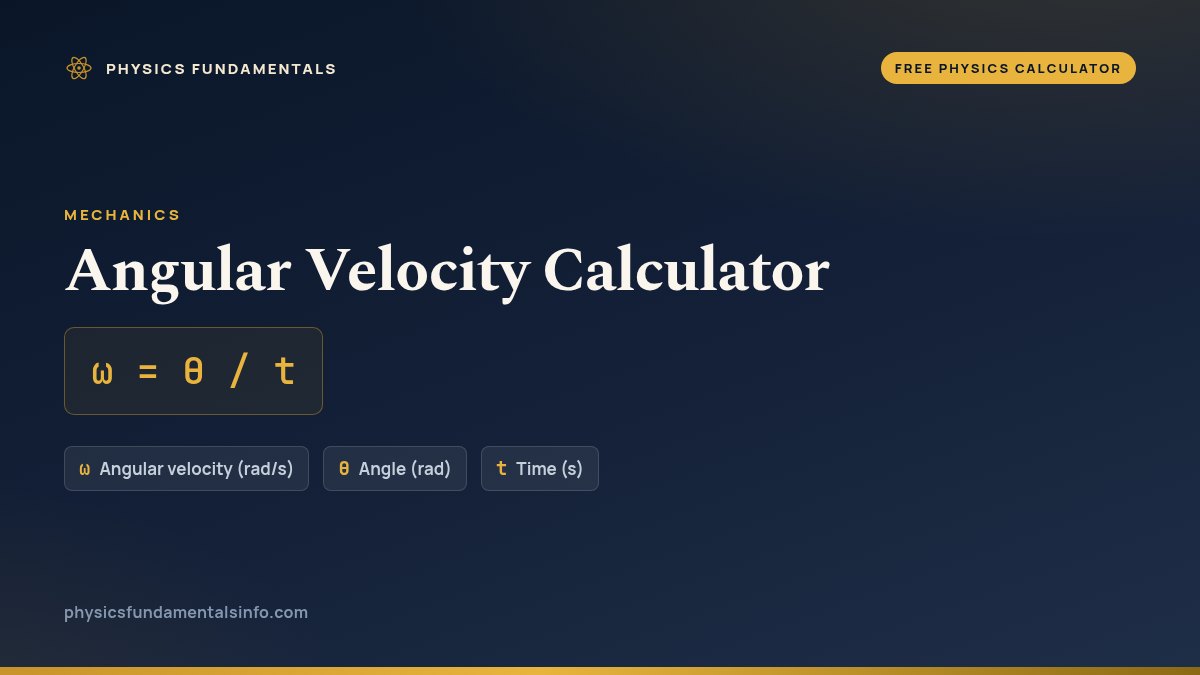
Angular velocity: angular velocity (ω) is how fast an angle is swept out over time, defined by ω = θ/t. This free calculator solves for angular velocity, angle or time — in radians, degrees, revolutions, rpm or rev/s — and shows every step of the working.
What Is the Angular Velocity Calculator?
The angular velocity calculator is a free online tool built on the formula ω = θ / t. Enter the values you already know, in whichever units suit you, and it solves for angular velocity, angle or time and shows every step of the substitution. Angular Velocity is how fast an angle is swept out — plus rpm to rad/s.
| Symbol | Quantity | Default unit | Also accepts | Example value |
|---|---|---|---|---|
| ω | Angular velocity | rad/s | rpm, deg/s, rev/s | 10 |
| θ | Angle | rad | rev, deg | 100 |
| t | Time | s | min | 10 |
How to calculate angular velocity
Angular velocity tells you how quickly something turns. To calculate it, divide the angle swept out by the time taken: ω = θ / t. In SI units the angle is measured in radians and the time in seconds, so angular velocity comes out in radians per second (rad/s). One full turn is 2π radians, so an object that completes one revolution every second has an angular velocity of about 6.28 rad/s.
There are three steps. First, decide which quantity you want — angular velocity, angle or time — and select it in the calculator’s Solve for menu. Second, enter the two values you already know and pick their units; you can mix degrees, revolutions, rpm and rev/s with seconds or minutes, and the calculator converts everything to radians and seconds for you. Third, read the answer with the worked steps, which show the formula, your numbers substituted in, and the final value with its units.
The equation rearranges easily. If you know angular velocity and time, the angle turned is θ = ω × t. If you know the angle and the angular velocity, the time taken is t = θ ÷ ω. Angular velocity also links directly to rotational rate: the frequency in turns per second is f = ω / 2π and the period of one turn is T = 2π / ω. When you solve for angular velocity, the calculator reports both f and T automatically.
A common task is converting revolutions per minute (rpm) — used for engines, motors and turntables — into rad/s. Because one revolution is 2π radians and a minute is 60 seconds, 1 rpm = 2π/60 ≈ 0.10472 rad/s; just choose the rpm unit and the calculator handles it. From angular velocity you can step up to the circular motion calculator for centripetal force, or see our guide on the frequency formula for how f, T and ω fit together.
Worked example
A wheel turns through 100 radians in 10 seconds. Its angular velocity is ω = θ / t = 100 / 10 = 10 rad/s. The frequency is f = ω / 2π = 10 / 6.283 ≈ 1.59 Hz and the period is T = 2π / ω = 6.283 / 10 ≈ 0.628 s — so the wheel makes about 1.6 full turns every second. Expressed as rpm, 10 rad/s is roughly 95.5 rpm.
Why angular velocity matters
Angular velocity underpins the design of engines, motors, gears and turbines, the dynamics of spinning hard drives and flywheels, the orbital and spin rates of planets and satellites, and the analysis of anything that rotates — from a bicycle wheel to a centrifuge.
Frequently asked questions
What is the formula for angular velocity?
Angular velocity (ω) is the angle swept divided by the time taken: ω = θ / t. It is measured in radians per second (rad/s). The same equation rearranges to θ = ω·t and t = θ/ω, so you can solve for any one of the three quantities.
How do you convert rpm to rad/s?
Revolutions per minute (rpm) is one revolution — 2π radians — every 60 seconds, so 1 rpm = 2π/60 ≈ 0.10472 rad/s. To go the other way, multiply rad/s by 60/(2π) ≈ 9.5493. Selecting “rpm” as the unit in this calculator does the conversion for you, both ways.
How are angular velocity, frequency and period related?
Frequency f is the number of full turns per second: f = ω / 2π, in hertz. The period T is the time for one full turn: T = 2π / ω = 1/f, in seconds. When you solve for angular velocity, the calculator shows both f and T alongside the answer.
What is the difference between angular velocity and linear velocity?
Angular velocity ω measures how fast an angle changes (rad/s) and is the same for every point on a rigid rotating body. Linear (tangential) velocity v measures how fast a point moves along its circular path and depends on radius: v = ω·r, so points farther from the axis move faster.
Is angular velocity a vector?
Yes. The full angular velocity is a vector that points along the axis of rotation, with its direction given by the right-hand rule. For motion about a single fixed axis — the case this calculator handles — you usually only need its magnitude, the scalar ω = θ/t.
References & formula source
- Halliday, Resnick & Walker — Fundamentals of Physics, Chapter 10 (Rotation).
- Young & Freedman — University Physics with Modern Physics, §9.1 (Angular Velocity and Acceleration).
- BIPM — The International System of Units (SI): the radian and the second.
- Further reading: Angular velocity — Wikipedia