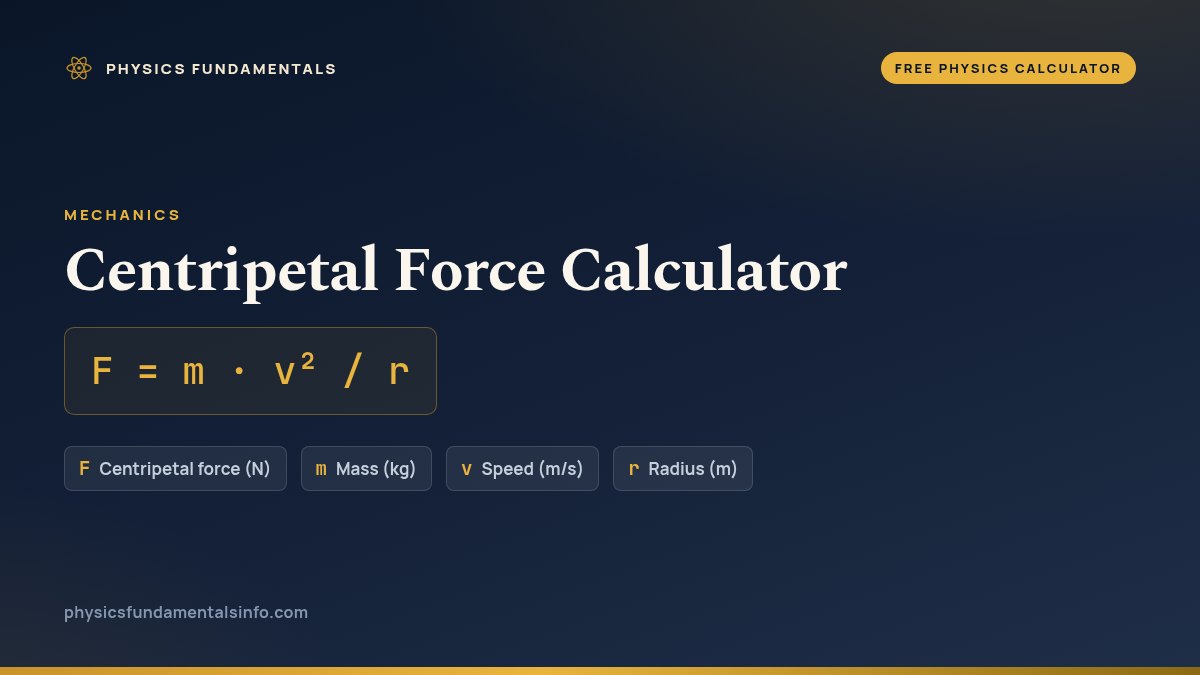
Centripetal force: the net inward force (F) that keeps an object of mass m moving in a circle of radius r at speed v, given by F = m·v²/r. This free calculator solves for force, mass, speed or radius — in any unit — and shows every step of the working.
What Is the Centripetal Force Calculator?
The centripetal force calculator is a free online tool built on the formula F = m · v² / r. Enter the values you already know, in whichever units suit you, and it solves for force, mass, speed or radius and shows every step of the substitution. Centripetal Force is inward force keeping an object moving in a circle.
| Symbol | Quantity | Default unit | Also accepts | Example value |
|---|---|---|---|---|
| F | Centripetal force | N | kN | — |
| m | Mass | kg | g | 2 |
| v | Speed | m/s | km/h, mph | 10 |
| r | Radius | m | cm, km | 5 |
How to calculate centripetal force
Anything moving in a circle is constantly changing direction, and changing direction means accelerating — even when the speed stays the same. That acceleration always points toward the centre of the circle, and producing it requires a net inward force called the centripetal force. Its size is given by F = m·v²/r, where m is the object’s mass, v is its speed along the circle, and r is the radius of the path.
There are three steps. First, decide which quantity you want — force, mass, speed or radius — and select it in the calculator’s Solve for menu. Second, enter the three values you already know and pick their units; the calculator converts everything to SI base units (kilograms, metres and metres per second) behind the scenes, so you never have to convert by hand. Third, read the answer together with the worked steps, which show the formula, your numbers substituted in, and the final value with its units. When you solve for force, the calculator also reports the centripetal acceleration a = v²/r.
The equation rearranges easily. If you know the force, speed and radius, the mass is m = F·r/v². If you know the force, mass and radius, the required speed is v = sqrt(F·r/m). If you know the force, mass and speed, the radius of the path is r = m·v²/F. Notice that force grows with the square of speed: double the speed and you need four times the force to hold the same circle — which is why cornering fast is so much harder than cornering slowly.
Centripetal force is not a new kind of force; it is the role played by whatever real force points inward — tension, gravity, friction, or a normal force. For the full set of circular-motion quantities including angular velocity and period, use the circular motion calculator; for a definition of the term itself, see the physics glossary.
Worked example
A 2 kg ball is whirled on a string in a circle of radius 5 m at a speed of 10 m/s. The centripetal acceleration is a = v²/r = 10² / 5 = 20 m/s², and the centripetal force is F = m·v²/r = 2 · 10² / 5 = 40 N. That 40 N is the tension the string must supply. Speed the ball up to 20 m/s on the same circle and the force jumps to 2 · 20² / 5 = 160 N — four times larger for double the speed, exactly as the squared term predicts.
Why centripetal force matters
Centripetal force explains how cars take corners, how satellites and planets stay in orbit, how centrifuges separate samples, and why riders feel pressed into their seats on a loop-the-loop. Get the force wrong — too little grip, too tight a turn — and the object leaves its circular path along a tangent, which is the physics behind skidding cars and the limits of banked tracks.
Frequently asked questions
What is the formula for centripetal force?
Centripetal force is F = m·v²/r, where m is mass, v is speed and r is the radius of the circular path. It is the net inward force required to keep an object moving in a circle of radius r at speed v. The same equation rearranges to m = F·r/v², v = sqrt(F·r/m) and r = m·v²/F.
What is the difference between centripetal and centrifugal force?
Centripetal force is a real, inward force (tension, gravity, friction or a normal force) that actually causes circular motion. “Centrifugal force” is not a real force at all — it is an apparent outward effect you feel only in a rotating reference frame, due to inertia. In an inertial frame there is only the inward centripetal force.
How is centripetal force related to centripetal acceleration?
Centripetal acceleration is a = v²/r, directed toward the centre. By Newton’s second law the force needed to produce it is F = m·a = m·v²/r. So the force is simply mass times the centripetal acceleration. When you solve for force here, the calculator also reports a = v²/r.
What provides the centripetal force in real situations?
It depends on the system. For a car cornering it is friction between the tyres and road; for a satellite it is gravity; for a ball on a string it is the string’s tension; on a banked curve it is a component of the normal force. Centripetal force is the name for the role a force plays, not a new kind of force.
Does centripetal force do work on the object?
No. Centripetal force always points toward the centre, perpendicular to the velocity, so it does no work and does not change the object’s speed or kinetic energy. It only changes the direction of motion, which is exactly what keeps the object on its circular path.
References & formula source
- Halliday, Resnick & Walker — Fundamentals of Physics, Chapter 6 (Force and Motion II: uniform circular motion).
- Young & Freedman — University Physics with Modern Physics, §5.4 (Dynamics of Circular Motion).
- NASA Glenn Research Center — Beginner’s Guide to Aeronautics: forces in circular motion.
- Further reading: Centripetal force — Wikipedia