Newton’s laws of motion are three rules that describe how forces affect movement. The first law states an object keeps its velocity unless a net force acts on it; the second law states force equals mass times acceleration (F = ma); the third law states every force has an equal, opposite reaction force.
Snap your foot off the accelerator and a car still rolls forward. Yank a tablecloth fast enough and the plates barely shift. Step off a small boat onto a dock and the boat shoots backwards. None of these are tricks — each is one of Newton’s three laws of motion doing exactly what it always does.
First written down by Isaac Newton in 1687, these three short statements explain the motion of almost everything you can see and touch: footballs, cars, rockets, planets, and your own body. Master them and the rest of mechanics — momentum, energy, orbits — falls into place. This guide explains all three laws in plain language, gives you the F = ma formula with worked examples, and lets you experiment with force and acceleration in an interactive lab.
What Are Newton’s Laws of Motion?
Newton’s laws of motion are three foundational principles of classical mechanics that link the forces acting on an object to how that object moves. Together they answer a single question: what does a force actually do? (NASA Glenn Research Center)
The intuitive idea is this. Left alone, things don’t change their motion (first law). A push or pull changes their motion in a predictable amount (second law). And you can never push something without it pushing back on you just as hard (third law).
Here is the precise version of each:
- First law (inertia): An object remains at rest, or moves at constant velocity in a straight line, unless acted on by a net external force.
- Second law (F = ma): The net force on an object equals its mass times its acceleration. Force and acceleration point in the same direction.
- Third law (action–reaction): When object A exerts a force on object B, object B exerts an equal and opposite force on object A.
The diagram below shows all three at a glance.
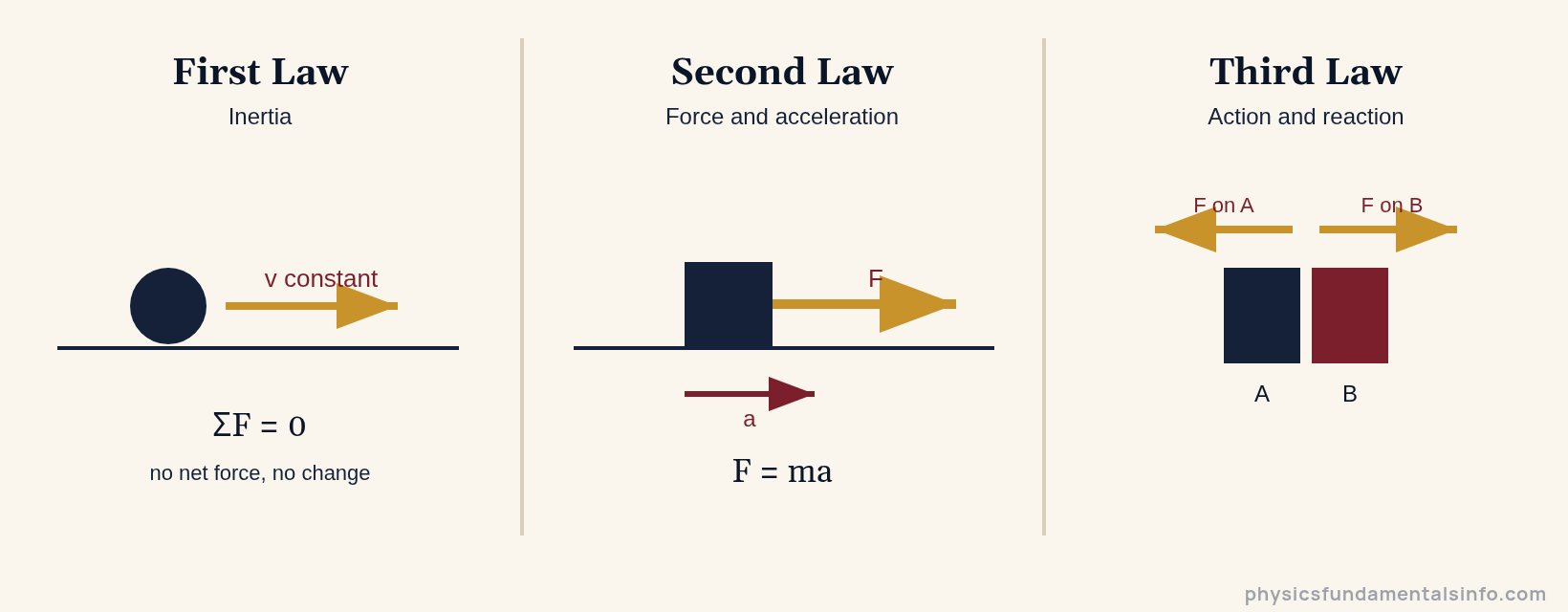
Newton’s three laws of motion: constant velocity with zero net force, F = ma, and equal-and-opposite force pairs.
Newton’s First Law: The Law of Inertia
Newton’s first law states that an object will keep doing whatever it is already doing — staying still, or moving at a constant speed in a straight line — until a net external force changes it. This tendency to resist a change in motion is called inertia, and more massive objects have more of it.
The everyday version “things slow down and stop on their own” is misleading. They slow down because of forces such as friction and air resistance. Remove those forces and motion simply continues. That is why a hockey puck glides so far across smooth ice, and why a spacecraft coasts for years between planets with its engines off.
An example of the first law
When a car brakes hard, your body lurches forward. The seatbelt then provides the backward force that decelerates you. You were not “thrown” forward — your body was already moving forward and simply kept going (inertia) until the belt supplied the force to stop you. This is the first law you feel in your gut.
Newton’s Second Law: The F = ma Formula
The second law is the quantitative heart of mechanics. It tells you exactly how much a force changes an object’s motion:
- F = net (resultant) force on the object, measured in newtons (N)
- m = mass of the object, measured in kilograms (kg)
- a = acceleration produced, measured in metres per second squared (m/s2)
One newton is defined as the force needed to accelerate a 1 kg mass at 1 m/s2, so 1 N = 1 kg·m/s2. The word “net” is critical: F is the sum of all forces acting, not just the one you apply. If you push a box with 10 N while friction pulls back with 3 N, the net force is 7 N.
Rearranged, the same law gives you whatever you need to find:
- Acceleration: a = F / m
- Force: F = ma
- Mass: m = F / a
How the second law really works
The fuller, original statement is that force equals the rate of change of momentum, F = Δp/Δt, where momentum p = mv. When mass is constant this simplifies to the familiar F = ma. The momentum form is what you need for rockets, which lose mass as they burn fuel.
Two things follow immediately. For a fixed force, doubling the mass halves the acceleration. For a fixed mass, doubling the force doubles the acceleration. Sanity check: a 1 N force on a 1 kg book gives 1 m/s2; the same 1 N on a 1,000 kg car gives just 0.001 m/s2 — barely a crawl. That feels right, and it is exactly what F = ma predicts.
Newton’s Third Law: Action and Reaction
Newton’s third law states that forces always come in pairs: if A pushes on B, then B pushes back on A with equal size and opposite direction. The popular phrasing is “for every action there is an equal and opposite reaction.”
The key — and the part most people miss — is that the two forces act on different objects. When you jump, your feet push down on the Earth; the Earth pushes up on you with the same force, and because you have far less mass than the planet, you are the one that visibly accelerates. A rocket works the same way: it throws hot gas downward, and the gas pushes the rocket upward.
The free-body diagram below isolates a single box from the worked example, so you can see how the forces on one object combine into a net force.
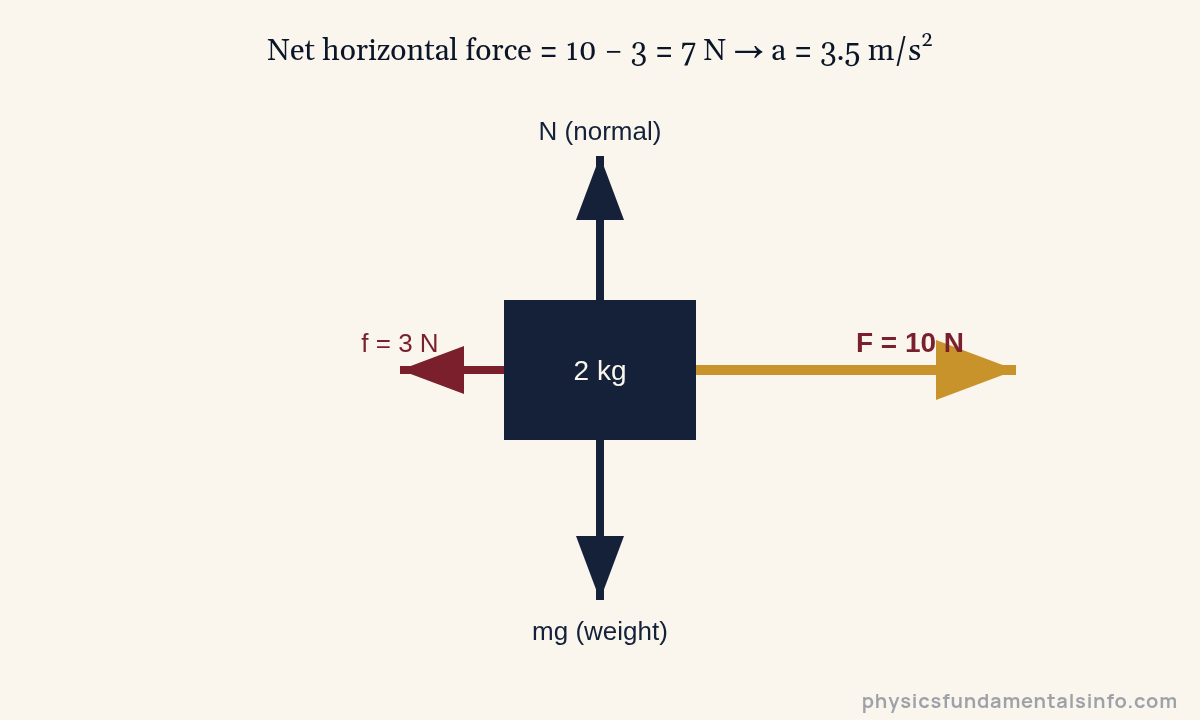
Free-body diagram: a 10 N applied force minus 3 N of friction leaves a 7 N net force, giving a = 3.5 m/s2.
The Three Laws at a Glance
| Law | What it says | Formula | Everyday example |
|---|---|---|---|
| First (Inertia) | Velocity stays constant unless a net force acts. | ΣF = 0 → a = 0 | You lurch forward when a car brakes. |
| Second (F = ma) | Net force = mass × acceleration. | F = ma | A heavier shopping trolley is harder to speed up. |
| Third (Action–reaction) | Every force has an equal, opposite partner on another body. | FAB = −FBA | A rifle recoils as the bullet fires forward. |
Real-World Examples of Newton’s Laws
Walking. You push backwards on the ground with your foot; by the third law the ground pushes you forwards. Without friction (think wet ice) that reaction force vanishes and you slip.
Rocket launch. The engine expels gas downwards at high speed; the equal upward reaction lifts the rocket. This is why rockets work in the vacuum of space — they need no air to push against.
Seatbelts and headrests. Both exist because of the first law. In a crash your body keeps moving until a force stops it; the restraint supplies that force gently rather than the steering wheel supplying it violently.
Kicking a football. A small mass (the ball) with a large force gets a large acceleration (F = ma). The same kick against a parked car barely moves it, because the car’s mass is enormous.
A swimmer. Push the water backwards with your arms and the water pushes you forwards — third law again, in a different medium.
Common Misconceptions About Newton’s Laws
“Moving objects need a constant force to keep moving.”
Wrong. A constant velocity needs zero net force (first law). You only need a force to change the motion — to speed up, slow down, or turn. In space, with no friction, an object coasts forever with the engines off.
“Heavier objects fall faster.”
In a vacuum, all objects fall with the same acceleration, g ≈ 9.81 m/s2, regardless of mass. A heavier object feels a larger gravitational force (F = mg), but it also has proportionally more inertia, so a = F/m = g for everything. Air resistance — not weight — is why a feather drifts down slower than a coin.
“Action–reaction forces cancel out.”
They never cancel, because they act on different objects. Forces only add up (and possibly cancel) when they act on the same object. Your feet push the Earth and the Earth pushes you — two bodies, two separate forces.
“F = ma means force causes motion.”
Force causes acceleration — a change in motion — not motion itself. An object can be moving fast with no force on it at all (first law). Mixing up “motion” and “change in motion” is the single most common error in mechanics.
How Newton’s Laws Relate to Momentum and Energy
The second law is the doorway to the rest of mechanics. Written as F = Δp/Δt, it leads directly to the impulse–momentum theorem and to the conservation of momentum which is really just the third law applied to a collision: equal and opposite forces produce equal and opposite changes in momentum.
Multiply force by distance instead of time and you get work, the bridge to kinetic and potential energy. The forces you analyze with these laws — gravity, friction, tension, the normal and friction forces on a surface — are the same forces you draw on free-body diagrams. Once you understand the difference between mass and weight, almost every introductory mechanics problem becomes a variation on F = ma.
When Do Newton’s Laws Break Down?
Newton’s laws are astonishingly accurate for everyday objects, but they are not the final word. They begin to fail in two extreme regimes.
Very high speeds. As an object approaches the speed of light (c = 299,792,458 m/s), Einstein’s special relativity takes over and mass and time behave in ways Newton’s equations cannot capture. Very small scales. At the level of atoms and electrons, quantum mechanics rules instead.
For cars, planets, footballs, and rockets, though, the corrections are utterly negligible — Newtonian mechanics is the trusted classical limit, and it is what engineers use to this day.
Worked Problems
Show Solution
Solution:
Step 1: Use Newton’s second law, F = ma, rearranged for acceleration: a = F / m.
Step 2: Substitute with units: a = 10 N / 2 kg.
Step 3: Solve: a = 5 m/s2.
Answer: a = 5 m/s2 (in the direction of the force)
Show Solution
Solution:
Step 1: Find the net force first: F_net = F_applied − f = 10 N − 3 N.
Step 2: F_net = 7 N. Then a = F_net / m = 7 N / 2 kg.
Step 3: Solve: a = 3.5 m/s2.
Answer: a = 3.5 m/s2
Show Solution
Solution:
Step 1: Use F = ma directly.
Step 2: Substitute: F = 1,000 kg × 2 m/s2.
Step 3: Solve: F = 2,000 N.
Answer: F = 2,000 N (= 2 kN)
Show Solution
Solution:
Step 1: Weight is the force of gravity: W = mg.
Step 2: Substitute: W = 70 kg × 9.81 m/s2.
Step 3: Solve: W = 686.7 N.
Answer: W ≈ 687 N (3 s.f.)
Show Solution
Solution:
Step 1: Net force = 20 N − 8 N = 12 N.
Step 2: a = F_net / m = 12 N / 4 kg.
Step 3: Solve: a = 3 m/s2.
Answer: a = 3 m/s2
Show Solution
Solution:
Step 1: a = F / m, with the braking force opposing motion.
Step 2: Substitute: a = 6,000 N / 1,200 kg.
Step 3: Solve: a = 5 m/s2.
Answer: deceleration = 5 m/s2 (acceleration of −5 m/s2)
Show Solution
Solution:
Step 1: Two vertical forces act: the normal force N (up) and weight mg (down). The net upward force produces the upward acceleration, so N − mg = ma.
Step 2: Rearrange and substitute: N = m(g + a) = 60 kg × (9.81 + 2) m/s2.
Step 3: Solve: N = 60 × 11.81 = 708.6 N.
Answer: N ≈ 709 N — heavier than their true weight of about 589 N, which is why a rising lift makes you feel momentarily heavier.
Frequently Asked Questions
What are Newton's three laws of motion?
What is an example of Newton's first law?
Why don't the third law's action-reaction forces cancel out?
Is F = ma the first or second law?
Do Newton's laws apply in space?
What is the difference between mass and weight?
Further Reading
Keep building your mechanics foundation with our guide to what energy really is in physics — you’ll see how the same force you apply with F = ma turns into kinetic and potential energy. Master these three laws first, and the rest of physics stops feeling like memorisation. It starts to feel like one connected story.