Kinetic energy is the energy an object has because it is moving — equal to half its mass times the square of its speed, KE = ½mv². This free calculator solves for the kinetic energy, the mass or the speed, in any unit, and shows every step of the working.
What Is the Kinetic Energy Calculator?
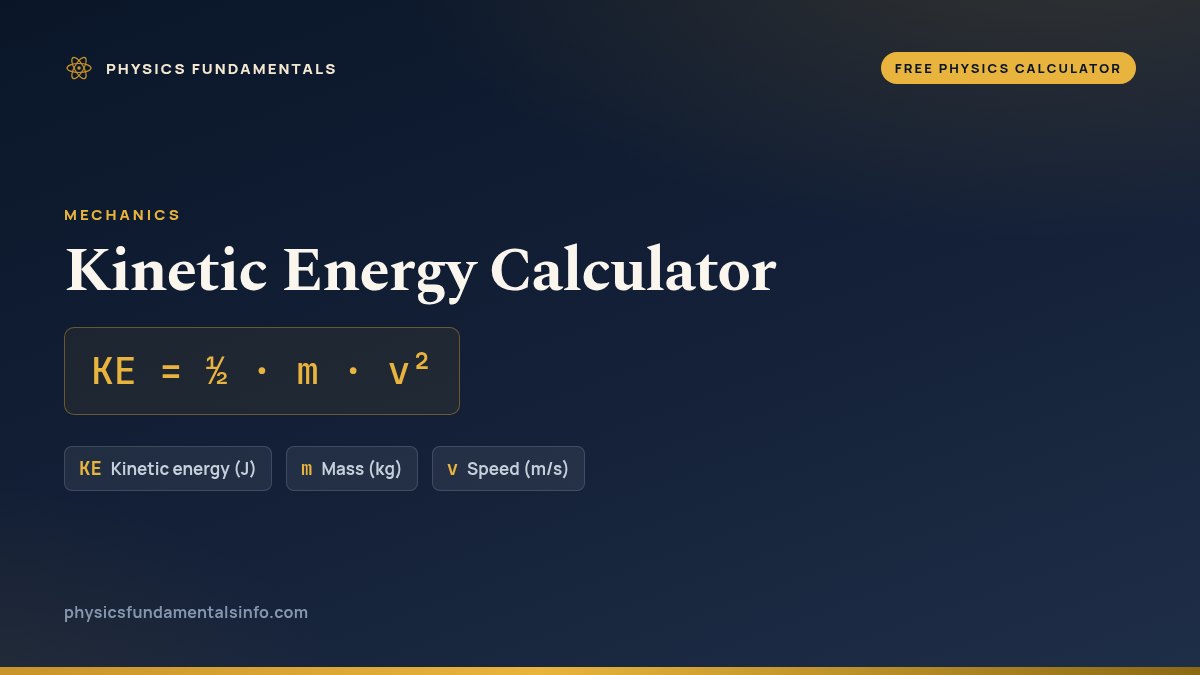
The kinetic energy calculator is a free online tool built on the formula KE = ½ · m · v². Enter the values you already know, in whichever units suit you, and it solves for kinetic energy, mass, velocity and shows every step of the substitution. Kinetic Energy is energy of motion — note the v² dependence.
| Symbol | Quantity | Default unit | Also accepts | Example value |
|---|---|---|---|---|
| KE | Kinetic energy | J | kJ, MJ | 100 |
| m | Mass | kg | g, tonne | 2 |
| v | Speed | m/s | km/h, mph | 10 |
How to calculate kinetic energy
Kinetic energy is the energy of motion: the energy an object carries simply because it is moving. For an object of mass m moving at speed v, the kinetic energy is KE = ½·m·v², measured in joules when mass is in kilograms and speed is in metres per second. The crucial feature is the v² dependence: doubling the speed quadruples the kinetic energy — which is exactly why stopping distances and crash severity rise so steeply with speed. For a fuller derivation of where KE = ½mv² comes from, see our guide to the kinetic energy formula.
There are three steps. First, decide what you want — the kinetic energy, the mass, or the speed — and pick it in the calculator's Solve for menu. Second, enter the two quantities you know: energy in joules, kilojoules or megajoules; mass in kilograms, grams or tonnes; speed in m/s, km/h or mph. Third, read the answer with the worked steps, which show the rearranged formula, your numbers substituted in, and the result with units. To find mass or speed the calculator simply inverts the relation: v = sqrt(2·KE / m) and m = 2·KE / v².
Kinetic energy is the energy of motion; the energy locked inside mass itself is given by mass–energy equivalence (E = mc²). The kinetic energy of a raised, falling object is constantly being traded with its gravitational potential energy as it speeds up — the sum of the two staying constant when no friction acts. You can look up any of these terms in the physics glossary.
Worked example
Take a 2 kg ball moving at 10 m/s. Its kinetic energy is KE = ½·m·v² = ½ × 2 × 10² = 100 J. Now speed it up to 20 m/s — twice as fast. Because the speed is squared, the kinetic energy becomes ½ × 2 × 20² = 400 J, four times as much, not twice. That non-linear jump is the single most important thing to feel about kinetic energy, and it is why a small increase in highway speed makes such a large difference to braking energy and impact force.
Why it matters
Kinetic energy underlies vehicle safety and braking-energy calculations, ballistics and impact analysis, sports performance, the design of regenerative braking systems, and the power output of wind turbines, where the energy harvested scales with the cube of wind speed. Anywhere a moving mass has to be sped up, slowed down, or made to do work, the kinetic-energy formula is the starting point.
Frequently asked questions
What is the formula for kinetic energy?
Kinetic energy is KE = ½mv², where m is the mass in kilograms and v is the speed in metres per second. The result is an energy in joules. Because the speed is squared, kinetic energy grows much faster than speed: doubling the speed quadruples the energy.
Why does kinetic energy depend on v² and not just v?
The v² term comes from the work–energy theorem: the work done by a constant force over a distance equals ½mv², which integrates the force through the motion. The practical consequence is dramatic — a car at 60 mph carries four times the kinetic energy it had at 30 mph, which is why stopping distances and crash severity rise so steeply with speed.
What units does the kinetic energy calculator use?
Energy is in joules (with kilojoule and megajoule options), mass in kilograms (or grams and tonnes), and speed in metres per second (or km/h and mph). The calculator converts every input to SI before computing, so you can mix units freely and still get a correct answer in joules.
How do I find the mass or speed from a known kinetic energy?
Rearrange KE = ½mv². For speed, v = sqrt(2·KE / m); for mass, m = 2·KE / v². Just switch the “Solve for” menu to v or m and the calculator applies the rearranged formula and shows each step.
What's the difference between kinetic energy and momentum?
Both describe motion but differ in their dependence on speed: momentum p = mv is linear in v and is a vector, while kinetic energy KE = ½mv² is quadratic in v and is a scalar. In collisions, total momentum is always conserved, but kinetic energy is conserved only in perfectly elastic collisions.
References & formula source
- Halliday, Resnick & Walker — Fundamentals of Physics, Chapter 7 (Kinetic Energy and Work).
- Young & Freedman — University Physics with Modern Physics, §6.2 (Kinetic Energy and the Work–Energy Theorem).
- Serway & Jewett — Physics for Scientists and Engineers, Chapter 7 (Energy of a System).
- Further reading: Kinetic energy — Wikipedia